 Bird App
Bird of the day
Long-eared owl
Asio otus
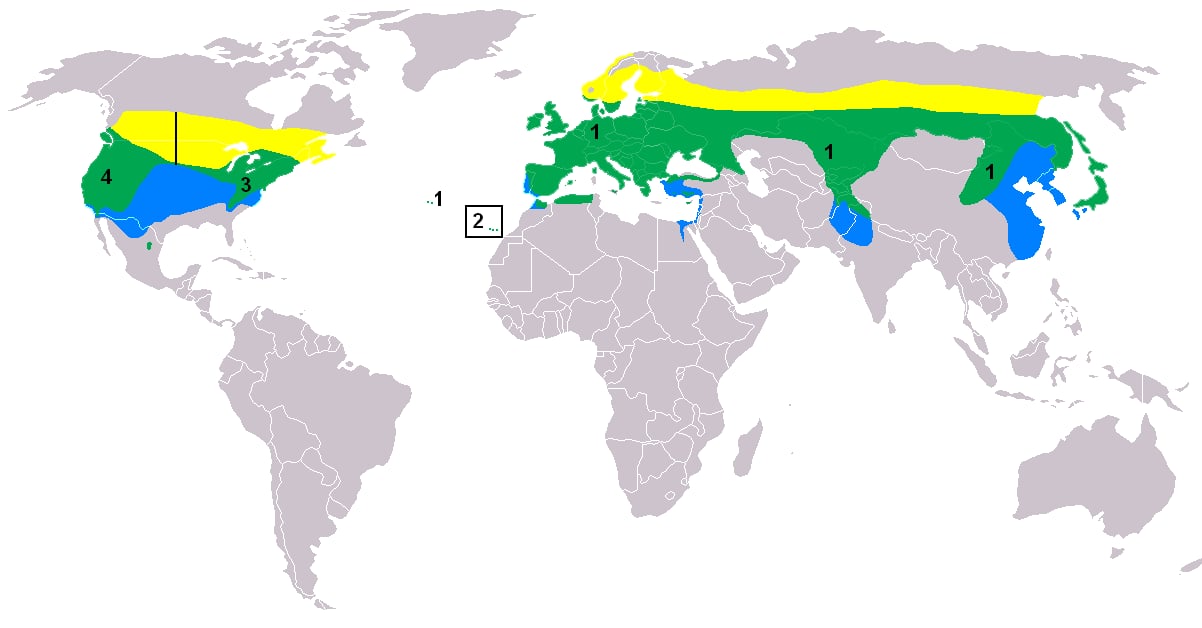
The long-eared owl (Asio otus), also known as the northern long-eared owl or, more informally, as the lesser horned owl or cat owl, is a medium-sized species of owl with an extensive breeding range. The genus name, Asio, is Latin for "horned owl", and the specific epithet, otus, is derived from Greek and refers to a small eared owl. The species breeds in many areas through Europe and the Palearctic, as well as in North America. This species is a part of the larger grouping of owls known as typical owls, of the family Strigidae, which contains most extant species of owl.
This owl shows a partiality for semi-open habitats, particularly woodland edge, as they prefer to roost and nest within dense stands of wood but prefer to hunt over open ground. The long-eared owl is a specialized predator, focusing its diet on small rodents, especially voles, which compose most of their diet. Under some circumstances, such as population cycles of their regular prey, arid or insular regional habitats or urbanization, this species can adapt fairly well to a diversity of prey, including birds and insects. The long-eared owl utilizes nests built by other animals, in particular by corvids. Breeding success in this species is correlated with prey populations and predation risks. Unlike many owls, long-eared owls are not strongly territorial or sedentary. They are partially migratory and sometimes characterized as "nomadic". Another characteristic of this species is its partiality for regular roosts shared by a number of long-eared owls at once. The long-eared owl is one of the most widely distributed and most numerous owl species in the world, and due to its very broad range and numbers it is considered a least concern species by the IUCN. Nonetheless, strong declines have been detected for this owl in several parts of its range.
This species is a slim and long winged owl with erectile ear tufts, which are positioned closer to the center of the head than in many other types of owl. The purposes of ear tufts are not definitively known and are present in about half of living owls. A theory amongst biologists and ornithologists is that ear tufts could be a means of intraspecies communication of intent and mood.
In general coloration, the long-eared owl is a hue of ochraceous-tawny with a grayish or brownish wash variably manifesting. The base color is overlaid with variable blackish vertical streaks (and occasionally spots), which are more apparent about the wings and back. The scapulars are marked whitish, which provide further contrast when seen against the base color and blackish markings. The wing's dark carpal patches can also display broad panels of buff or almost orange on the wings across the base of primaries, which represent an emphasized version of a pattern shared with other owls that tend to be vole-hunting specialists, like short-eared owls (Asio flammeus) and great gray owl (Strix nebulosa). On the underside, the body tends to be a somewhat paler ochraceous-tawny compared to the upperside. Long-eared owls tend to have dusky streaks on the upper breast, below which they may be heavily marked with herring bone pattern (which is created by dusky shaft-streaks and crossbars on these feathers). There is much individual and regional variation in markings with owls dwelling in more extensively forested regions tending to be of a darker hue, densely washed above as to appear largely dusky brown on the back and the underside overlaid with bolder dusky-blackish marks. Meanwhile, in some desert-like regions, the plumage tends towards a washed out look, at times appearing cream or yellowish, with sparser and lighter dusky markings overall. The facial disc is well developed and variably colored (see subspecies) in the species, rimmed dusky often with white running down along the center through the bill, while at times the white lines form a "moustache" and/or extending to the inside of the facial disc rim. The ear tufts are usually dusky in front and tawny on the back. Long-eared owl possess a blackish bill while its eyes vary from yellowish-orange to orange-red. Tarsi and toes are feathered.
The long-eared owl is a medium-sized owl, which measures between 31 and 40 cm (12 and 16 in) in total length. Their wingspan is relatively large for their size, measuring 86 to 102 cm (2 ft 10 in to 3 ft 4 in). Compared to other widespread owls of medium size and to which they can appear broadly similar in size, such as barn owl (Tyto alba), short-eared owls and tawny owls (Strix aluco), the long-eared owl is lighter and slenderer bodied, with mature weights around half of those of tawny owls being common. As expected in owls and birds of prey in general, long-eared owls display reverse sexual dimorphism in which females are usually larger than males (to the contrary of most non-raptorial birds). Males furthermore may be paler in plumage than females. In Finland, one survey of the body mass of mature birds found that 22 males averaged 288 g (10.2 oz) while 20 females averaged 327 g (11.5 oz). In body mass, European long-eared owls per a study were shown to run contrary to Bergmann's rule (that widespread animals should be smaller closer to the Equator) as body mass seemed to increase further south, being lightest in Sweden, where 37 males averaged 197 g (6.9 oz) and 24 females averaged 225 g (7.9 oz), intermediate in Denmark and heaviest in the Netherlands, where 21 males averaged 256 g (9.0 oz) and 24 females averaged 308 g (10.9 oz). In migratory owls largely from Scandinavian summer grounds in England, the average weight of 8 males was 263.6 g (9.30 oz) and the average of 28 females was 294.7 g (10.40 oz). Meanwhile, in various studies in North America, 38 males (in Montana) were found to average 245.3 g (8.65 oz), 55 males (also Montana in a different study) to average 261 g (9.2 oz) and 15 males (from Idaho) 232 g (8.2 oz). From the same studies, respectively, 28 females averaged 279.4 g (9.86 oz), 49 females averaged 337 g (11.9 oz) and 19 females averaged 288 g (10.2 oz). Museum specimens in North America were found to average 245 g (8.6 oz) in 38 males and 279 g (9.8 oz) in 28 females, while 520 migrating adults in Duluth, Minnesota averaged 281.1 g (9.92 oz). In all, long-eared owl males may vary in weight from 160 to 330 g (5.6 to 11.6 oz) while females may vary from 180 to 435 g (6.3 to 15.3 oz).
In standard measurements, long-eared owls vary in wing chord length from 262 to 315 mm (10.3 to 12.4 in) in males, with 883 in North America averaging 285.1 mm (11.22 in), and 255 to 332 mm (10.0 to 13.1 in) in females, with 520 American ones averaging 286.2 mm (11.27 in). The tail may measure 121.5 to 161 mm (4.78 to 6.34 in) in males and 143.5 to 165 mm (5.65 to 6.50 in) in females, with 1,408 owls averaging 146.3 mm (5.76 in). Less widely measured are bill length, which averaged 15.7 mm (0.62 in) in males and 16.2 mm (0.64 in) in females from North America, and tarsus length, which averaged 38.2 mm (1.50 in) in 20 males and 39.9 mm (1.57 in) for 16 females from Europe, with a range in both sexes of 36.9 to 42.3 mm (1.45 to 1.67 in). In terms of their skeletal structure, it bears a relatively wide skull but small eyes and orbits, while the beak is elongated but weak. The legs are long and thin and, while needle-sharp, the talons are relatively fine and the feet weak for an owl. However, the talons are still proficient at drawing blood if contact is made with human skin.
If seen well, an experienced observer is usually able to distinguish a long-eared owl by combination of its field marks, size and coloration. However, some species may be confused for them. The Stygian owl (Asio stygius) (which barely overlaps, perhaps in northern Mexico) is larger with partially bare toes and generally darker with more boldly patterned plumage, with nearly the entire facial mask appearing off-black. Tawny owls, which co-exist with long-eared owls in Eurasia, are unlikely to be mistaken given that they usually appear considerably rounder and bulkier overall (and are indeed slightly larger and much heavier), and possess a much broader, more rounded head. The tawny owl has no ear-tufts, eyes of blackish-brown colour and relatively shorter wings. In flight, tawny owls show well-fingered primaries (with five apparent emarginations) unlike the squared off wings of the long-eared owl. The Eurasian eagle-owl (Bubo bubo) is larger than a long-eared owl with more powerful-looking feet and talons and a huge squared-off-looking head with the ear-tufts set nearer to the edge. The eagle-owl is more heavily patterned on the crown and back with heavy blackish marking but has a less strongly demarcated (and shallower) facial disc when compared to the long-eared owl. In some parts of the wintering range, other eagle-owls may abut the wide range of long-eared owls in Eurasia (and perhaps northwestern Africa) but are usually distinguishable (similarly as in the Eurasian species) by size differences, plumage characteristics and, occasionally, habitat preferences. Asian fish owls, a subset of eagle-owls, are generally also much larger than long-eared owls with tousled-looking ear-tufts, less variable coloring and feathered over only part of their tarsi. In North America, great horned owls (Bubo virginianus), have a squarish head and more widely separated ear-tufts. Like other Bubo species, great horned owls are also larger than any long-eared owl. Great horned owls also have typically heavily barred, rather than streaked, underparts. Scops and screech owls are much smaller than long-eared owls, as well as differently marked (often with more individually varying overall coloring, i.e. from gray to brown to rufous) and usually having rather short ear-tufts. The Marsh owl (Asio capensis) (rare overlap, perhaps in northern Morocco) is generally brown with fine mottling or barring below and has brown eyes and tiny ear-tufts.
Over much of its range, long-eared owls occur with the related short-eared owl, which is slightly larger. Much has been written about distinguishing them in the field, though, if seen well, the resemblance between the species is not particularly strong. Furthermore, the two species differ in habitat preferences, with the short-eared owl often favoring (where available) any kind of entirely treeless, open habitats (including many wetlands and Arctic tundra as well as steppe, prairie and extensive meadows), often avoiding the edge habitats favored by the long-eared owl. However, in dim light, at a distance or in flight, confusion is certainly possible. In both long-eared and short-eared owls, the flight style when seen has a distinctive, erratic and buoyant flapping quality that many birdwatchers consider reminiscent of a moth. At rest, the ear-tufts of the long-eared owl serve to easily distinguish the two (although long-eared owls can sometimes hold their ear-tufts lax). The iris-colour differs: yellow in short-eared, and often orange in long-eared. Furthermore, the black surrounding the eyes is vertical and slight on the long-eared, and horizontal and far more conspicuous on the short-eared. Overall, the short-eared owl tends to be a paler, sandier-looking bird than the long-eared, lacking the darker and more extensive markings of the latter. There are a number of other ways in which the two species differ which are best seen when they are flying. Short-eared owls often have a broad white band along the rear edge of the wing, which is not shown by long-eared owls. On the upperwing, the short-eared owl's primary-patches are usually paler and more obvious. The band on the upper side of the short-eared owl's tail is usually bolder than that of the long-eared. The short-eared's innermost secondaries are often dark-marked, contrasting with the rest of the underwing. The long-eared owl has streaking throughout its underparts, whereas on the short-eared the streaking ends at the breast. The dark markings on the underside of the tips of the longest primaries are bolder on short-eared owls. The upperparts of short-eared owls are coarsely blotched, whereas on the long-eared they are more finely marked. The short-eared owl also differs structurally from the long-eared, having longer, slimmer wings. The shorter and broader wings in combination with a squarer tail in long-eared owls produce proportions more reminiscent of a buzzard than the short-eared owl. When studied by their osteological features, however, the long-eared and short-eared owls are difficult to distinguish.
The long-eared owl has relatively large ear slits placed asymmetrically on the sides of its head, as in a majority of owls, with the left ear higher and right lower in order to allow them to absorb sound both from above and below. The ear slits occupy very nearly the full height of the skull, being about 38 mm (1.5 in) long and covered in movable skin flaps. The right ear is about 13% larger based on freshly dead owls. Due to its ear structure, the hearing of a long-eared owl is around ten times better at hearing high and medium pitches than humans. Barn owls and boreal owl (Aegolius funereus) have (via convergent evolution) roughly similar ear structures, with the relative size of the ear structure and facial disc in owls generally indicative of the level of importance of acute hearing to their life history. Owls with relatively smaller ear slits and shallower or vestigial facial discs tend to skew towards more crepuscular or partially diurnal behaviors, whereas owls such as long-eared owls are more or less entirely nocturnal. It is well known that a majority of owls can hunt in darkness due to their extraordinary hearing, which allows them to pinpoint locations of prey, but they can also utilize their hearing to track intraspecific calls and activities and avoid predation risks.
The vocalizations of this species are highly variable. Amongst owls of all ages, long-eared owls in Michigan were recorded to have made 23 different vocalizations. Karel Voous considered them to likely be the most diverse vocalists of all owl species in the Northern hemisphere. The song of the male long-eared owl is a deep whoop, which is repeated at intervals of several seconds. It starts with some hoots at slightly lower pitch before reaching full volume and quality. On calm nights, this song may carry over up to 1 to 2 km (0.62 to 1.24 mi) away (at least to human auditory perception). The song of the male is around 400 hertz. In North America, some observers have considered the male's song as analogous to the deep cooing of band-tailed pigeons (Patagioenas fasciata). Females gives a weaker, less clear and much higher pitched song with a nasal quality. In nearly all owl species, the females, despite being typically the larger sex, have smaller syrinx than the males and so tend to have less powerful voices. The call of the female is at times compared to a weak tin whistle and is only audible at close range, being about 4-5 halftones higher than the song of the male. Females usually call only in duet with male during courtship, but also when the nest is selected and around the beginning of incubation (probably in conjunction with food-begging). Female calling may occur as frequently as every 2–8 seconds at times of night between nest selection and egg laying. Both sexes utter a cat-like, hoarse jaiow notes or high yip-yip notes, the latter reminiscent of a call made by barn owls. When disturbed near the nest holding young, both parents may utter a series of tinny tones, watt-watt-watt-watt. During the period of courtship the male flies around and flaps its wing around, producing a clapping sound. During the display flight, the male make as many as 20 claps. As with many owls, all ages produce hissing sounds and bill snapping when they feel threatened, especially in the context of nesting. Fledging young call all with high-pitched, drawn-out notes, variously transcribed as feek, peeyee and pzeei, and are often likened to the noise of a gate swinging on a rusty hinge.
Aliases
Asio otus, northern long-eared owl, lesser horned owl, cat owl
Range
Data retrieved on October 14, 2025 at 7:57 PM