Bird of the day
Rufous-thighed hawk
Accipiter erythronemius
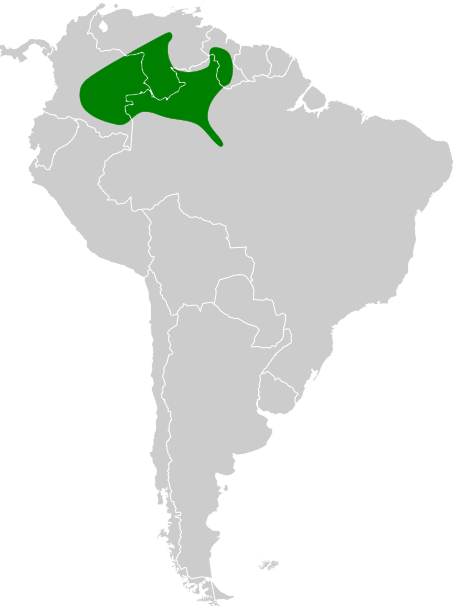
The rufous-thighed hawk (Accipiter erythronemius) is a small hawk found from southern Brazil and southeastern Bolivia to Paraguay, Uruguay and northern Argentina. It is usually considered a subspecies of the sharp-shinned hawk by most taxonomists, including the American Ornithological Society, but the taxonomy is far from resolved, with some authorities considering the southern taxa to represent three separate species: white-breasted hawk (A. chionogaster), plain-breasted hawk (A. ventralis), and rufous-thighed hawk (A. erythronemius).
This is a small Accipiter hawk, with males 23 to 30 cm (9.1 to 11.8 in) long, with a wingspan of 42 to 58 cm (17 to 23 in) and weight from 82–115 g (2.9–4.1 oz). As common in Accipiter hawks, females are distinctly larger in size, averaging some 30% longer, and with a weight advantage of more than 50% being common. The female measures 29 to 37 cm (11 to 15 in) in length, has a wingspan of 58 to 68 cm (23 to 27 in) and weighs 150 to 219 g (5.3 to 7.7 oz). The wings measure 14.1–22.9 cm (5.6–9.0 in) each, the tail is 12–19 cm (4.7–7.5 in) long and the tarsus is 4.5–5.9 cm (1.8–2.3 in). Measurements given here are for the sharp-shinned hawk, but they are comparable for the remaining species.
Adults have short broad wings and a medium-length tail banded in blackish and gray with the tip varying among individuals from slightly notched through square to slightly rounded (often narrowly tipped white). The remiges (typically only visible in flight) are whitish barred blackish. The legs are long and very slender (hence the common name) and yellow. The hooked bill is black and the cere is yellowish.
The rufous-thighed hawk resembles the sharp-shinned hawk, but upperparts are darker, streaking to underparts rufous or dusky, cheeks are typically with a clear rufous patch (occasionally lacking almost entirely) and iris is yellow (contra illustrations in some books). Juveniles resemble juveniles of sharp-shinneds, but streaking to the underparts are typically restricted to throat and central underparts, with flanks scaled or barred (often also the belly).
Aliases
Accipiter erythronemius