 Bird App
Bird of the day
Wild turkey
Meleagris gallopavo
The wild turkey (Meleagris gallopavo) is an upland game bird native to North America, one of two extant species of turkey and the heaviest member of the order Galliformes. It is the ancestor to the domestic turkey (M. g. domesticus), which was originally derived from a southern Mexican subspecies of wild turkey (not the related ocellated turkey).
An adult male (tom or gobbler) normally weighs from 5 to 11 kg (11 to 24 lb) and measures 100–125 cm (39–49 in) in length. The adult female (hen) is typically much smaller at 2.5–5.4 kg (5.5–11.9 lb) and is 76 to 95 cm (30 to 37 in) long. Per two large studies, the average weight of adult males is 7.6 kg (17 lb) and the average weight of adult females is 4.26 kg (9.4 lb). The record-sized adult male wild turkey, according to the National Wild Turkey Federation, weighed 16.85 kg (37.1 lb), with records of tom turkeys weighing over 13.8 kg (30 lb) uncommon but not rare. Considering its maximum and average weight, it is among the heaviest flying birds in the world.
The wings are relatively small, as is typical of the galliform order, and the wingspan ranges from 1.25 to 1.44 m (4 ft 1 in to 4 ft 9 in). The wing chord is only 20 to 21.4 cm (7.9 to 8.4 in). The bill is also relatively small, as adults measure 2 to 3.2 cm (0.79 to 1.26 in) in culmen length. The tarsus of the wild turkey is quite long and sturdy, measuring from 9.7 to 19.1 cm (3.8 to 7.5 in). The tail is also relatively long, ranging from 24.5 to 50.5 cm (9.6 to 19.9 in).
Fully-grown wild turkeys have long, reddish-yellow to grayish-green legs. Each foot has three front toes, with a shorter, rear-facing toe; males have a spur behind each of their lower legs, used to spar with other males.
The body feathers are generally blackish and dark, sometimes gray-brown, overall, with a coppery sheen that becomes more complex in older males. Mature males have a large, featherless, reddish head and red throat, with red wattles on the throat and neck. The head has fleshy, unique growths called caruncles, which may be used to identify certain birds from one another. When toms are excited, a fleshy flap on the bill (called a snood) expands, and this, the wattles and the bare skin of the head and neck all become red with enhanced flow of blood to the head. Tail feathers are of the same length in adults but of different lengths in juveniles.
Males have a long, dark, fan-shaped tail and glossy, bronze wings. As with many other species of Galliformes, turkeys exhibit strong sexual dimorphism. The male is substantially larger than the female, and his feathers have areas of red, purple, green, copper, bronze, and gold iridescence. The preen gland (uropygial gland) is also larger in males compared to females. In contrast to the majority of other birds, they are colonized by bacteria of unknown function (Corynebacterium uropygiale). Males typically have at least one "beard", a tuft of coarse hair-like filaments (mesofiloplumes), growing from the center of the breast. Beards grow continuously during the turkey's lifespan and a one-year-old male has a beard up to 5 in (13 cm) long. Approximately 10% of females have a beard, usually shorter and thinner than that of the male.
Females have feathers that are duller overall, in shades of brown and gray. Parasites can dull the coloration of both sexes; in males, vivid coloration may serve as a signal of health. The primary wing feathers have white bars. Turkeys have approximately 5,000 to 6,000 feathers. Juvenile males are called jakes; the difference between jakes and toms is that jakes have very short "beards" and tail fans with longer feathers in the middle. The tom's tail fan feathers are uniform in length.
The turkey has the second-highest maximum average weight of any North American bird, after the trumpeter swan (Cygnus buccinator). By average mass, however, several other American birds surpass the mean weight of the turkey, including the American white pelican (Pelecanus erythrorhynchos), the tundra swan (Cygnus columbianus columbianus), the endangered California condor (Gymnogyps californianus), and whooping crane (Grus americana).
Aliases
Meleagris gallopavo
Range
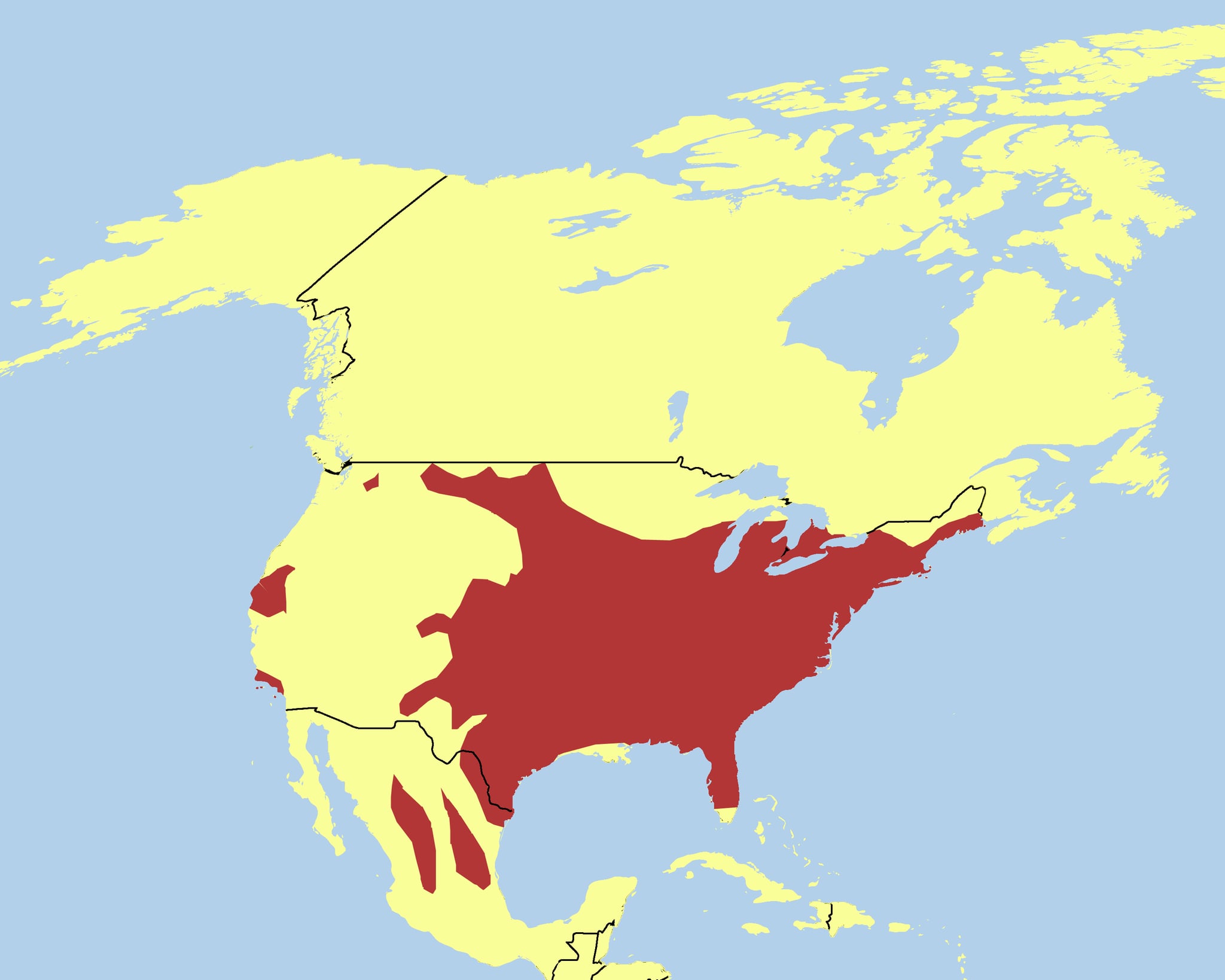
Data retrieved on October 15, 2025 at 7:54 AM