 Bird App
Bird of the day
Keel-billed toucan
Ramphastos sulfuratus
The keel-billed toucan (Ramphastos sulfuratus), also known as rainbow-billed toucan or sulphur-breasted toucan, is a species of toucan native to southern Mexico, Central America and the far northwest of South America, and is found in tropical forests. It is the national bird of Belize. It is an omnivorous forest bird that feeds on fruit, seeds, insects, invertebrates, lizards, snakes, and small birds and their eggs.
Including its bill, the length of the keel-billed toucan ranges from around 42 to 55 cm (17 to 22 in), while its wing length typically ranges from 189.4 to 208.4 mm (7.46 to 8.20 in). The bird typically weighs about 380–500 g (13–18 oz).
The large and brightly coloured bill averages around 12–15 cm (4.7–5.9 in), about one third of the bird's total length. The bill is mainly green with a red tip and orange sides. While the bill seems large and cumbersome, it is in fact a spongy, hollow bone covered in keratin, a very light and hard protein. It has been suggested that the bill colour may also help regulate body temperature, using the many blood vessels running through it.
The plumage of the keel-billed toucan is mainly black, with a yellow neck and chest, red under-tail coverts, and a narrow red band at the base of the yellow on the chest. Moulting occurs once per year. It has blue feet and red feathers at the tip of its tail.
As with almost all birds in the order Piciformes, keel-billed toucans have zygodactyl feet, with toes 2 and 3 facing forwards, and toes 1 and 4 facing backwards, so two toes face forward and two face back. Because toucans spend a large portion of time in the trees, this may help the birds to stay on the branches of the trees and jump from one branch to another.
Other than size, males and females of the species look similar.
Aliases
Ramphastos sulfuratus
Range
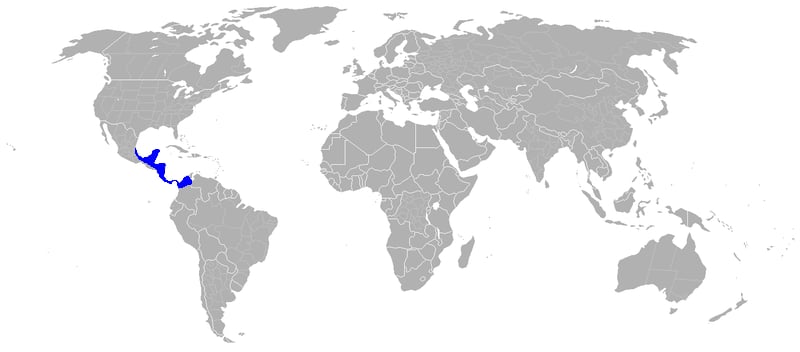
Data retrieved on October 15, 2025 at 7:54 AM