 Bird App
Bird of the day
Stresemann's bushcrow
Zavattariornis stresemanni
The Ethiopian bushcrow (Zavattariornis stresemanni), also known as the Stresemann's bushcrow, Abyssinian pie, bush crow, or by its generic name Zavattariornis, is a rather starling-like bird, which is a member of the crow family, Corvidae. It is slightly larger than the North American blue jay and is a bluish-grey in overall colour which becomes almost white on the forehead. The throat and chest are creamy-white with the tail and wings a glossy black. The black feathers have a tendency to bleach to brown at their tips. The iris of the bird is brown and the eye is surrounded by a band of naked bright blue skin. The bill, legs, and feet are black.
Feeding is usually in small groups and the bird takes mainly insects. Breeding usually starts in March, with the birds building their nest high in an acacia tree. The birds usually lay five to six cream eggs with lilac blotches. The nest itself is globular in shape with a tubular entrance on top. It is possible that more than just the breeding pair visit the nest and that the young of previous years help in rearing the young.
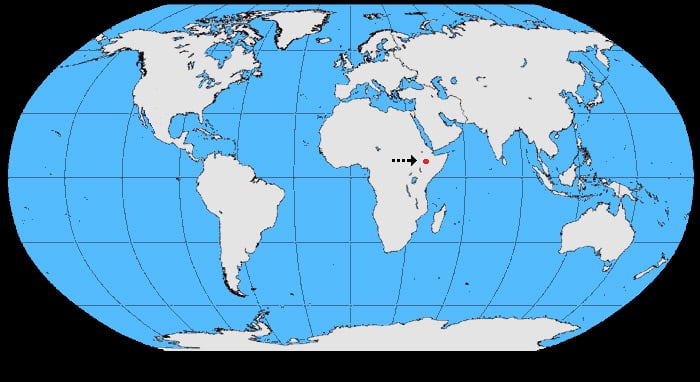
The range of this species is quite restricted, it being confined to thorn acacia country in southern Ethiopia near Yavello (Javello), Mega, and Arero. It can be absent from apparently suitable country near these areas; the reasons for this were formerly unclear, but are now thought to be related to the species requiring a "bubble" of lower temperature for proper foraging, which is only present within its small range, making it one of the few warm-blooded animals whose survival is wholly dependent on temperature (along with the sympatric white-tailed swallow). This requirement makes it extremely vulnerable to climate change, and massive declines and even potential extinction in the wild are projected in the future, making it one of the birds most threatened by climate change.
The Ethiopian bushcrow is about 28 centimetres (11 in) long and weighs 130 grams (4.6 oz). The sexes look similar and are not sexually dimorphic. Overall it is pale grey with a black tail and wings. The head, mantle, scapulars, back, rump, and uppertail coverts are all a pale grey. The feathers on the forehead, upper ear-coverts, and throat fade into white. The bright azure skin around the bushcrow's eye is featherless and can be inflated, narrowing the blackish-brown eye into a slit. The feathers behind the eye are capable of moving to reveal an oblong pink patch of skin. The bird's black beak decurves into a sharply pointed tip and is relatively small for a corvid. This beak is 33 to 39 millimetres (1.3 to 1.5 in) long. The feathers on the bird's chin are fine and can form a small tuft when erected. The bushcrow's breast and flanks are pale grey, fading into white on the rear flanks, belly, and undertail. On the wings, the lesser and median upper-wing coverts are grey, while the rest of the wing is a slightly glossy blue-black. Its blue-black tail is relatively long and square-ended. Its legs are black. When the plumage becomes worn, the upperparts appear to have a brownish tinge. The juvenile Ethiopian bushcrow is slightly duller than the adult, and the feathers of the body and upperwings are fringed with creamy-fawn. The facial skin, bill, and legs are also a dull grey.
The bushcrow is a very vocal species, particularly when foraging. Its main contact call has been described as a single metallic "kej". While flying, the species frequently calls out a nasal, rapid "kerr kerr kerr". While these are the most frequent vocalizations, several others are known. Allopreening adults utter a metallic "kaw, kaw, kaw". Foraging birds call out "how, how, how", a single, quiet "quak", and a soft, repeated "guw". While building its nest, the bushcrow is known to utter a low "keh" sound, and adults utter a deep "waw" while rubbing their bills together.
Aliases
Zavattariornis stresemanni, Ethiopian bush-crow
Range
Data retrieved on September 27, 2026 at 3:59 PM