 Bird App
Bird of the day
Bateleur
Terathopius ecaudatus
The bateleur (; Terathopius ecaudatus), also known as the bateleur eagle, is a medium-sized eagle in the family Accipitridae. It is often considered a relative of the snake eagles and, like them, it is classified within the subfamily Circaetinae. It is the only member of the genus Terathopius and may be the origin of the "Zimbabwe Bird", the national emblem of Zimbabwe. Adult bateleurs are generally black in colour with a chestnut colour on the mantle as well as on the rump and tail. Adults also have gray patches about the leading edges of the wings (extending to the secondaries in females) with bright red on their cere and their feet. Adults also show white greater coverts, contrasting with black remiges in males, gray patches on the underwing primaries and black wingtips. The juvenile bateleur is quite different, being largely drab brown with a bit of paler feather scaling. All bateleurs have extremely large heads for their size, rather small bills, large feet, relatively short legs, long, bow-like wings and uniquely short tails, which are much smaller still on adults compared to juvenile birds.
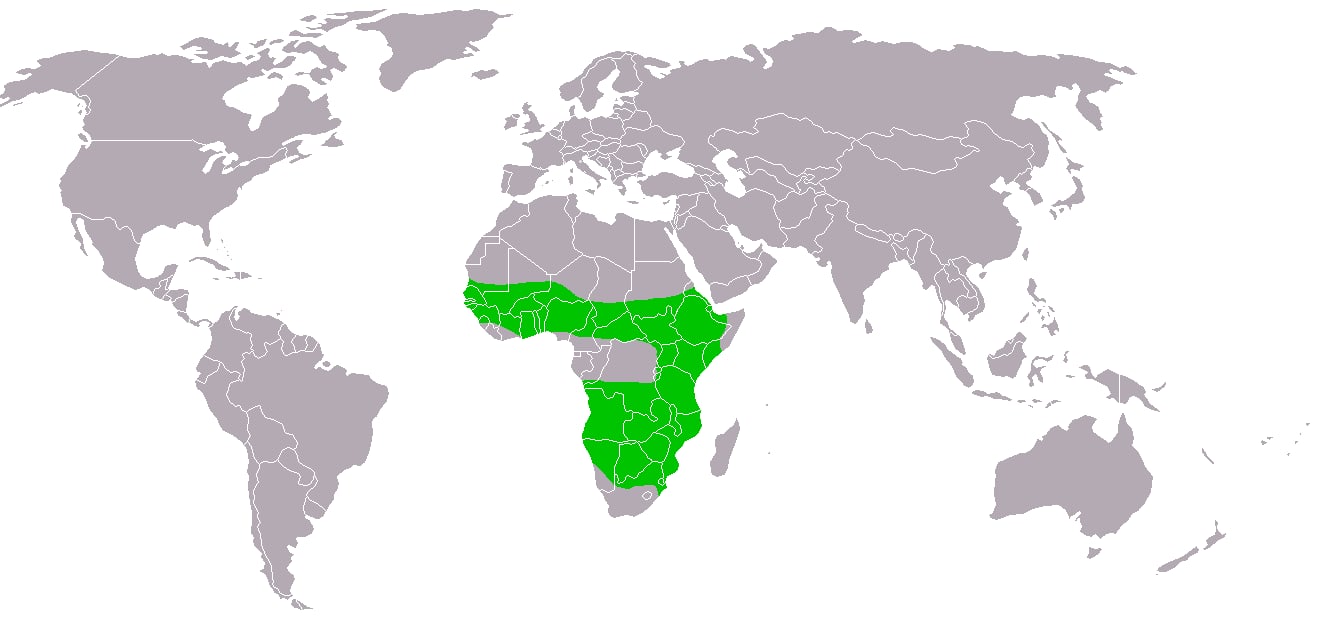
This species is native to broad areas of Sub-Saharan Africa and scarcely up into Arabia. It is characteristically a bird of somewhat open habitats such as savanna with some trees present and open dry woodland. It is in life history, a rather peculiar bird of prey with a free-wheeling generalist diet that includes much carrion but also tends to hunt a wide range of live prey, including many small to unexpectedly relatively large mammals and reptiles along with generally relatively small birds. Bateleurs are highly aerial birds that spend much time soaring and will frequently fly with exaggerated embellishments, perhaps when excited or angered. They tend to build a relatively small if sturdy stick nest in a large tree and lay only a single egg. Despite being a rather aggressive bird in other contexts, bateleurs are easily flushed from their own nest, making them exceptionally vulnerable to nest predators, including humans, and nest failures. It may take as long as 7 to 8 years to attain full maturity, perhaps the longest stretch to maturity of any raptor. This species has long been known to be declining rather pronouncedly in overall population and it is mostly confined to protected areas today. Currently the IUCN classifies the bateleur as an Endangered species due primarily to anthropogenic causes such as habitat destruction, pesticide usage and persecution.
The bateleur is of note for its unique morphology and plumage, with some anatomical similarities to both snake eagles and vultures. The species has a thick neck and a very large, rather conspicuously cowled head with a proportionately short bill, albeit one covered with a very large cere. The cowl is also present on snake eagles but in those it is less dramatically apparent. The other features in perched adult bateleurs are rather oddly stumpy, such as the short legs and exceptionally short tail, possibly the shortest proportionately of all raptors. Its posture while perched is extremely upright, making them look like quite a tall raptor on the ground despite its rather short legs. Even while perched, the body tends to be dominated by their exceptionally large wings, which possess some 25 secondary feathers, perhaps more than any other raptor.
The adult bateleur usually has a chestnut coloration along the mantle, back, rump and tail, including the undertail coverts. The adult male bateleur is predominantly black with grey shoulders, which appear edged with white when freshly moulted. The adult female differs by having grey-brown, not black, on the greater coverts and black-tipped grey, not black, secondaries. Furthermore up to 7% of adults have a "cream morph" where they have chestnut tails but the other chestnut areas are almost fully replaced by cream to pale brown coloring. The cream morph may reportedly be slightly more prevalent in drier areas. The bare parts of adult bateleurs are exceptionally conspicuous, with the adult cere, bare facial skin and feet all being rather bright red, however in some they can also temporarily fade to pink, pale pink or yellowish at times, such as when they are perching in the shade or bathing. The bare parts flush the most red during times of excitement. The bill itself is black with a yellow centre and red base. The eyes are dark brown.
The juvenile is very distinct from the adults of the species. Juveniles of the bateleur have a longer tail than mature birds. They furthermore have essentially all brown coloring, with dull rufous to creamy edging apparent on some areas. The head of the juvenile bateleur is paler and tawnier than elsewhere on its body while the eyes are brown, the cere a rather unique greenish-blue and the feet whitish in colour. At as late as 2–3 years of age, the immature bateleur is still much the same in appearance as the juvenile but by the fourth year becomes more sooty-brown, with sexual dimorphism already evidenced by the more extensive dark wing markings of males. In the 5th year, the plumage may show the first signs of chestnut and the grey colour about back and shoulders tend to manifest. Also from 3–5 years old, the cere and feet turn yellow then to dull-pink. By the sixth and seventh years of life, the plumage of subadult bateleurs blackens and the chestnut portions of the plumage increase. The shoulders become fully grey by the 8th year, the likely age of maturity. As for the bare parts in juvenile bateleurs, the cere and facial skin are a distinct pale grey-blue to green-blue. The juvenile's feet are greenish-white to greyish-white, at 4-5 the cere, facial skin and feet turn yellow, then pink before finally reddening. The eyes are similar in hue to those of adult bateleurs but are a slightly lighter, being more honey-brown, while the bill of juveniles are mainly pale grey-blue in colour.
In flight, the bateleur appears as a rather large raptor with disproportionately elongated, rather narrow and slightly bow-shaped wings, which appear pinched in at the bases, broad across the secondaries and regularly narrow, pointed and upturned at the tips. Upon sighting, the wings often catch the eye before the large head, which is proportionately slightly bigger even than their cousins, the snake eagles. The tail is so short in adult bateleurs that the feet extend below the tail tip, almost giving the impression that the raptor nearly has no tail. This is as opposed to juveniles, where the feet come up about 5 cm (2.0 in) short of the tail tip, with the feet coming to exceed the tail, which is shrinking via moults, in length around the 5th year of maturation. The adult bateleur's wingspan is an extraordinary 2.9 times greater than its total length. The adult male bateleur is mostly black above with a chestnut back and tail and grey forewings, below he is black on the body, contrasting with a chestnut tail, as well as with the white wing linings and black flight feathers except for the greyish based primaries. The adult female bateleur is similar in plumage to the male overall but differs in her black-tipped grey secondaries above and more extensively white underwings with the black on the female confined to the wingtips and trailing edges. The juvenile bateleur on the wing appears broader winged and especially longer tailed with a largely uniform brown coloration, including the greater coverts, with paler feather mainly about the head as well as on the flight feathers.
The bateleur is a mid-sized eagle and large raptor. It is likely the second heaviest of the Circaetinae subfamily of accipitrids. By far the largest of the subfamily is the Philippine eagle which is more than twice as massive and is far larger in all aspects of measurement than the bateleur, with a drastically differing structure (broad, relatively short wings, very long legs and tail). One traditional snake eagle, the brown snake eagle ( Circaetus cinereus), rivals the bateleur in most aspects of size including body mass but possesses a rather longer tail and slightly shorter but broader wings. Additionally, the widespread and slightly broader-winged short-toed snake eagle and proportionately long and slender-winged black-breasted snake eagle (Circaetus pectoralis) can be nearly as large in wingspan as the bateleur but tend to be somewhat less heavy. The total length of the bateleur is 55 to 70 cm (22 to 28 in). Typical length of a full-grown bird is around 63.5 cm (25.0 in). The wingspan of bateleurs can vary from 168 to 190 cm (5 ft 6 in to 6 ft 3 in). Body mass of bateleurs can vary from 1,800 to 3,000 g (4.0 to 6.6 lb). One sample of 10 unsexed bateleurs weighed an average of 2,200 g (4.9 lb) while a smaller sample of three weighed an average of 2,392 g (5.273 lb). Additionally, a median body mass of 2,385 g (5.258 lb) was cited in one study.
The bateleur evidences some sexual dimorphism in favour of the female as is expected in raptorial birds but this size difference is fairly minimal relative to many other accipitrids, averaging up to about 6%. Among standard measurements, males have a wing chord length of 476 to 553 mm (18.7 to 21.8 in) while that of the female is 530 to 559 mm (20.9 to 22.0 in). In tail length, adult males measure 98 to 124 mm (3.9 to 4.9 in) and can be even shorter in adult females at 105 to 113 mm (4.1 to 4.4 in), in some cases the adult's tail may reportedly measure as short as 72 mm (2.8 in). This contrasts with the tail of juvenile bateleurs which measures 142 to 172 mm (5.6 to 6.8 in). The tarsus can measure from 67 to 75 mm (2.6 to 3.0 in) in males and 72 to 75 mm (2.8 to 3.0 in) in females. Unsexed adult bateleurs in Tsavo East National Park were found to average 513 mm (20.2 in) in wing chord length, 34.5 mm (1.36 in) with a range of 28.6 to 38 mm (1.13 to 1.50 in) in culmen length and a relatively small hind claw length of 30.6 mm (1.20 in). While the hind or hallux claw is usually the most enlarged in most species of accipitrid, on the other hand in the Tsavo East bateleurs, unusually the middle claw on the front of the foot was slightly larger at 32 mm (1.3 in). Notably the proportions of bateleurs are similar to snake eagles with robust feet with rough, thick skin and short talons, the bateleur in particular having very thick, large toes structurally almost like those of a big owl and very sharp talons reminiscent in sharpness of highly predaceous larger African raptors. Further like snake eagles, bateleurs have a rather large headed but with a smallish beak coupled with a large gape. These adaptations generally equip the subfamily to better handle and ingest snakes relative to other accipitrids.
The bateleur, particularly in its adult plumage, is often considered one of the most distinctive raptors in the world. When perched or flying adults or older immatures are quite unmistakable. The bateleur can be readily be distinguished even by inexperienced observers from the very differently-shaped and usually rather smaller-bodied and winged augur buzzards (Buteo augur) and jackal buzzards (Buteo rufofuscus). These do not overlap with bateleurs in nearly all respects of morphology, proportions nor flight actions. Nonetheless, both of these buzzards are sometimes mistaken for bateleurs due to their own combinations of black, white and chestnut, which are completely differently composed than those of the bateleur. Despite how distinctive the buzzards are from the bateleur, some reports of bateleurs from areas where they are currently gone are almost certain to have been misidentified jackal buzzards. Juveniles and immatures of up to 2–3 years old are hardly less distinctive in shape but could be confused, largely due to similar proportions of their large head, brown plumage and whitish legs with certain snake eagles. The brown snake eagle is perhaps the most similar to the juvenile bateleur but it has yellow eyes, longer legs, much broader, shorter and differently shaped wings with the tips of wings reaching its banded tail. Even the black-chested and the rather slight Beaudouin's snake eagle (Circaetus beaudouinii) are sometimes considered potentially confusable with juvenile bateleurs, but both of these respective species are rather uniform and darker brown ventrally and about the head and much paler dorsally, with a highly different contrasting whitish cream colour below.
Bateleurs are usually silent for much of the year. The main call, uttered whether perched or in aerial display, or when pirating from other raptors, is a far-carrying, loud raucous schaaaa-aw. They may too vocalize in a similar manner during courtship. Alternatively, bateleur calls may consist of resonant barking calls, kow-aw. The barking call can be accompanied by half-spread wings and jerking of the body up and down or may too be uttered in flight, the latter in a similar manner to that of a fish eagle. Distraction display are sometimes accompanied by subdued barking chatter, ka-ka-ka-ka.... A not dissimilar call of kau-kau-kau-koaagh-koaggh has been described as given by perched birds. Other softer calls are uttered when perched near the nest. The young of the bateleur tend to engage harsh squealing call is kyup-kyup keeaw keeaw, usually as a hunger call at approach of parent with food. Also the species' young may make a melodious twip call.
Aliases
Terathopius ecaudatus, Bateleur Eagle
Range
Data retrieved on September 27, 2026 at 3:48 PM