 Bird App
Bird of the day
Red-eared firetail
Stagonopleura oculata
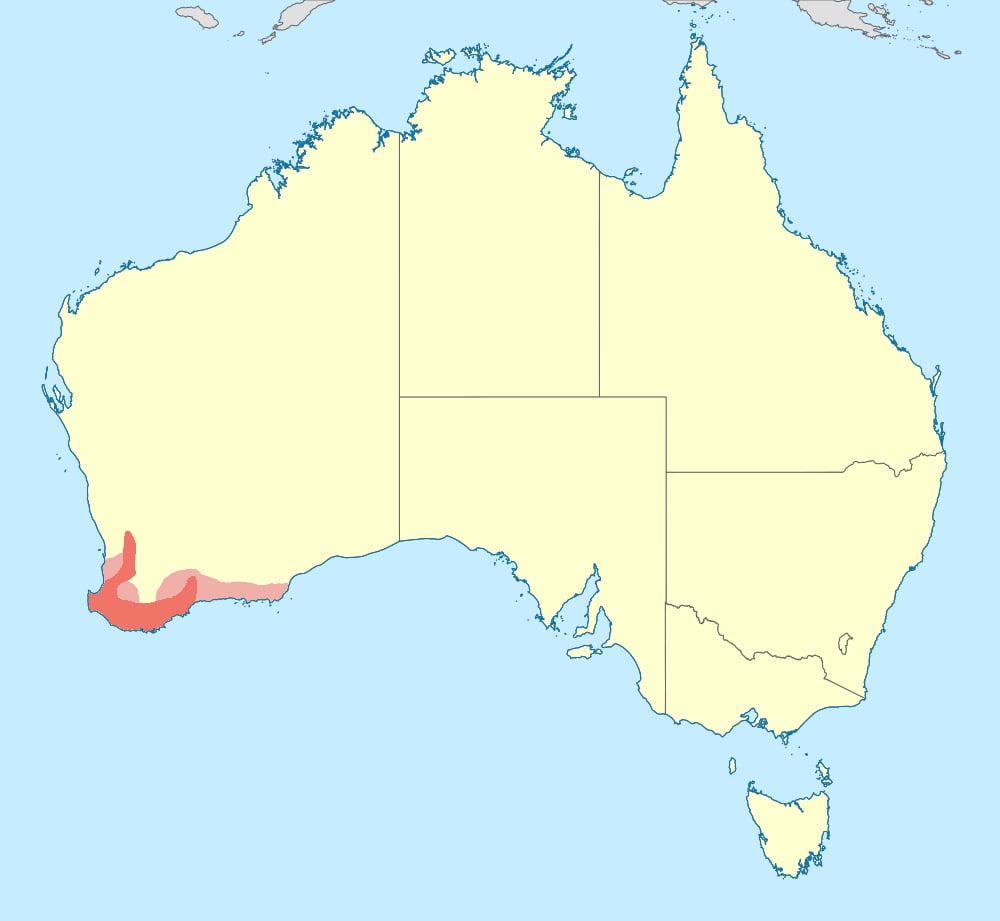
The red-eared firetail (Stagonopleura oculata), also known as the boorin, is a small finch-like species of bird. It occurs in dense wetland vegetation of coastal to sub-coastal regions in Southwest Australia. Its appearance is considered appealing, with white spots, black barring and vivid crimson marks at the ear and upper tail. Red-eared firetails are usually only glimpsed briefly, if at all, as they move rapidly and discreetly through their habitat. Most observations occur when their soft voice is heard, or in flight when flushed from the dense scrub. Males and females are similar in colouring and bond as lifelong pairs that occupy a territory centred on their roosting and brooding nest site. The species occupies a similar ecological niche to the beautiful firetail (Stagonopleura bella) found in the east of Australia, although unlike other species of the genus they only occasionally group together and are almost never seen in large flocks.
The red-eared firetail is rare in captivity, being neither recommended nor generally permitted, as they require expertise and a large specialised environment to maintain their secretive habits; however, the observations in avicultural literature have supported and contributed to knowledge of its behaviour. Despite their shyness toward other birds and people, they are known to be less so when venturing out to bird feeders. The species is not easily confused with other birds in its native habitat, excepting perhaps the red-browed finch (Neochmia temporalis) that has escaped captivity and bred in the region.
The red-eared firetail is a small grass-finch with black-barred and white-spotted plumage, distinguished by its scarlet bill, black mask, and bright crimson red patch behind the eye and at the rump. The plumage of the upper parts is olive-brown and the breast is buff-brown, both of which are thinly barred black. White spots appear on the blackish underparts. The female closely resembles the male, except when his colouring intensifies during the breeding season.
The adult plumage is crossed with black vermiculated lines, finely at the nape and crown and more strongly at the scapular feathers, upper-wing coverts, back, and the mantle; these sinuous black markings appear on otherwise greyish-brown upperparts. A similar patterning, in a dusky black colour, is finer at the brown throat and cheek and bolder at the grey-buff of the foreneck. The feathers of the underparts—undertail coverts, abdomen and flank—are white with a black margin and there is barring that outlines the distinct spots. The light brown thigh is slightly crossed with black. Paler lines cross the brown coverts under the tail. The secondary flight feathers and coverts are also greyish brown, with grey-black barring. The primaries and their coverts are dark brown; the outer primaries have a thin margin of a paler brown. A deep shade of crimson is apparent on the rump and tail coverts. A thin black band extends across the frons, broadening at the lores and circling the eyes to give a masked appearance, contrasting the distinctive patch of crimson at the ear coverts and scarlet of the bill; this mask is comparatively larger in males when closely observed. The colour of the tail feathers is a dusky shade of brown with fine black barring and the central tail feathers become crimson toward the coverts.
Descriptions of the iris are as red or dark brown, the eye-ring as pale blue, and the legs as dark- or pink-brown. The bill of both sexes is red, although a coating on the bill of the male intensifies its colour during the breeding season. The average size of the adult is around 125 millimetres (mm) in length. The weight of males is 11.4–16.0 grams, females have a narrower range of 12.5–13.6 grams. Using a sample of thirty males and fifteen females, the average length in of the wing is 56.2 mm, bill 11.8 mm, tail 43.7 mm, and tarsus 17.0 mm for the male; the female has an average length of wing at 56.4 mm, bill 11.6 mm, tail 42.4 mm, and tarsus 17.4 mm.
The juvenile plumage resembles the adult, without the deep crimson ear patch and spotted belly. When observed in captivity, the white spots appeared first, beginning at the flank, with the red ear as the last characteristic to emerge. The vermicular bars of the adult plumage are absent at the nape and crown, and are more subdued on the rest of the upper parts. The black at the eyes and lores is absent or nearly so; the distinct red of the upper tail coverts and rump is duller, and underparts are lighter, buff coloured, and mottled rather than spotted. Immature birds usually attain adult plumage within four months although this period is extended if born late in the breeding season. The juvenile's bill begins as a brownish black colour, becoming scarlet between fourteen and twenty two days after fledging, with blue luminous tubercules are evident at the gape. The legs are a duller shade of brown and the naked and white eye-ring is only slightly blue.
The eggshell is pure white, smooth and finely grained, without gloss, but with a salmon-pink tone produced by the contents. The eggs were described as 12 mm × 16 mm in size and oval in shape by Alfred North (1901–14); Forshaw gave the form as "ovate to elliptical ovate". A sample of forty six specimens from nine clutches were taken and noted as 15.9–17.8 mm × 11.9–13.2 mm to give average dimensions of 16.6 mm × 12.4 mm (Johnstone & Storr, 2004). A clutch of six eggs at Torbay (1959) and another of five closer to Albany (1967) were recorded as larger than this average size.
Aliases
Red-eared firetail finch, Red-eared Firetail
Range
Data retrieved on October 15, 2025 at 7:46 AM