 Bird App
Bird of the day
Audubon's oriole
Icterus graduacauda
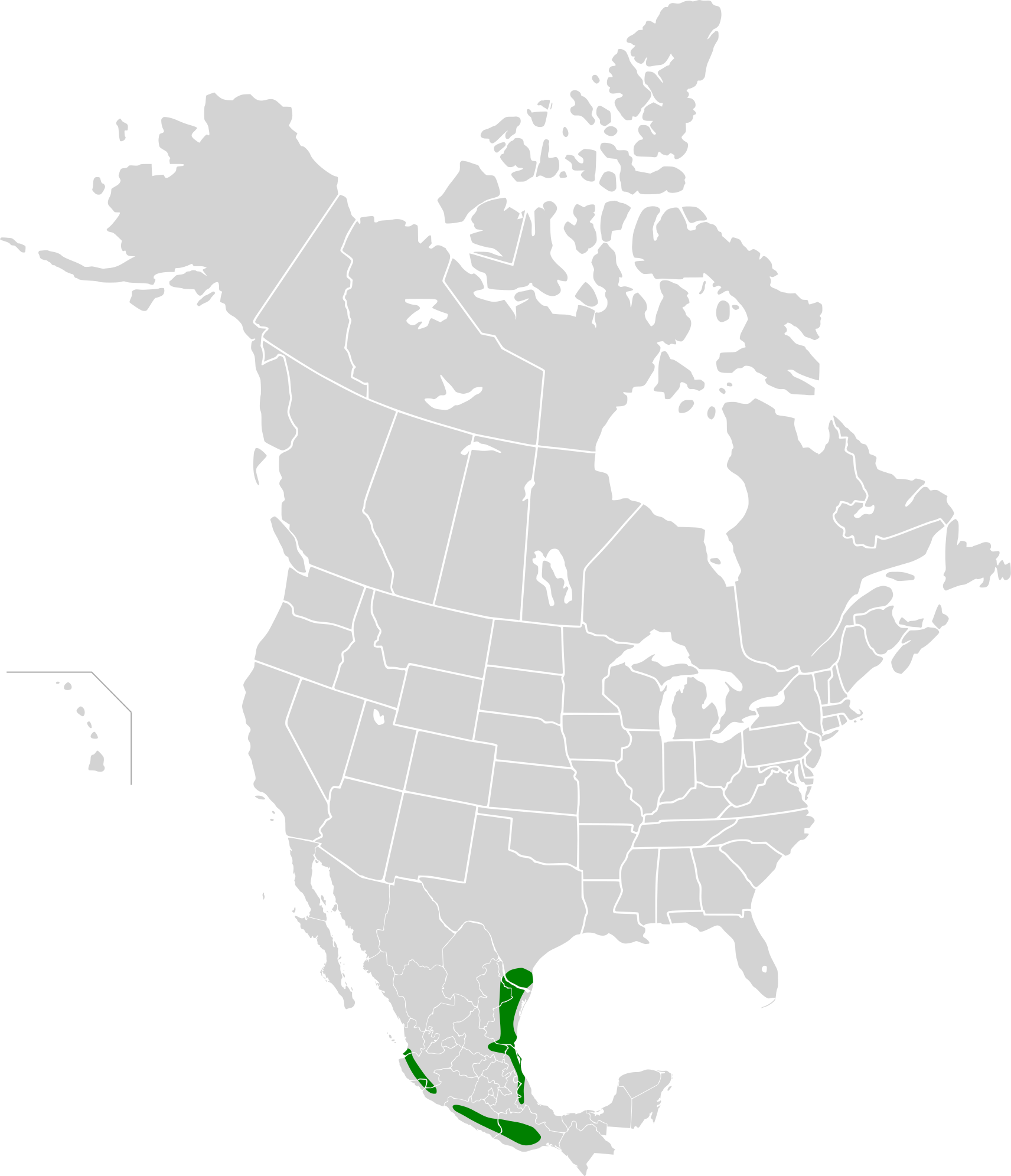
Audubon's oriole (Icterus graduacauda), formerly known as the black-headed oriole, is a New World passerine inhabiting the forests and thickets of southeastern Texas and the Mexican coast. It is the only species to have a black hood and yellow body. It is divided into four subspecies and two allopatric breeding ranges. The westernmost range extends from Nayarit south to southern Oaxaca, whereas the eastern range stretches from the lower Rio Grande valley to northern Querétaro. The most common in the western range are the subspecies I. g. dickeyae and I. g. nayaritensis; I. g. graduacauda and I. g. audubonii can be found in the eastern range. Like most Central American birds, it is not a migratory species and does not display significant sexual dimorphism. DNA analysis of the ND2 and cyt-b genes strongly suggests that I. graduacauda is most closely related to I. chrysater, the yellow-backed oriole. It is a member of the genus Icterus and therefore should not be confused with the Old World orioles.
The male of the species has a black hood, mandible, and throat, as well as a black tail. Wings are black, but the remiges and rectrices (flight feathers) are fringed with white. The secondary coverts form yellow epaulets. The back and vent are yellow washed with olive, and the underside is almost uniformly yellow. Females of this species have a slightly more olive nape and back than the males. The adult female's plumage is similar to the juvenile plumage; however, unlike adults, the wings are dull brown instead of black. In general, immature specimens have the hood; wingbars; remiges; and epaulets of adult specimens. The first-basic plumage retains the darker, greener coloration of the juvenile plumage, however. Molting generally occurs in early autumn, though some specimens have been noted to molt as early as June.
The subspecies I. g. dickeyae is of note because of the differences in appearance, behavior, and phylogeny between it and the other subspecies of I. graduacauda. The olive wash is weaker, making the bird more proportionally yellow than others of its species. In addition, the yellow epaulets are diminished in dickeyae, being confined to the lesser coverts. This subspecies is endemic to high altitude pine forests is western Mexico.
Aliases
Icterus graduacauda, black-headed oriole
Range
Data retrieved on September 27, 2026 at 4:01 PM