 Bird App
Bird of the day
Canada warbler
Cardellina canadensis
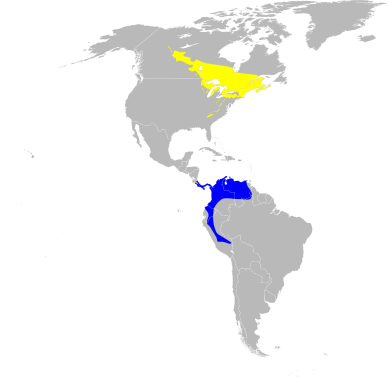
The Canada warbler (Cardellina canadensis) is a small boreal songbird of the New World warbler family (Parulidae). It summers in Canada and northeastern United States and winters in northern South America.
The Canada warbler is sometimes called the "necklaced warbler", because of the band of dark streaks across its chest. The adults have minimal sexual dimorphism, although the male's "necklace" is darker and more conspicuous and also has a longer tail. Adults are 12–15 cm (4.7–5.9 in) long, have a wingspan of 17–22 cm (6.7–8.7 in), and weigh 9–13 g (0.32–0.46 oz).
The chest, throat, and belly of the bird are yellow, and its back is dark grey. It has no wingbars or tail spots, but the underside of the tail is white. It has a yellow line in front of its eye in the direction of the beak, but the most striking facial feature is the white eyerings or "spectacles". Immature specimens have similar coloration as adults but duller and with less pronounced facial features.
The of this bird is loud and highly variable, resembling chip chewy sweet dichetty. Their calls are low chup's.
A 2013 study showed that male Canada warblers have two performance-encoded song types. Mode I, used mostly during the day, when unpaired either alone or near a female during early nesting, involves stereotyped songs sung slowly and regularly. Mode II, used at dawn, after pairing and when near another male, involves variable songs, sung rapidly with irregular rhythm and chirping between songs. Most of the phrases used were common to both modes, a feature unique among parulids, which ordinarily have an individual's repertoire separated into two distinct parts.
In 2000, a female Canada warbler (or a post-hatching year-old male that failed to moult, something never before observed) in Giles County, Virginia was observed singing. Its repertoire consisted of a repeated song of 12 to 13 notes as well as several shorter songs consisting of the first five or six notes of the longer song. The bird did not respond to the playback of its own song or a recording of a male. Although female singing among the parulids has long been considered "idiosyncratic", singing by female Canada warblers is supported by the observation of female singing in congener Wilson's warbler and the closely related hooded warbler.
Aliases
Canada Warbler
Range
Data retrieved on September 27, 2026 at 5:58 PM