Bird App
Bird of the day
Black-legged seriema
Chunga burmeisteri
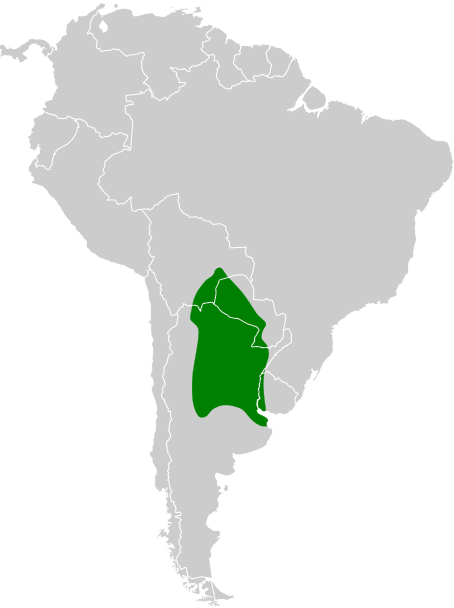
The black-legged seriema (Chunga burmeisteri) is one of two living species of seriemas in the family Cariamidae. It is found from southeastern Bolivia and northern Paraguay south into north-central Argentina. It is a large, mostly grey bird with a long neck, a long tail, and long, slender black legs. Its belly, vent and thighs are yellowish-white. The sexes look similar, as do immature birds, though the latter are more patterned on head, neck and back. First described for science by Gustav Hartlaub in 1860, it is monotypic, with no subspecies. Like its red-legged cousin, it is an omnivore. It seldom flies, instead pursuing prey and eluding danger on foot. Its loud calls, said to sound like kookaburras, turkeys or yelping dogs, are often given in duet. Little is known about its breeding ecology. It is known to breed in November and December, building a platform nest of sticks and laying two white eggs, which are sometimes marked with a few brownish or purple spots. The International Union for Conservation of Nature rates the species as one of least concern, due to its large range and apparently stable numbers.
The black-legged seriema is a large bird, measuring some 70–85 cm (28–33 in) in length, and weighing roughly 1.2 kg (2.6 lb). This makes it one of the largest ground-dwelling birds in the Neotropics; only the red-legged seriema and the rheas are larger. It is long-necked and long-tailed, with very long, slender legs and short, rounded wings. Overall, it is ash-grey in colour, though closer examination shows that the "grey" body feathers are actually finely vermiculated with black and white. It has an inconspicuous frontal crest, composed of erect, hairlike bristles. It has whitish supercilia and lores, and the feathers on its crown and nape are barred in black and white. Its belly is paler grey, and its lower abdomen, crissum and thighs are yellowish-white. The flight feathers on the wings are thickly barred with black and white, and its grey tail is barred and narrowly tipped with black. Its feathers are loosely webbed, giving the bird a "soft" appearance. Those on its nape are particularly long, forming an inconspicuous crest. Its stout black bill has a strongly decurved culmen and a small hook at the tip. Its iris is reddish-brown, and its legs are dark-grey to black. Its feet have three short front toes with very sharp claws, and one small elevated hind toe which also found on Dromaeosauridae. The sexes look alike, and youngsters are similar, though somewhat more patterned. The latters' heads, necks and breasts are barred, and their backs and upperwing coverts are speckled with white.
Its call notes are a series of yelps and barks, said to sound like a turkey, a kookabura or a small dog. Pairs call in tandem, with the duet said to be loud, slow and evenly-pitched, but somewhat harsh and unmusical.
The only species that the black-legged seriema could conceivably be confused with is the red-legged seriema. Though similar in general appearance, the black-legged seriema is smaller, and lacks the distinctive frontal crest of its red-legged cousin. It has a black bill and dark legs, rather than a red bill and red legs, and a dark eye rather than a pale one. Although the two overlap locally in their ranges, they tend to live in different habitats.
Aliases
Chunga burmeisteri
Range