Bird App
Bird of the day
Mistle thrush
Turdus viscivorus
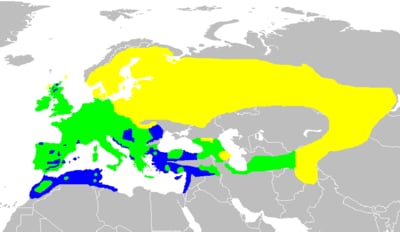
The mistle thrush (Turdus viscivorus) is a bird common to much of Europe, temperate Asia and North Africa. It is a year-round resident in a large part of its range, but northern and eastern populations migrate south for the winter, often in small flocks. It is a large thrush with pale grey-brown upper parts, a greyish-white chin and throat, and black spots on its pale yellow and off-white under parts. The sexes are similar in plumage, and its three subspecies show only minimal differences. The male has a loud, far-carrying song which is delivered even in wet and windy weather, earning the bird the old name of stormcock. Historically, the name was also sometimes spelled "missel thrush".
Found in open woods, parks, hedges and cultivated land, the mistle thrush feeds on a wide variety of invertebrates, seeds and berries. Its preferred fruit include those of mistletoe, holly, rowan, and yew. Mistletoe is favoured where it is available, and this is reflected in the thrush's English and scientific names; the plant, a parasitic species, benefits from its seeds being excreted by the thrush onto branches where they can germinate. In winter, a mistle thrush will vigorously defend mistletoe clumps or other fruit-bearing trees as a food reserve for when times are hard, chasing off other thrushes and other fruit-eating birds like waxwings.
The open cup nest is built against a trunk or in a forked branch, and is fearlessly defended against potential predators, sometimes including humans or cats. The clutch, typically of three to five eggs, is incubated for 12–15 days, mainly by the female. The chicks fledge about 14–16 days after hatching. There are normally two broods. There was a range expansion in the 18th and early 19th centuries, and a small decline in recent decades, perhaps due to changes in agricultural practices. Given its numbers and large range, this thrush is classified by the International Union for Conservation of Nature as being of least concern.
The mistle thrush is the largest thrush native to Europe. The nominate subspecies measures 27–28 cm (11–11 in) in length, with a 45 cm (18 in) wingspan. It weighs 93 to 167 g (3.3 to 5.9 oz), with an average of around 130 g (4.6 oz). It has a stocky upright posture when on the ground. It has pale grey-brown upperparts, the chin and throat are greyish-white, and the yellowish-buff breast and off-white belly are marked with round black spots. The spotting becomes denser on the lower chest. The long tail has white tips on the outer feathers, and the underwing coverts are white. The eyes are dark brown and the bill is blackish with a yellowish base to the lower mandible. The legs and feet are yellowish-brown. There are no plumage differences between the sexes. Juveniles are similar to adults, but they have paler upperparts with creamy 'teardrop' centres to many of the feathers and smaller spots on the yellowish underparts. By their first winter they are very similar to adults, but the underparts are usually more buff-toned.
There is clinal variation in nominate T. v. viscivorus across its range with the darkest birds in western Europe, and the palest in Siberia and Turkey. The southeastern subspecies T. v. bonapartei is 30 cm (12 in) in length, and therefore slightly larger than the nominate form. It is paler grey above and whiter below, with fewer black spots. The southwestern subspecies T. v. deichleri resembles T. v. bonapartei in appearance, but is closer in size to the nominate T. v. viscivorus, although it has a more slender bill.
Adults have a full moult after breeding, beginning between late May and the end of June, and completed by early October. Juvenile birds have a partial moult, replacing their head, body, and covert feathers; this is completed by October, although the start of the moult depends on when the chicks hatched.
The mistle thrush is much larger, paler and longer-tailed than the sympatric song thrush. In the western Himalayas it could be confused with both the plain-backed and the long-tailed thrushes. These are similar to the mistle thrush, but the plain–backed thrush lacks obvious wing bars, is more rufous above than its relative, and is barred rather than spotted below. The long-tailed thrush has olive-toned upperparts, bars on its breast and two wing bars. Juvenile mistle thrushes are superficially similar to White's thrush, but that species has golden-yellow plumage, scalloped underparts and a distinctive underwing pattern.
The male mistle thrush has a loud melodious song with fluted whistles, sounding like chewee-trewuu ... trureetruuruu or similar, repeated three to six times, and used to advertise his territory, attract a mate and maintain the pair bond. The tone resembles that of the song thrush or blackbird, but compared to its relatives the mistle thrush's repertoire is less varied and the delivery is slower. The song is, however, much louder, often audible up to 2 km (2,000 yd) away. The song is given from a treetop or other elevated position mainly from November to early June. The male is most vocal in the early morning, and its tendency to sing after, and sometimes during, wet and windy weather led to the old name "stormcock". The song may be heard in any month, although it is uncommon from July to August while the thrush is moulting. The main call, given by both sexes, is a dry chattering krrrr, louder when it is alarmed or excited. It is often likened to the sound of a football rattle, a form of musical ratchet. There is also a squeaky tuk contact call.
Aliases
Turdus viscivorus, mistle thrush
Range