Bird App
Bird of the day
Hose's broadbill
Calyptomena hosii
Hose's broadbill (Calyptomena hosii) is a species of bird in the family Calyptomenidae. It was described by the British naturalist Richard Bowdler Sharpe in 1892 and is named after the British zoologist Charles Hose, who collected the holotype of the species. It is 19–21 cm (7.5–8.3 in) long, with females weighing 92 g (3.2 oz) on average and males weighing 102–115 g (3.6–4.1 oz). Males are bright green and have conspicuous black spots on the wings, black markings on the head, blue underparts, black flight feathers, and a large green tuft covering most of the bill. Females have smaller forehead tufts, lime-green underparts with sky blue instead of azure blue on the undertail coverts, and lack black markings on the head, except for a black spot in front of the eye.
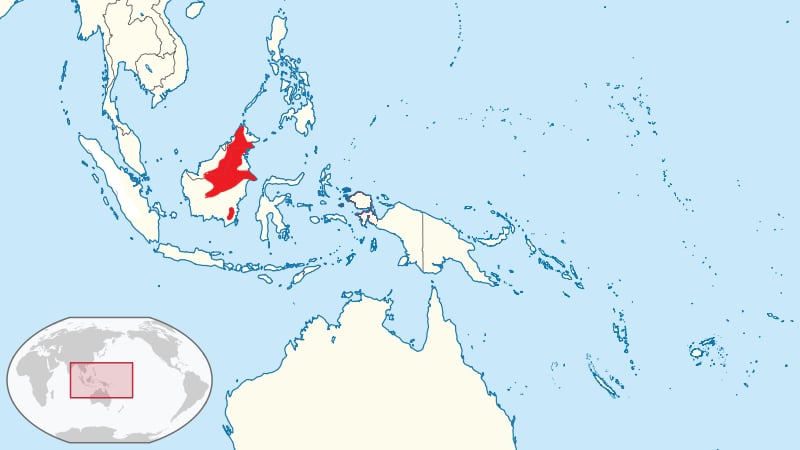
The species is endemic to montane regions in north, central, and southeastern Borneo, where it mostly occurs in forests at elevations of 600–1,220 m (1,970–4,000 ft). Omnivorous, it mainly feeds on fruit like figs and berries, supplementing its diet with insects and leaf buds. It is mainly seen alone or in pairs but can form flocks of up to 6–8 birds near fruiting trees. Breeding occurs from April to October, with clutches of 2–4 eggs being laid in delicate hanging nests. It is classified as being near-threatened by the International Union for Conservation of Nature due to a moderately rapid decline in its population caused by habitat destruction.
Hose's broadbill is 19–21 cm (7.5–8.3 in) long, with females weighing 92 g (3.2 oz) on average and males weighing 102–115 g (3.6–4.1 oz). Males have bright shimmery green upperparts, with a large tuft of feathers on the forehead covering most of the bill and a thin pale green eye-ring. There is a black spot in front of the eyes and black patches behind the ear-coverts, on the back of the neck, and across the upper back. The wing coverts have conspicuous circular black spots and the flight feathers are black with green edges. The breast is indigo blue and the belly and undertail coverts are azure blue.
Females differ in their smaller forehead tufts, paler upperparts with a slight olive tint, and lime-green underparts with sky blue instead of azure blue. They also have lime green eye-rings and no black on the head other than the spot in front of the eye. The iris is blackish, the bill is dark brownish-black to black, and the feet are dark olive green. Juveniles are mostly like females, but juvenile males have dark feathers on the back of the neck. Immature males are similar to adult males, but lack most of the head markings and have less blue on the underparts.
The species can be differentiated from the other two species of Calyptomena , which also occur in Borneo, by its blue underparts. It can be told apart from the green broadbill by its larger size and spots on the wings, instead of bars as in the latter. Whitehead's broadbill is larger and has a black patch on the breast.The only recorded vocalisation is a low, soft, pleasant dove-like coo-wooo, with the second note upslurred. It is given while making bobbing head movements.
Aliases
Calyptomena hosii
Range