Bird App
Bird of the day
Ross's goose
Anser rossii
Ross's goose (Anser rossii) is a white goose with black wingtips and a relatively short neck. It is the smallest of the three white geese that breed in North America. It is similar in appearance to a white-phase snow goose, but about 40% smaller. Other differences from the snow goose are that the bill is smaller in proportion to its body and lacks "black lips". Like snow geese, Ross's geese may exhibit a darker "blue" phase or morph, though this is extremely rare (<0.01% of adult birds).
Before the early 1900s, this goose was considered a rare species, possibly as a consequence of open hunting, but numbers have increased dramatically as a result of conservation measures. It is now listed as a species of Least Concern by the IUCN, and is protected by the Migratory Bird Treaty Act.
Ross's goose is named in honor of Bernard R. Ross (1827–1874), who was associated with the Hudson's Bay Company in Canada's Northwest Territories. Members of the Hudson's Bay Company were the first Europeans to discover the arctic nesting grounds of Ross's geese in 1940. The first recognizable description of Ross's geese, under the name "horned wavey", was given by explorer Samuel Hearne eighty years before John Cassin named it after Ross.
Ross's goose have a rounded head above a short neck. The bill is short and triangular, and has a bluish base with warty structures that increase in prominence with age. Adults are identified by all-white secondary feathers, while juveniles' will be dark centered. Females average 6% smaller than males. Legs will begin as olive gray on goslings and turn deep red as they mature.
There is no geographic variation or identified subspecies. Related species include other Anser geese, particularly the lesser snow goose, where the two mtDNA lineages imply frequent hybridization. Two hypotheses about the evolution of Ross's goose are that they arose from a population of snow geese that were isolated by glacial advance or in a refugium that remained ice free.
Measurements:
Male
Length: 23.2–25.2 in (59–64 cm)
Weight: 42.3–55.3 oz (1198–1567 g)
Wingspan: 44.5-45.7 in (113–116 cm)
Female
Length: 22.6–24.4 in (57.3–62 cm)
Weight: 37.6–51.3 oz (1066–1454 g)
Aliases
Anser rossii, Chen rossii
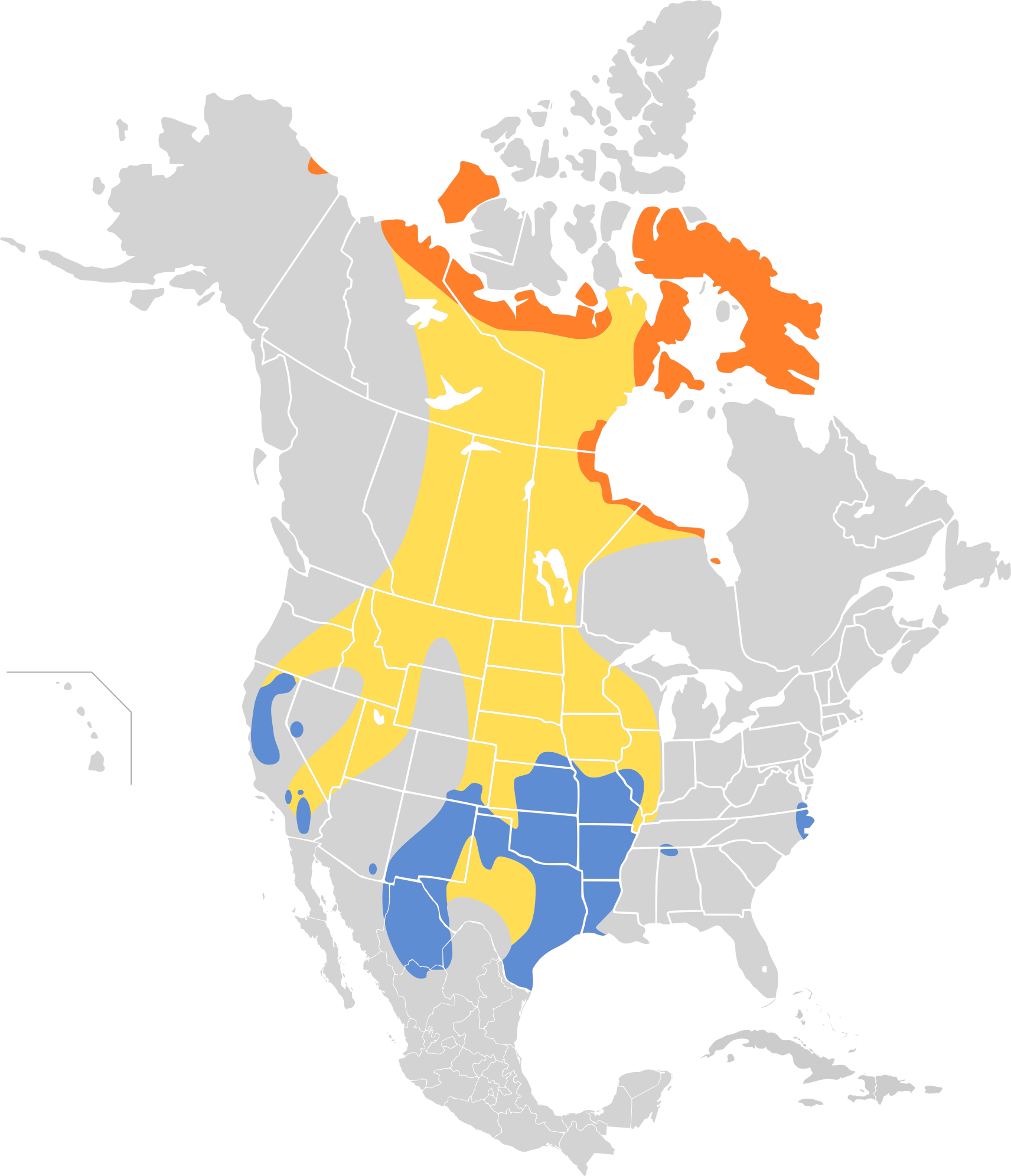
Range