Bird App
Bird of the day
Black-and-yellow broadbill
Eurylaimus ochromalus
The black-and-yellow broadbill (Eurylaimus ochromalus) is a species of bird in the typical broadbill family Eurylaimidae. A small, distinctive species, it has a black head, breastband, and upperparts, a white neckband, yellow streaking on the back and wings, and vinous-pink underparts that turn yellow towards the belly. The beak is bright blue, with a green tip to the upper mandible and black edges. It shows some sexual dimorphism, with the black breastband being incomplete in females.
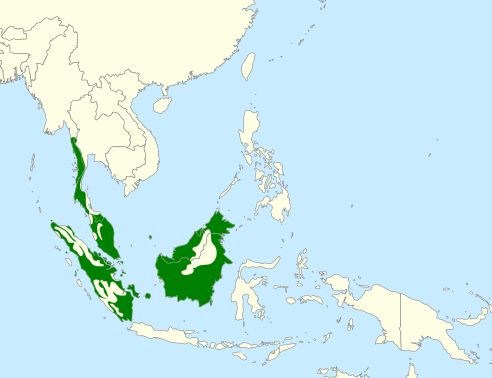
Native to Brunei, Indonesia, Malaysia, Myanmar, Singapore, and Thailand, it inhabits evergreen forest, dipterocarp forest, swamp forest, heath forest, and forest edge, along with secondary forest and plantations that contain large trees. Mainly inhabiting lowlands, the species is found up to elevations of 1,220 m (4,000 ft). The black-and-yellow broadbill is mainly insectivorous, but also feeds on molluscs and incidentally takes fruit.
The black-and-yellow broadbill breeds during the dry season throughout its range, with both sexes helping build a large, untidy, pear-shaped nest out of moss, fungal mycelia, and leaves. Eggs are laid in clutches of two or three, sometimes containing a fourth runt egg, and are incubated by both sexes. The species is listed as near-threatened by the IUCN because of a decline in its population caused by habitat loss.
The black-and-yellow broadbill is a small, distinctive species of typical broadbill that is 13.5–15 cm (5.3–5.9 in) long and weighs 31–39 g (1.1–1.4 oz). Males have black heads and upperparts with a white collar and black breastband, along with prominent yellow markings on the back and wings. The underparts are vinous-pink, fading to yellow towards the belly and undertail coverts (tail feathers that cover the underside of the base of the tail). The tail is black, with yellow spots on the middle feathers and whiter ones on the outer feathers. The iris is pale yellow, while the bill is bright blue, with a green tip to the upper mandible and black edges. The base of the bill lacks bristles, which are present in some other species of broadbills. The legs are reddish, with long tarsometatarsi. The species shows some sexual dimorphism, with females having a gap in the centre of the black breastband. Juveniles lack a well-defined breastband and have a pale yellow supercilium (a stripe running from the beak to above the eye) with grayish-white underparts.
Reddish colours in the plumage of the black-and-yellow broadbill are caused by the biological pigment 2,3-didehydro-papilioerythrinone, which is also present in the feathers of the banded broadbill, black-and-red broadbill, and Sarcophanops species. The yellow in the species' plumage is caused by the carotenoid 7,8-dihydro-3′-dehydro-lutein, which is also present in the plumage of the banded broadbill.
Like other typical broadbills, the black-and-yellow broadbill has a large, wide bill that is thought to have first evolved in the common ancestor of all broadbills as an adaptation to an insectivorous diet. Its large and fleshy tongue helps manipulate objects inside its beak, allowing it to mash food against the inside of the beak to "chew" it.
The black-and-yellow broadbill's song is a cicada-like bubbling trill that starts with a few sharp downslurred notes before rising in pitch and gradually speeding up into an 8–12 second long low, quivering trill. This song is similar to that of a banded broadbill, but is longer, accelerates more slowly, lacks an initial whistle, and ends suddenly. This song is given by a pair of birds, often calling alternately, while other individuals with the calling pair have been recorded giving a shrill, mournful peep. Other calls include a kor kor kor made by nesting males and a squeaky kyeeow.
Black-and-yellow broadbills have been also observed singing and counter-singing (singing in response to another bird) when close to other individuals, interspersing their songs with a throaty keowrr. The latter calls are also occasionally used during aggressive confrontations.
Aliases
Eurylaimus ochromalus
Range