 Bird App
Bird of the day
Black-legged kittiwake
Rissa tridactyla
The black-legged kittiwake (Rissa tridactyla) is a seabird species in the gull family Laridae. This species was first described by Carl Linnaeus in his landmark 1758 10th edition of Systema Naturae as Larus tridactylus. The English name is derived from its call, a shrill 'kittee-wa-aaake, kitte-wa-aaake'. In North America, this species is known as the black-legged kittiwake to differentiate it from the red-legged kittiwake, but in Europe, where it is the only member of the genus, it is often known just as kittiwake.
The adult is 37–41 cm (15–16 in) in length with a wingspan of 91–105 cm (36–41 in) and a body mass of 305–525 g (10.8–18.5 oz). It has a white head and body, grey back, grey wings tipped solid black, black legs and a yellow bill. Occasional individuals have pinky-grey to reddish legs, inviting confusion with red-legged kittiwake. The inside of their mouth is also a characteristic feature of the species due to its rich red colour. Such red pigmentation is due to carotenoids pigments and vitamin A which have to be acquired through their diet. Studies show that integument colour is associated with male's reproductive success. This hypothesis would explain the behaviour of couples greeting each other by opening their mouth and flashing their bright mouth it to their partner while calling. As their Latin name suggests, they only possess three toes since their hind toe is either extremely reduced or completely absent. In winter, the species acquires a dark grey smudge behind the eye and a grey hind-neck collar. The bill also turns a dusky-olive colour.
Kittiwakes are similar to most other gulls in their moulting pattern with one full moult and one partial moult each year. The full moult from summer to winter plumage though is very protracted, beginning as early as late May or June, and continuing through summer until completed by October, or rarely as late as the end of the year. Then in early spring, there is a partial moult (head and body feathers, but not the wing or tail feathers) from winter plumage to summer plumage in March to early April.
At fledging, the juveniles differ from the adults in having a black 'W' band across the length of the wings and whiter secondary and primary feathers behind the black 'W', a black hind-neck collar and a black terminal band on the tail. They can also be identified due to their solid black bill. This plumage is a hatch-year plumage and will only remain for their first year. Kittiwakes obtain their mature plumage at 4 years old, but will gradually change their juvenile plumage over time until maturity is reached. A second-year juvenile resembles a hatch-year regarding the plumage, though the bill is no longer solid black but instead has a greenish colour. The black marking on the coverts and the tail is still visible. The black marking will only moult during their third year, where the black is no longer present on the coverts, but the grey smudge on the head remains. A third-year bird will also exhibit a small zone of bright yellow/orange at the base of its mostly greenish bill. It is only at four years old that the bill will reach an overall colour of bright yellow and complete its mature plumage.
The old fisherman's name of "tarrock" for juvenile kittiwakes is still occasionally used.
The kittiwake is named after its call that resembles a long "kit-ti-wake". Apart from their typical call, kittiwakes have a wide array of calls. Their greeting call is used by the two members of a pair when meeting at the nest after an absence of one or both members. Before and during copulation, the female will often call by making a series of short high pitched "squeak". This call is also used by the female to beg for food from the male (courtship feeding). When predators are around, the kittiwake alarm call, an "oh oh oh oh" will be heard all across the colony. Kittiwake will call all day for various reasons and will only stop when the sun is down.
The red-legged kittiwake is the only other species in the genus Rissa and can be differentiated from its counterpart by its red legs, as the name suggests. The head of the red-legged kittiwake is slightly smaller and bears a shorter bill. The chicks of the Pacific black-legged kittiwake and red-legged kittiwake cannot be distinguished during their youngest downy phase.
Juvenile black-legged kittiwakes can be confused with juvenile little gull and both juvenile and adult Sabine's gull, although the kittiwakes' plumage has broader black 'W' on the wing, the primaries and a different pattern going across the coverts.
Aliases
Kittiwake, Rissa tridactyla
Range
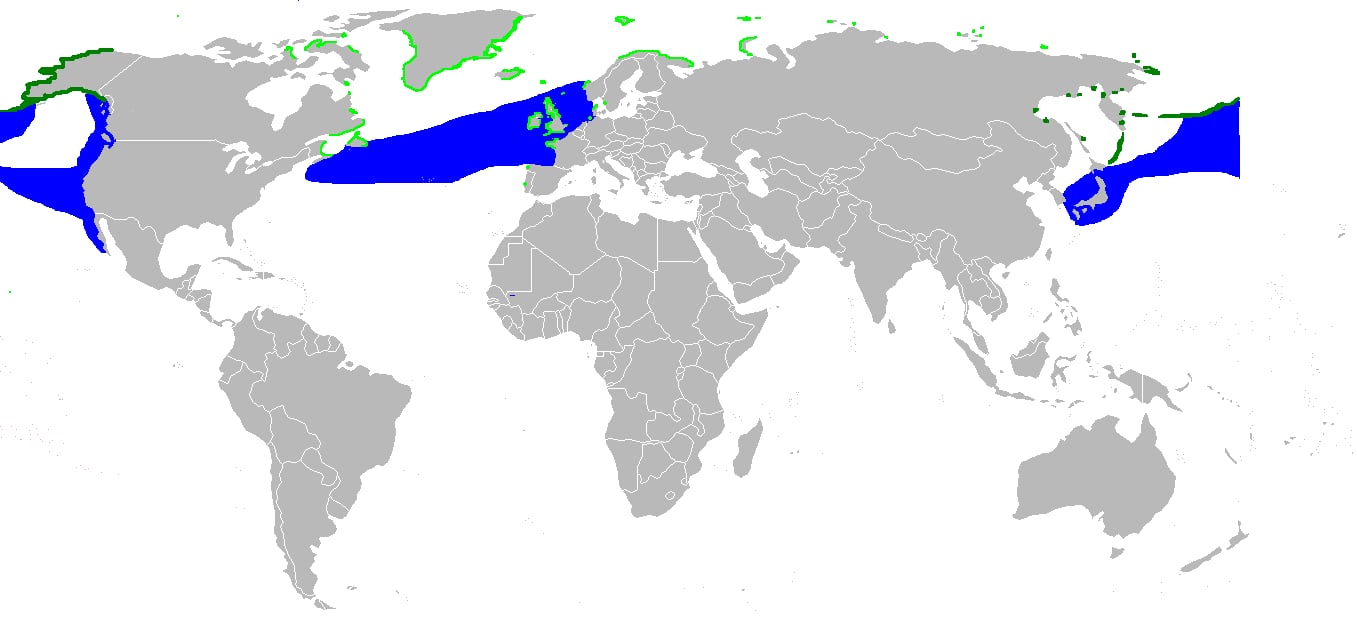
Data retrieved on October 15, 2025 at 5:49 AM