 Bird App
Bird of the day
Blue-headed hummingbird
Cyanophaia bicolor
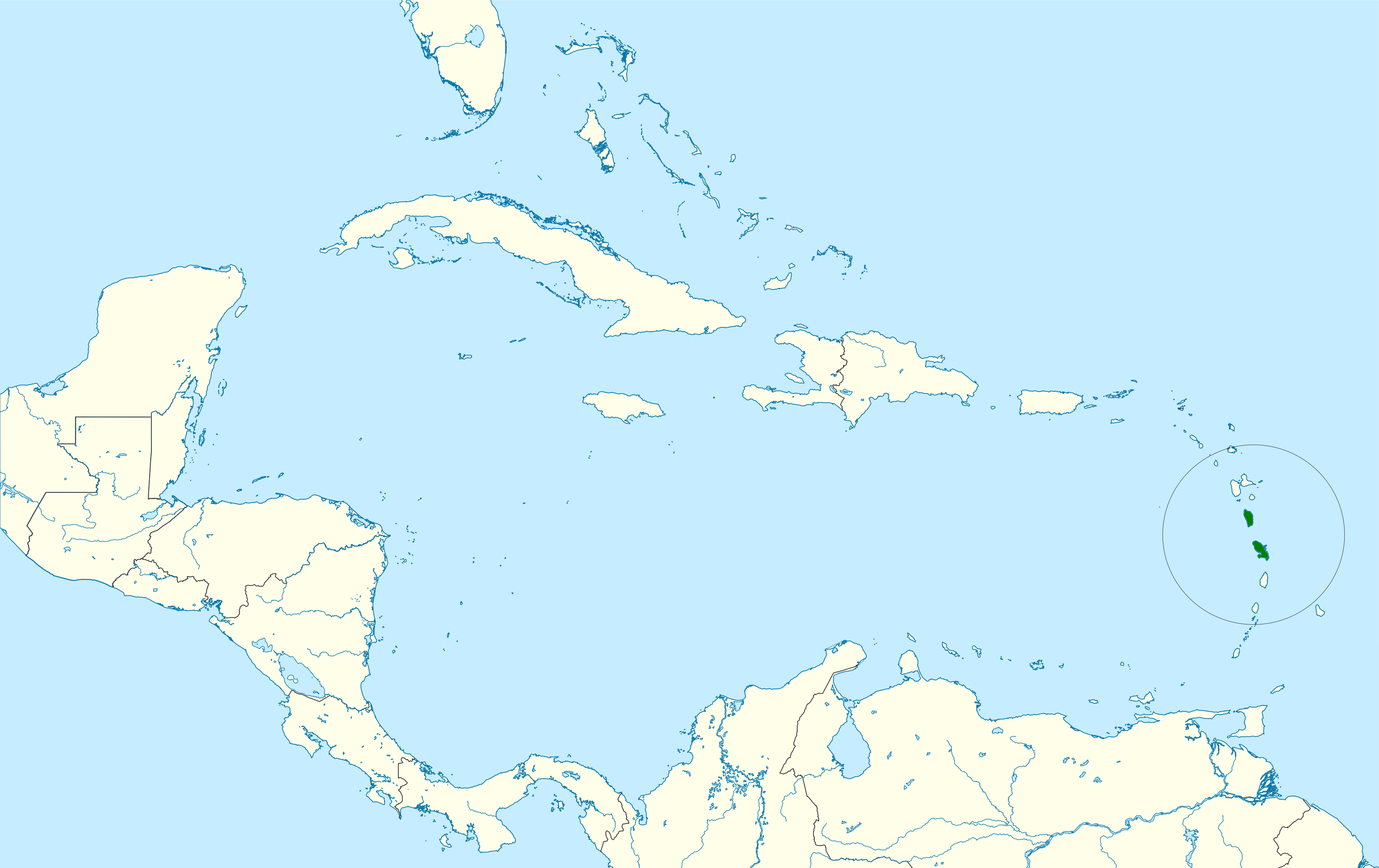
The blue-headed hummingbird (Riccordia bicolor) is a hummingbird of the genus Riccordia. It is exclusively found on the islands of Dominica and Martinique in the Lesser Antilles in forests along rivers. The males and females have distinct appearances; the female has a white front, and her back and wings are iridescent bronze-green colored. The male is entirely emerald of varying shades, with an especially blue head. The blue-headed hummingbird's behavior is typical of most hummingbirds, mostly feeding off of nectar. It nests from February to May in tree ferns, incubating a clutch of two white eggs for 16 to 18 days. It is a near-threatened species, with an estimated mature population of 25,000–150,000.
The blue-headed hummingbird is a medium-sized hummingbird at 9.4–9.9 cm in length and 3.9–4.7 g in weight. On average, the bill (measuring along the culmen) is 17 mm, each wing is 59 mm long, and the tail is 37.2 mm in length. Its iris is dark brown but may appear black due to lighting, and the skin around its eyes are dark gray. Its legs are slightly larger compared to other hummingbirds but are otherwise typical, small and weak. It is sexually dimorphic; the female is slightly smaller compared to the male, and each gender's plumage is different.
The female blue-headed hummingbird is iridescent; from behind she is a shiny, bronze-like green that appears indigo from certain angles. Her throat and neck are whitish. Her largest flight feathers (the primaries and secondaries) are black and lose their glossiness with wear. Her tail feathers (rectrices) have a detailed pattern: the center two feathers are the same metallic green as her back with darker fringes, but the remaining four feathers on both sides are dark green to black and terminate with a white or gray tip that become broader farther from the center, and the outermost two feathers on each side are especially broad, resulting in a stepped appearance. The underside of her tail feathers and her belly are gray with green spots on the fringes. The sides of her head and especially the area around her eyes are darker, and the top of her head is markedly more cyan compared to the rest of her body.
The male is strikingly different from the female. He is almost entirely an iridescent green-blue color of different shades, except for the feathers around his thighs, which are white to grayish. At certain angles (especially the back of the head, the lower back, the rump, and the breast) his feathers appear especially vivid and blue. His head and throat are a vivid azure, as is his tail feathers and underparts. His largest flight feathers are similar to that of the female but exaggerated, with a slight violet sheen when fresh. The underside of his wing is much duller in comparison, largely colored black, although the feathers nearest to the head (the underwing lesser and median coverts) are a much more vibrant bright green bronze.
The juvenile blue-headed hummingbird strongly resembles the adult, however, it is generally duller in color, its bill is shorter and not decurved, and its tail and wing feathers are smaller. The juvenile female's upperparts do not look as indigo from some angles, and her tail feathers have much whiter tips. Unlike the adult, who has an entirely black beak, the juvenile male's lower beak is a bright pink that may be tipped black. His tail feathers are also less azure and more of a dusky blue.
The blue-headed hummingbird is largely distinct in its range. A female blue-headed may look similar to the female Antillean crested hummingbird, which also has a white breast and chin with gray underparts; however it can be distinguished from the blue-crested by its shorter bill and eponymous crest. The male blue-crested hummingbird may look black in poor lighting, making it hard to distinguish from the male purple-throated and green-throated caribs, however, unlike the blue-crested hummingbird, the wings of the two caribs are usually much brighter than the rest of the body, their bills are longer with a downwards curve, and they are larger in size.
Aliases
Blue-headed Hummingbird
Range
Data retrieved on September 27, 2026 at 4:04 PM