 Bird App
Bird of the day
Stripe-backed bittern
Ixobrychus involucris
The stripe-backed bittern (Botaurus involucris) is a South American bird species belonging to the family Ardeidae, which includes Herons, Egrets and Bitterns. It was formerly placed in the genus Ixobrychus. Commonly found near freshwater swamps, marshes, lake shores and streams, stripe-backed bitterns span over a wide distribution that divides into the northern and southern populations, spanning on both sides of the Andes. Although increasingly recognized and researched worldwide, much life history details are lacking concerning this species, which remains understudied compared to its similar looking sister clade, including the least bittern (Botaurus exilis).
Stripe-backed bitterns are very small, averaging from 28 to 35 cm in length. Their pale brown back is ornamented with both black and yellowish-beige streaks, the latter also running along their broad wings. The colour patterns on their back complements the ones on their wings as to suppress obvious contrast between the two. Black stripes continue their way on the darker brown crown, while the underbelly is lighter brown and striped with white. As for the beak, the colour can differ from pale green to orange. This bittern species exhibits no sexual dimorphism, making it difficult to distinguish males from females. Furthermore, juveniles are not phenotypically described in the literature. Discriminating sex and age for this species has proved to be a challenge, so has the simple quest to even observe them in the wild. Stripe-backed bitterns tend to adopt an upright stance in which they "freeze" in place to observe their surroundings, making it more efficient to hunt their preys. When threatened, they respond by pointing their neck and bill skyward. This augments the difficulty to spot them easily. Following a solitary lifestyle, chances of finding them in groups are scarce but sights in pairs have been reported in the past.
The stripe-backed bittern is easily confused with the least bittern. The most striking difference consist of the contrast between the dark coloured, completely streak less back of the least bittern, compared to its patterned wings. Least bitterns also differ by the rufous coloration on the sides of their head, also present on the neck of females.
Aliases
Ixobrychus involucris
Range
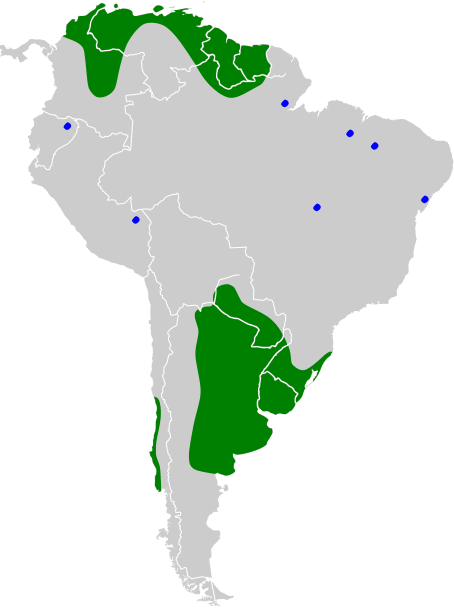
Data retrieved on October 15, 2025 at 5:37 AM