 Bird App
Bird of the day
Black-cowled oriole
Icterus prosthemelas
The black-cowled oriole (Icterus prosthemelas) is a species of bird in the family Icteridae. It is common and widespread in the Caribbean lowlands and foothills from southern Mexico to western Panama. It lives primarily in humid or semihumid forest, as well as in clearings, along forest edges, in plantations, in semi-open areas with scattered trees and bushes, and in gardens. The adult male is black, with yellow on the belly, shoulder, rump, wing lining, and crissum. The female's plumage varies depending on location. In the south of its range, it is similar to that of the male. In the north, its crown and upperparts are olive-yellow, while its face, throat, upper breast, wings, and tail are black.
It forages mostly at mid-levels, and its diet includes a mix of arthropods, nectar and fruit. The female lays three eggs in a shallow pendent nest, which is stitched to the underside of a large leaf. Both parents defend the nest, and brood and feed the young. Due to its very large range and apparently stable population, it is considered by the International Union for Conservation of Nature to be a species of least concern.
First described by Hugh Strickland in 1850, the black-cowled oriole has at times been considered conspecific with several oriole species from the Greater Antilles. There are two subspecies, I. p. prosthemelas and I. p. praecox, which differ in their juvenile plumage.
The black-cowled oriole is a medium-sized passerine, ranging in length from 18.5 to 21 cm (7.3 to 8.3 in). Males are larger and heavier than females, averaging 32.5 g (1.15 oz) while females average only 27.5 g (0.97 oz). In the north of the range, males and females are sexually dimorphic, while in the south, their plumages are similar. In both sexes, the bill is slender, slightly decurved, and black, with a silvery base to the lower mandible. The adult male's plumage is mostly black, with bright yellow patches on the shoulder, rump, and uppertail coverts. The wing lining, lower breast, thighs, and crissum are completely yellow, with a narrow wash of chestnut between the black and yellow on the breast. Where the female's plumage differs, she has a black face, throat and upper breast, with an olive-yellow crown and upperparts. Some females, particularly further south in the range, show a mix of black and yellow feathers on the head and back, while others have entirely black heads, and still others fully resemble males. Both sexes have blue-gray legs and feet, and brown eyes.
The immature of I. p. praecox is dull yellow-olive above and dull yellow below; the feathers on its back have black bases, which sometimes show through. Its face, forehead and throat are matte black, as are its wings and tail. This plumage is retained for a year, though individual, heavily worn, feathers may be replaced.
The bird's song is a fairly quiet, complicated series of soft, whistled notes and harsher chattering. These are described as being variously clear, metallic, slurred and mellow, and are delivered in an apparently random order. Its calls include a scratchy, rising weet, a nasal deep, a nasal eeaahnk, a quiet tee-u, and a sharper beehk or bihk. When alarmed, it gives a scolding series of sharp cherp and chep notes, variously transcribed as cheh-cheh-cheh-chek and churr'churr'churr, sometimes interspersed with snatches of song.
The juvenile black-cowled oriole resembles both the yellow-tailed oriole and the juvenile orchard oriole, but can be distinguished by its completely black tail and its lack of wing bars. It is larger than an orchard oriole and much smaller than a yellow-tailed oriole. Though the black-cowled oriole looks similar to the black-vented oriole, the two species are allopatric and live in different habitats; the black-vented oriole is found in dry highlands. The black-vented oriole is larger, bulkier, and longer-tailed, with a black crissum, an orangey-yellow belly, and a longer, straighter beak. Immature birds show less black on the face than do immature black-cowled orioles. Female and immature black-cowled orioles can be confused with the yellow-backed oriole, but that species is brighter yellow on the head and back, with less black on the face, and a stouter, straighter bill. Females and immatures also resemble the female bar-winged oriole, but that species is probably allopatric (found only on the Pacific slope), and typically has less dark wings and tail, and a pale wing bar. Audubon's oriole, which is seldom found in the same habitat or range, is larger, with a heavier, straight beak and tertials which are edged in white in fresh plumage.
Aliases
Icterus prosthemelas
Range
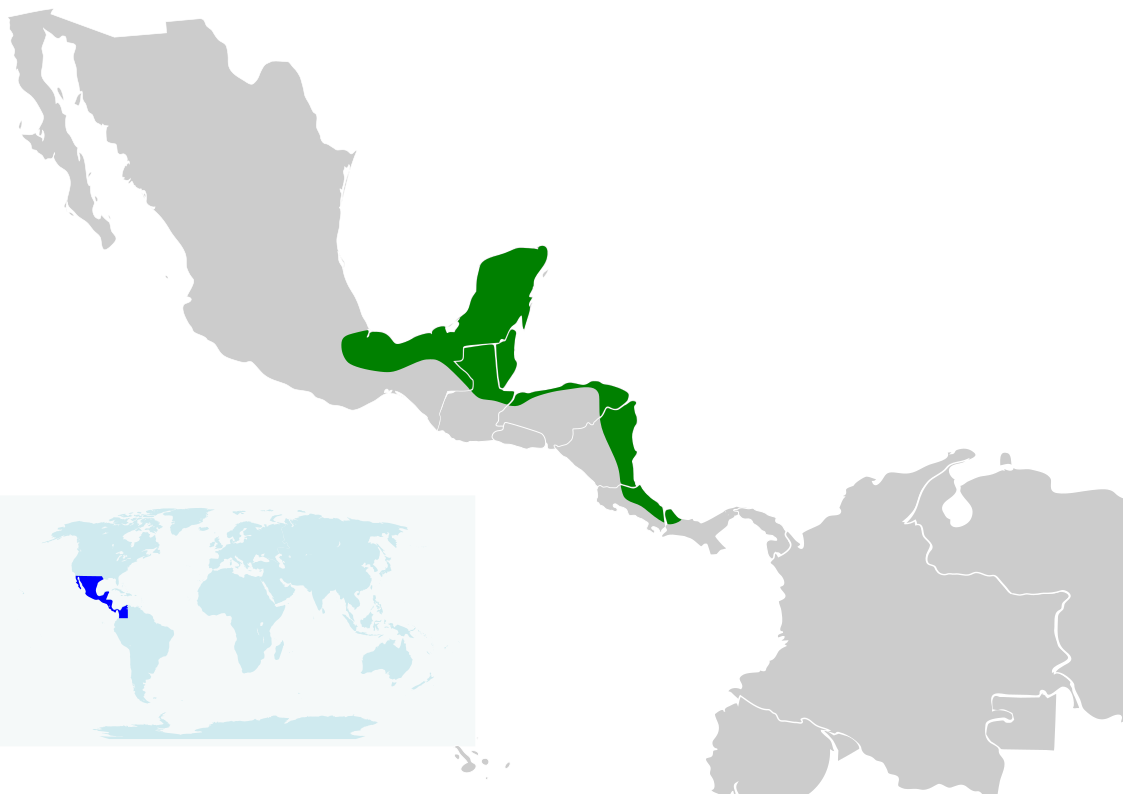
Data retrieved on October 15, 2025 at 5:34 AM