 Bird App
Bird of the day
Great spotted woodpecker
Dendrocopos major
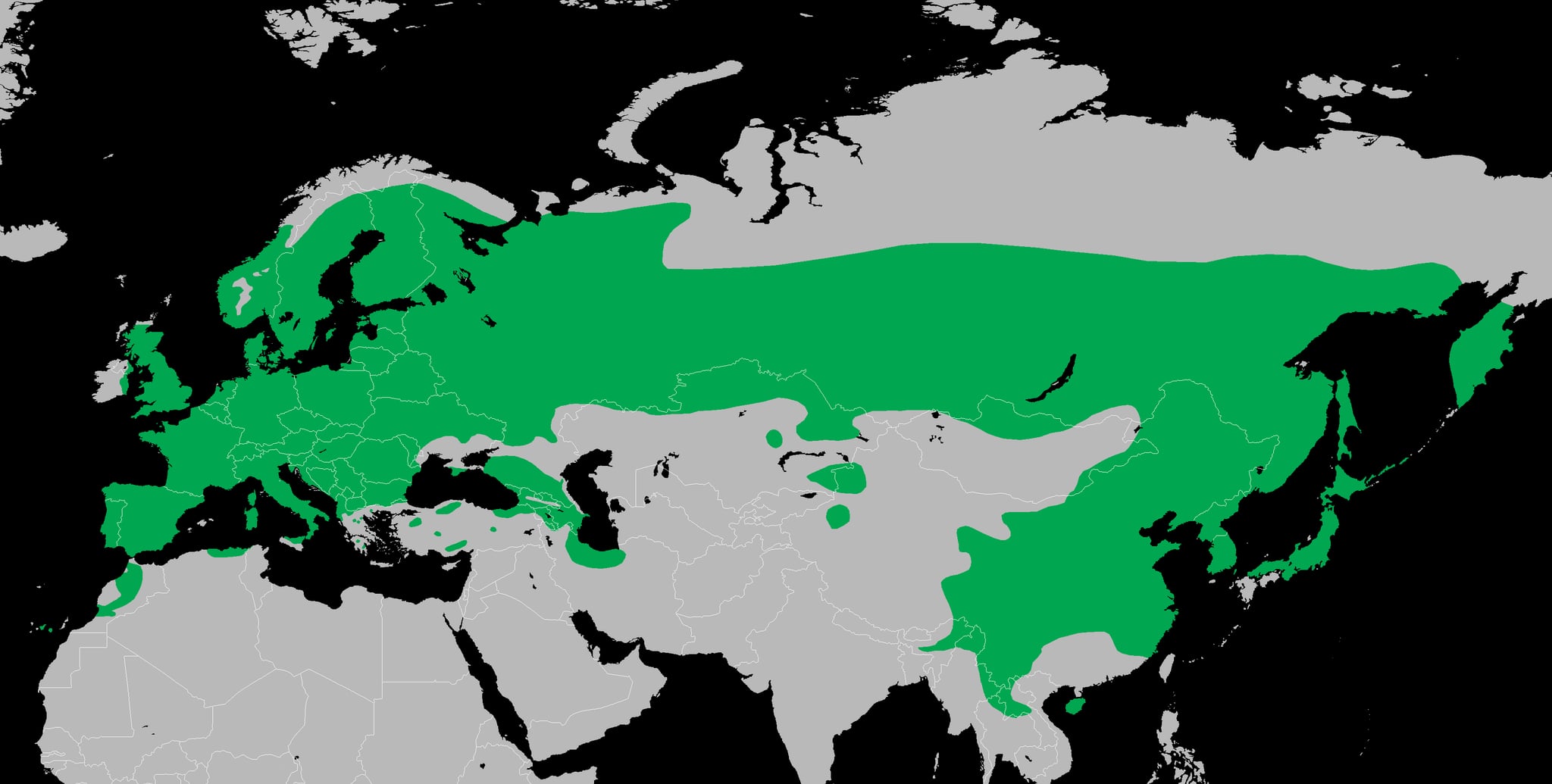
The great spotted woodpecker (Dendrocopos major) is a medium-sized woodpecker with pied black and white plumage and a red patch on the lower belly. Males and young birds also have red markings on the neck or head. This species is found across the Palearctic including parts of North Africa. Across most of its range it is resident, but in the north some will migrate if the conifer cone crop fails. Some individuals have a tendency to wander, leading to the recolonisation of Ireland in the first decade of the 21st century and to vagrancy to North America. Great spotted woodpeckers chisel into trees to find food or excavate nest holes, and also drum for contact and territorial advertisement; like other woodpeckers, they have anatomical adaptations to manage the physical stresses from the hammering action. This species is similar to the Syrian woodpecker.
This woodpecker occurs in all types of woodlands and eats a variety of foods, being capable of extracting seeds from pine cones, insect larvae from inside trees or eggs and chicks of other birds from their nests. It breeds in holes excavated in living or dead trees, unlined apart from wood chips. The typical clutch is four to six glossy white eggs. Both parents incubate the eggs, feed the chicks, and keep the nest clean. When the young fledge they are fed by the adults for about ten days, each parent taking responsibility for feeding part of the brood.
The species is closely related to some other members of its genus. It has a number of subspecies, some of which are distinctive enough to be potential new species. It has a huge range and large population, with no widespread threats, so it is classed as a species of least concern by the International Union for Conservation of Nature (IUCN).
An adult great spotted woodpecker is 20–24 cm (7.9–9.4 in) long, weighs 70–98 g (2.5–3.5 oz) and has a 34–39 cm (13–15 in) wingspan. The upperparts are glossy blue-black, with white on the sides of the face and neck. Black lines run from the shoulder to the nape, the base of the bill and about halfway across the breast. There is a large white shoulder patch and the flight feathers are barred with black and white, as is the tail. The underparts are white other than a scarlet lower belly and undertail. The bill is slate-black, the legs greenish-grey and the eye is deep red. Males have a crimson patch on the nape, which is absent from the otherwise similar females. Juvenile birds are less glossy than adults and have a brown tinge to their upperparts and dirty white underparts. Their markings are less well-defined than the adult's and the lower belly is pink rather than red. The crown of the juvenile's head is red, less extensively in young females than males.
The various subspecies differ in plumage, the general pattern being that northern forms are larger, heavier-billed and whiter beneath, as predicted by Bergmann's rule, so north Eurasian D. m. major and D. m. kamtschaticus are large and strikingly white, whereas D. m. hispanicus in Iberia and D. m. harterti in Corsica and Sardinia are somewhat smaller and have darker underparts. D. m. canariensis and D. m. thanneri in the Canary Islands are similar to the Iberian race but have contrasting white flanks. In Morocco, D. m. mauritanus is pale below with red in the centre of its breast, and birds breeding at higher altitudes are larger and darker than those lower in the hills. D. m. numidus in Algeria and Tunisia is very distinctive, with a breast band of red-tipped black feathers. Caspian D. m. poelzami is small, relatively long-billed and has brown underparts. D. m. japonicus of Japan has less white on its shoulders but more in its wings. The two Chinese forms, D. m. cabanisi and D. m. stresemanni, have brownish heads and underparts, and often some red on the breast. Both races have increasingly dark underparts towards the south of their respective ranges.
Some other species in its genus are similar to the great spotted woodpecker. The Syrian woodpecker lacks its relative's black cheek bar and has whiter underparts and paler red underparts, although juvenile great spotted woodpeckers often have an incomplete cheek bar, so can potentially be misidentified as Syrian. The white-winged woodpecker has a far more extensive white wing patch than the great spotted woodpecker. The Sind woodpecker is very similar to the Syrian species, and can be distinguished from great spotted woodpecker in the same way.
Adult great spotted woodpeckers have a complete moult after the breeding season which takes about 120 days. Northern D. m. major starts its moult from mid-June to late July and finishes in October or November, temperate races like D. m. pinetorum are earlier, commencing in early June to mid-July and completing in mid-September to late October, and southern D. m. hispanicus starts late May or June and finishes as early as August. Juveniles have a partial moult, retaining some of the wing coverts but replacing body, tail and primary feathers. This moult to near-adult plumage starts from late May to early August and finishes from mid-September to late November, timing varying with latitude as with the adults.
The call of the great spotted woodpecker is a sharp kik, which may be repeated as a wooden rattling krrarraarr if the bird is disturbed. The courtship call, gwig, is mostly given in the display flight. Drumming on dead trees and branches, and sometimes suitable man-made structures, serves to maintain contact between paired adults and to advertise ownership of territory.
Both sexes drum, although the male does so much more often, mostly from mid-January until the young are fledged. The far-carrying drumming is faster than for any other woodpecker in its range at around 10–16 strikes per second, typically in one-second bursts, although repeated frequently. As late as the early twentieth century it was thought that the drumming might be a vocalisation, and it was not until 1943 that it was finally proved to be purely mechanical.
Aliases
Dendrocopos major, Picoides major, GSW
Range
Data retrieved on October 15, 2025 at 5:14 AM