 Bird App
Bird of the day
Solitary sandpiper
Tringa solitaria
The solitary sandpiper (Tringa solitaria) is a small shorebird. The genus name Tringa is the Neo-Latin name given to the green sandpiper by Aldrovandus in 1599 based on Ancient Greek trungas, a thrush-sized, white-rumped, tail-bobbing wading bird mentioned by Aristotle. The specific solitaria is Latin for "solitary" from solus, "alone".
This species measures 18–23 cm (7.1–9.1 in) long, with a wingspan up to 50 cm (20 in) and a body mass of 31–65 g (1.1–2.3 oz). It is a dumpy wader with a dark green back, greyish head and breast and otherwise white underparts. It is obvious in flight, with wings dark above and below, and a dark rump and tail centre. The latter feature distinguishes it from the slightly larger and broader-winged, but otherwise very similar, green sandpiper (T. ochropus) of Europe and Asia, to which it is closely related. The latter species has a brilliant white rump. In flight, the solitary sandpiper has a characteristic three-note whistle. They both have brown wings with little light dots, and a delicate but contrasting neck and chest pattern. In addition, both species nest in trees, unlike most other scolopacids.
Aliases
Tringa solitaria
Range
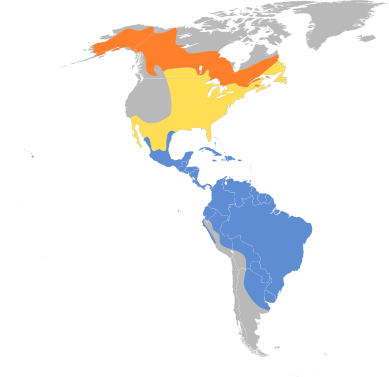
Data retrieved on October 15, 2025 at 5:06 AM