 Bird App
Bird of the day
Invisible rail
Habroptila wallacii
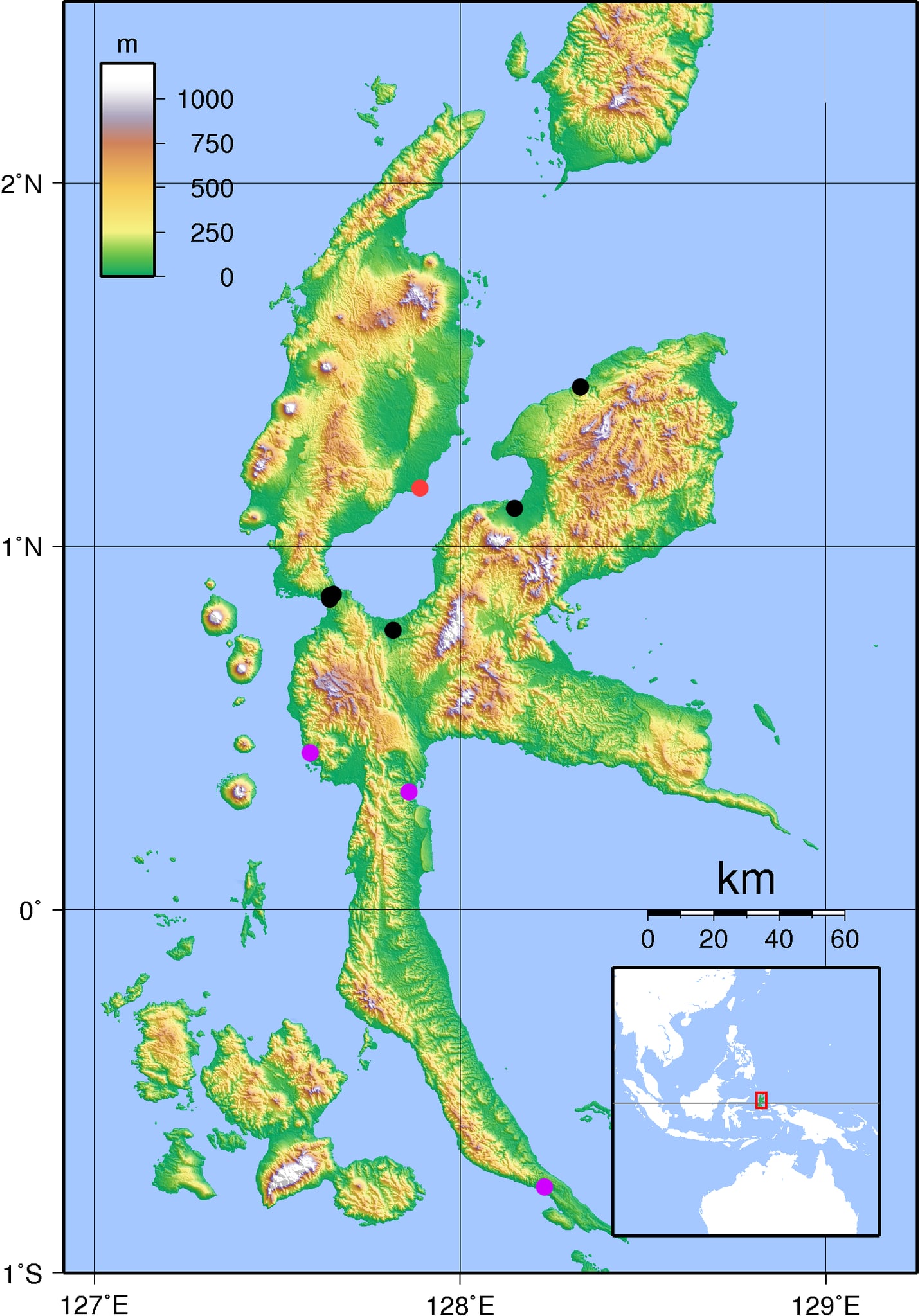
The invisible rail, Wallace's rail, or drummer rail (Habroptila wallacii) is a large flightless rail that is endemic to the island of Halmahera in Northern Maluku, Indonesia, where it inhabits impenetrable sago swamps adjacent to forests. Its plumage is predominantly dark slate-grey, and the bare skin around its eyes, the long, thick bill, and the legs are all bright red. Its call is a low drumming sound which is accompanied by wing-beating. The difficulty of seeing this shy bird in its dense habitat means that information on its behaviour is limited.
Recorded dietary items include sago shoots and insects, and it also swallows small stones to help break up its food. It is apparently monogamous, but little else is known of its courtship behaviour. The only known nest was a shallow bowl in the top of a rotting tree stump that was lined with wood chips and dry leaves. The two young chicks were entirely covered in black down typical of precocial newly hatched rails. The estimated population of 3,500–15,000 birds and the restricted range mean that the invisible rail is classified as vulnerable by the International Union for Conservation of Nature (IUCN). Habitat loss has occurred through the harvesting of sago and conversion of the wetlands to rice cultivation, and the rail is eaten by local people. The described nest was in an area frequented by local villagers, so the rail may be more adaptable to habitat changes than had been thought.
The invisible rail is a large, 33 to 40 cm (13–16 in) long, flightless bird. The adult has a mainly dark slate-grey body, dark brown plumage on the lower back, rump and wings, and a black uppertail. Its underparts are slightly paler slate-grey than the back, and the bare skin around the eye, the long, thick bill and the strong legs are bright red. It has a small spine at the bend of the wings. The sexes are identical in appearance; the plumage of fledged immature birds has not been described.
The invisible rail is superficially similar to the purple swamphen, Porphyrio porphyrio, which has recently been found in Halmahera, but that species is larger, with a short, thick red bill and a red forehead shield; it also has purple underparts and a white undertail. The invisible rail is different from the Calayan rail, Gallirallus calayanensis, in that it is larger and lacks the barred plumage of that species; there is no overlap between the ranges of the two species.
The call is a low drumming, accompanied by a tuk, tuk, tuk made with the wings. The nature of the vocalisation led to a local legend that the sound is made by the bird beating on a hollow tree or branch with its feet. Gerd Heinrich noted the local name "soisa", meaning drum, and described the call as being a subdued drumming purre – purre – purre – purre – purre which sometimes ends in a loud shrill scream. The bird also produced a dull hum similar to the voice of the banded pig (Sus scrofa vittatus) and reminiscent of the call of the snoring rail (Aramidopsis plateni). Calling is most frequent in the early morning or late evening, and a human tapping a sago stem with a machete may elicit a response from the bird. A quieter version of the call is given at the nest.
Other sounds attributed to this rail, such as loud screams, may be incorrect, since they are like those produced by the pale-vented bush-hen (Amaurornis moluccana).
Aliases
Wallace's rail, Habroptila wallacii, Rallus wallaci, Drummer Rail
Range
Data retrieved on October 14, 2025 at 9:17 PM