Bird App
Bird of the day
Red-tailed black cockatoo
Calyptorhynchus banksii
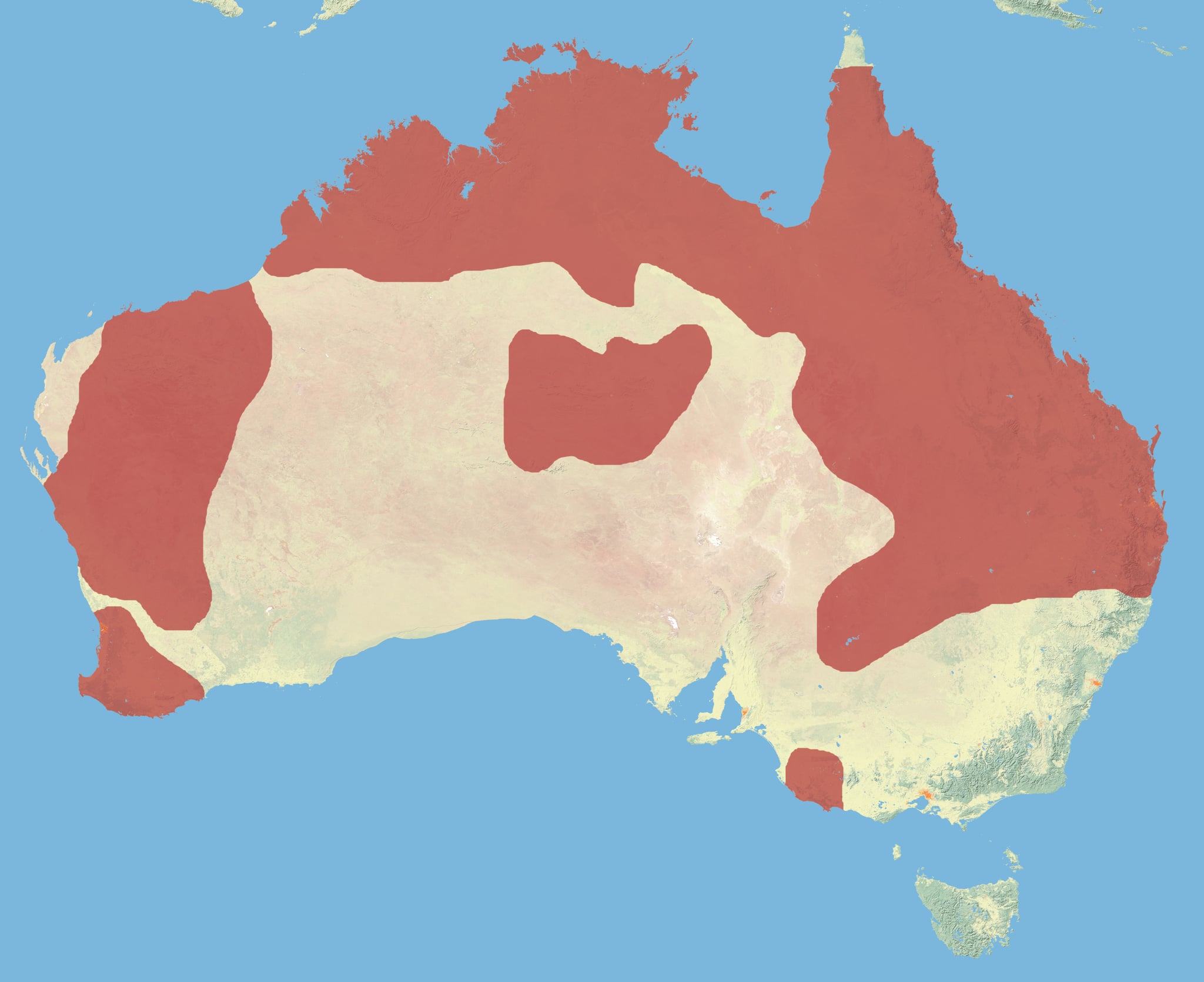
The red-tailed black cockatoo (Calyptorhynchus banksii) also known as Banksian- or Banks' black cockatoo, is a large black cockatoo native to Australia. Adult males have a characteristic pair of bright red panels on the tail that gives the species its name. It is more common in the drier parts of the continent. Five subspecies are recognised, differing chiefly in beak size. Although the more northerly subspecies are widespread, the two southern subspecies, the forest red-tailed black cockatoo and the south-eastern red-tailed black cockatoo are under threat.
The species is usually found in eucalyptus woodlands, or along water courses. In the more northerly parts of the country, these cockatoos are commonly seen in large flocks. They are seed eaters and cavity nesters, and as such depend on trees with fairly large diameters, generally Eucalyptus. Populations in southeastern Australia are threatened by deforestation and other habitat alterations. Of the black cockatoos, the red-tailed is the most adaptable to aviculture, although black cockatoos are much rarer and much more expensive in aviculture outside Australia.
Red-tailed black cockatoos are around 60 centimetres (24 in) in length and sexually dimorphic. The male's plumage is all black with a prominent black crest made up of elongated feathers from the forehead and crown. The bill is dark grey. The tail is also black with two lateral bright red panels. Females are black with yellow-orange stripes in the tail and chest, and yellow grading to red spots on the cheeks and wings. The bill is pale and horn-coloured. The underparts are barred with fine yellow over a black base. Male birds weigh between 670 and 920 grams (1.48 and 2.03 lb), while females weigh slightly less at 615–870 grams (1.356–1.918 lb). In common with other cockatoos and parrots, red-tailed black cockatoos have zygodactyl feet, two toes facing forward and two backward, that allow them to grasp objects with one foot while standing on the other, for feeding and manipulation. Black cockatoos are almost exclusively left-footed (along with nearly all other cockatoos and most parrots).
Juvenile red-tailed black cockatoos resemble females until puberty, which occurs around four years of age, but have paler yellow barred underparts. As the birds reach maturity, males gradually replace their yellow tail feathers with red ones; the complete process takes around four years.
As with other cockatoos, the red-tailed black cockatoo can be very long-lived in captivity; in 1938, ornithologist Neville Cayley reported one over fifty years old at Taronga Zoo. Another bird residing at London and Rotterdam Zoos was 45 years and 5 months of age when it died in 1979.
Several calls of red-tailed black cockatoos have been recorded. The bird's contact call is a rolling metallic krur-rr or kree, which may carry long distances and is always given while flying; its alarm call is sharp. Displaying males vocalize a sequence of soft growling followed by a repetitive kred-kred-kred-kred.
Aliases
Calyptorhynchus banksii, Banks' black cockatoo, Banksian black cockatoo, forest red-tailed black cockatoo, south-eastern red-tailed black cockatoo
Range