Nov 12

Bird of the day

Chestnut-sided shrike-vireo

Vireolanius melitophrys

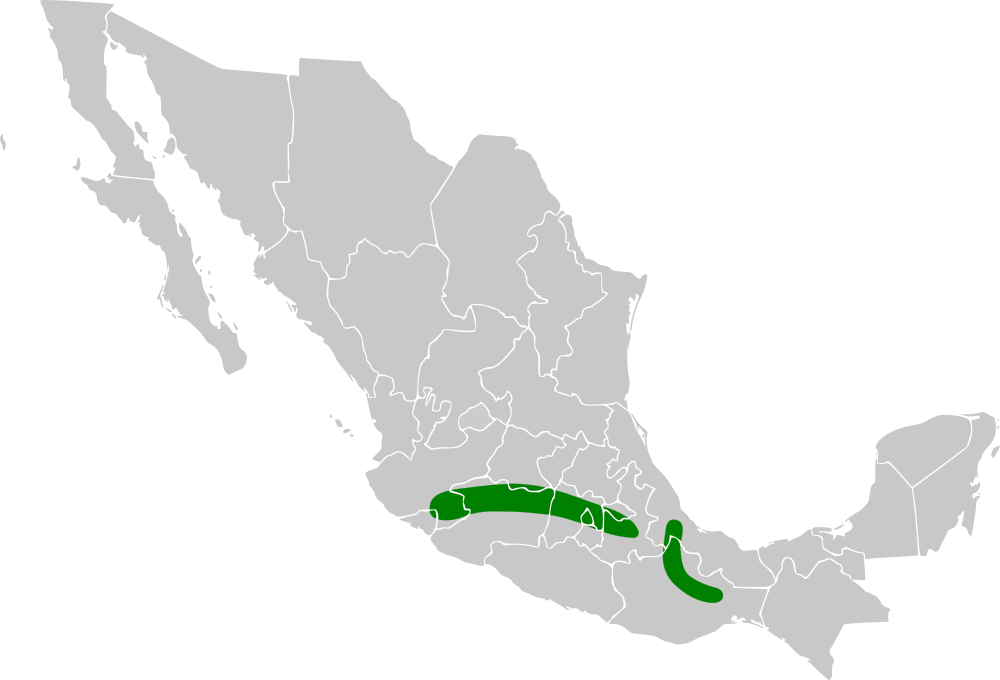
The chestnut-sided shrike-vireo (Vireolanius melitophrys), sometimes called the honey-browed shrike-vireo, is a species of bird in the family Vireonidae, and probably the largest member of the entire family. A widespread species of subtropical and tropical moist montane forests, this species is found from Jalisco and San Luis Potosí, Mexico in the north to southern Guatemala.

One of the largest species in Vireonidae, with a length of 16.5 to 18 cm (6.5 to 7.1 in) and a mean body mass of 34.7 g (1.22 oz). Sexes are of similar sizes. Only one other population of Vireonid reaches this size - the Cozumel rufous-browed peppershrike Cyclarhis gujanensis insularis.

A striking bird, adult chestnut-sided shrike-vireos have bright green backs and largely white undersides punctuated by their eponymous chestnut flanks that meet in a chest band. The head is characterized by a slate crown and nape, golden-yellow eyebrows that sometimes reach the lores at the bill base, black eyelines that are thin near the bill and thickest where they meet the gray nape, white cheeks, thin black malars, and a white throat. The legs are pink, and irides are yellow. Chestnut-sided shrike vireos are sexually dimorphic, unlike most species of Vireonid which are monomorphic (with the exception of the black-capped vireo Vireo atricapillus). Females can be separated from the males by their paler plumage and reduced chestnut coloration.

The song is a complex, multi-pitched single-syllable whistle that quickly ascends in pitch with multiple harmonics before a longer, less harmonized descent, often given in repeated succession with pauses between whistles generally lasting between 0.7–1 seconds. Calls consist of a hoarse chatter, similar to many other species of Vireonid. A relatively difficult to observe species, vocalizations have proven to be one of the best ways to detect chestnut-sided shrike-vireos, with songs audible up to 400 metres (1,300 ft) away.

Six primary vocalizations have been described by Barlow & James:

Aliases

Vireolanius melitophrys, Vireolanius militophrys, Chestnut-sided shrike vireo

Range

Range map of Chestnut-sided shrike-vireo