Bird App
Bird of the day
Mountain trogon
Trogon mexicanus
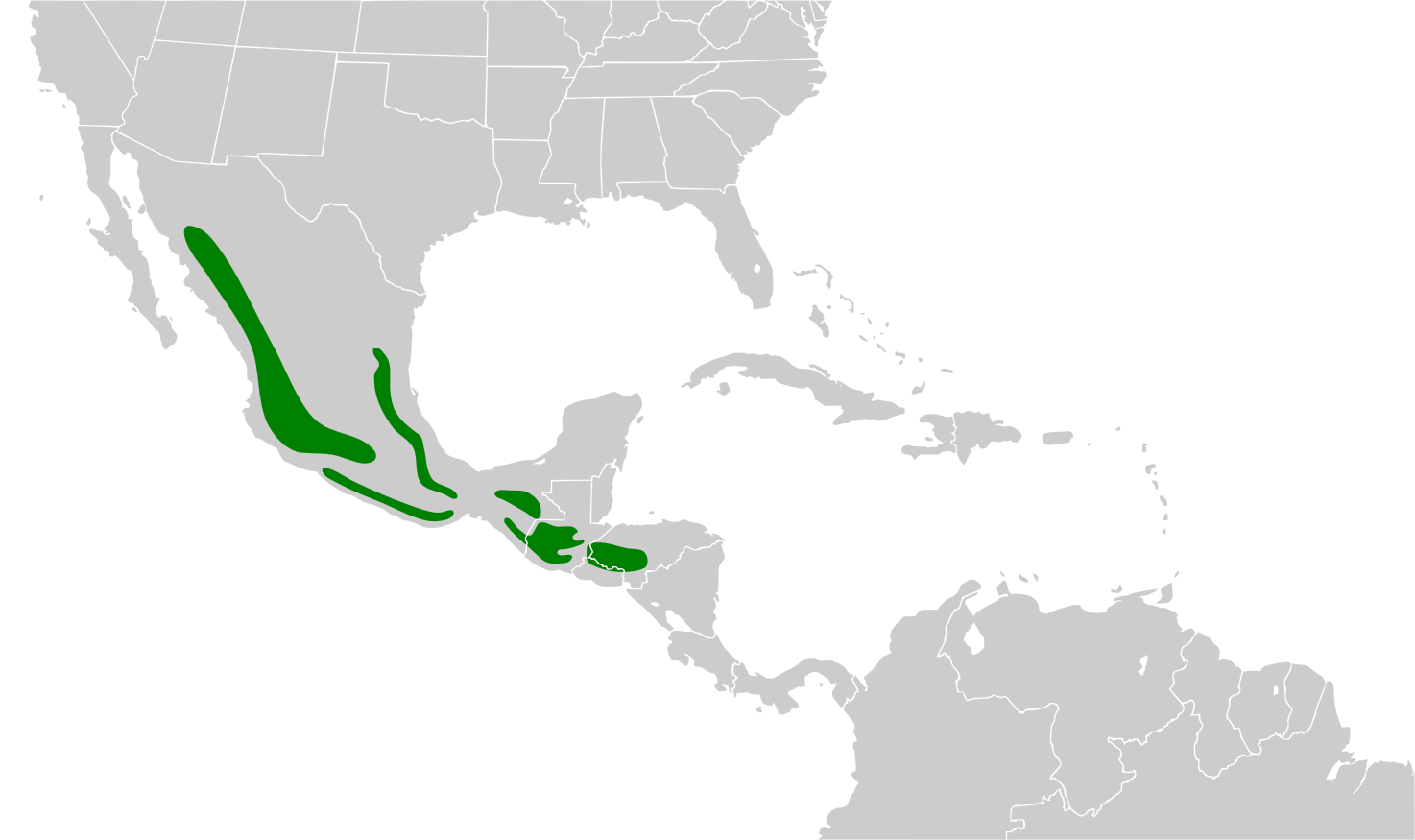
The mountain trogon (Trogon mexicanus), also known as the Mexican trogon, is a species of bird in the family Trogonidae. First described by William Swainson in 1827, it is resident in Guatemala, Honduras, and Mexico and has occurred in El Salvador as a vagrant. Like all trogons, the mountain trogon is sexually dimorphic. The male is metallic green on the crown, nape, upperparts and chest, the latter separated from its bright red belly and vent by a narrow band of white. The female is warm brown on the head, upperparts and chest, separated from its paler brown lower chest and red belly and vent by a narrow white band.
Its natural habitat is subtropical and tropical moist montane forests. It prefers pine-evergreen and pine-oak woodland between 3,000 and 10,000 ft (914 and 3,048 m) in elevation. Unlike some rarer trogons, this species shows some adaptability to human land use and has utilized coffee plantations with suitable shade trees like oaks.
The mountain trogon measures 11.5–12.5 in (29–31.5 cm) in length. It weighs between 61.5 and 85 g (2.2 and 3.0 oz), with a mean of 71 g (2.5 oz). Like all trogons, it is sexually dimorphic. The adult male is green on the crown, nape and upperparts; the upper side of its tail is bluish-green, with black tips to the rectrices. His face and throat are blackish, with an orange-red orbital ring and a bright yellow bill. He is green on the chest and red on the belly and undertail; the two colors are separated by a narrow band of white. The underside of his tail is black with three large white blocks created by white tips to the outer rectrices. His primaries are blackish, with black and white vermiculations on the wing coverts. The female is warm brown on her head and upperparts; her tail is rufous-brown on the upperside, with black tips to the rectrices. She has a small white crescent in front of her eye and a bold white crescent behind her eye. Her bill is dark above. Her chest is warm brown, separated from her brown lower chest and red belly by a narrow band of white. Her undertail is black and white; the outer webs of the rectrices are barred black and white, while the inner webs are black, broadly tipped with white. Her primaries are blackish with white outer webs, which form white streaks along her folded wing. Her wing coverts are pale brown, with dusky vermiculations.
There are several species with which the mountain trogon might be confused; they differ primarily in the color and patterning on their tails. The male elegant trogon's tail is copper-colored (rather than green) above and finely vermiculated black and white (rather than all black) below, while the female has a white patch behind and below her eye. The male collared trogon is golden-green on the back and uppertail, and its undertail is black with narrow white barring. The female collared trogon's tail is grayish below with a narrow dark bar at the tip of each rectrice.
Aliases
Trogon mexicanus
Range