Aug 23

Bird of the day

White-rumped sandpiper

Calidris fuscicollis

The white-rumped sandpiper (Calidris fuscicollis) is a small shorebird that breeds in the northern tundra of Canada and Alaska. This bird can be difficult to distinguish from other similar tiny shorebirds; these are known collectively as "peeps" or "stints".

These birds are not often spotted. In the summer, they are rarely seen because they are in such an obscure breeding location. Similarly, in the winter they are rarely seen because they travel too far south for many birdwatchers. Therefore, the majority of sightings occur during the spring or fall in temperate regions and are generally in small numbers around water.

The white-rumped sandpiper is a relatively small bird measuring only 7.8 in (20 cm). The top of its body is a dull grey-brown color and it has a white eye stripe. Its beak is of medium length, thin and dark, and its legs are very dark. This bird is often mistaken with many similar-looking sandpipers that live in its range or along its migration path.

The plumage is much less distinct during the winter; however, during all seasons males and females remain similar in their appearance. In adult alternate plumage, the crown and face have a brownish tinge. The supercilium is pale, there are black feathers on the back and there are grey edges on the wing coverts. The breast and flanks are streaked and the underparts are white. In adult basic plumage, the upperparts are a dark grey and at the centers there are black feathers. The underparts are white but the breast is dark grey. The supercilium is white, while the crown and eyeline are darker. The juvenile plumage features black-based feathers on the back and wing coverts. These have brown edges towards the scapulars and whiter edges towards the wing coverts. The breast is finely streaked and there is a white "V" on its back. The underparts and supercilium are white, the crown is brownish in color, and the face is pale

The two primary features used to identify this bird in the field are its long wings and its white rump. The white patch on the rump can be seen while the bird is in flight. Its long wings extend beyond the tail by about a quarter inch. Baird's sandpiper also shows this trait but can be distinguished by the lack of a white rump. There is also a thin white stripe on the wing and a row of marks on the flanks below the wings.

Aliases

Calidris fuscicollis

Range

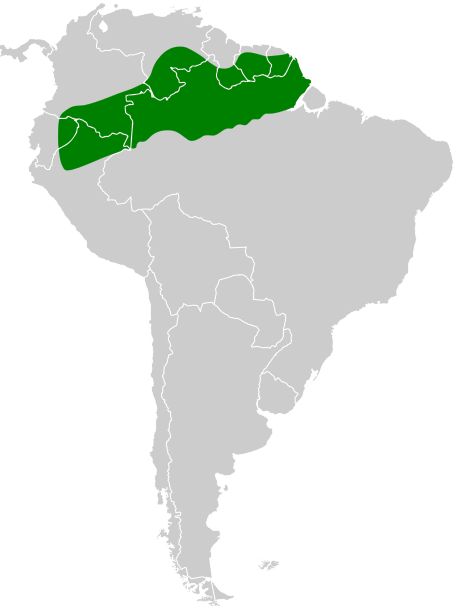
Range map of Hudsonian godwit