Bird of the day
Osprey
Pandion haliaetus
The osprey (; Pandion haliaetus), historically known as sea hawk, river hawk, and fish hawk, is a diurnal, fish-eating bird of prey with a cosmopolitan range. It is a large raptor, reaching more than 60 cm (24 in) in length and a wingspan of 180 cm (71 in). It is brown on the upperparts and predominantly greyish on the head and underparts.
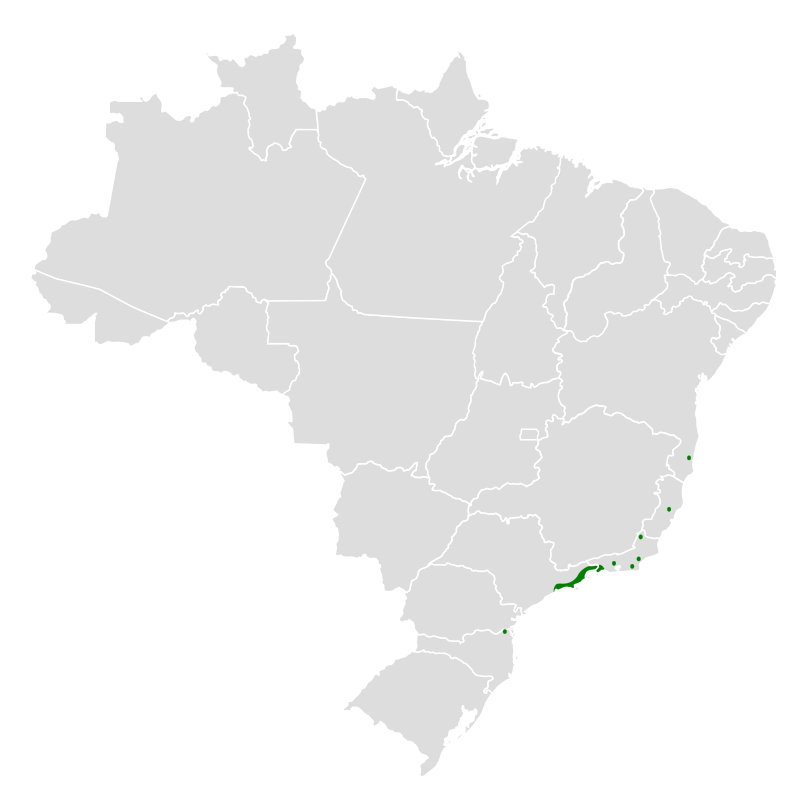
The osprey tolerates a wide variety of habitats, nesting in any location near a body of water providing an adequate food supply. It is found on all continents except Antarctica, although in South America it occurs only as a non-breeding migrant.
As its other common names suggest, the osprey's diet consists almost exclusively of fish. It possesses specialised physical characteristics and unique behaviour in hunting its prey. Because of its unique characteristics it is classified in its own taxonomic genus, Pandion, and family, Pandionidae.
The osprey differs in several respects from other diurnal birds of prey. Its toes are of equal length, its tarsi are reticulate, and its talons are rounded, rather than grooved. The osprey and owls are the only raptors whose outer toe is reversible, allowing them to grasp their prey with two toes in front and two behind. This is particularly helpful when they grab slippery fish.
The osprey is 0.9–2.1 kg (2.0–4.6 lb) in weight and 50–66 cm (20–26 in) in length with a 127–180 cm (50–71 in) wingspan. It is, thus, of similar size to the largest members of the Buteo or Falco genera. The subspecies are fairly close in size, with the nominate subspecies averaging 1.53 kg (3.4 lb), P. h. carolinensis averaging 1.7 kg (3.7 lb) and P. h. cristatus averaging 1.25 kg (2.8 lb). The wing chord measures 38 to 52 cm (15 to 20 in), the tail measures 16.5 to 24 cm (6.5 to 9.4 in) and the tarsus is 5.2–6.6 cm (2.0–2.6 in).
The upperparts are a deep, glossy brown, while the breast is white, sometimes streaked with brown, and the underparts are pure white. The head is white with a dark mask across the eyes, reaching to the sides of the neck. The irises of the eyes are golden to brown, and the transparent nictitating membrane is pale blue. The bill is black, with a blue cere, and the feet are white with black talons. On the underside of the wings the wrists are black, which serves as a field mark. A short tail and long, narrow wings with four long, finger-like feathers, and a shorter fifth, give it a very distinctive appearance.
The sexes appear fairly similar, but the adult male can be distinguished from the female by its slimmer body and narrower wings. The breast band of the male is also weaker than that of the female or is non-existent, and the underwing coverts of the male are more uniformly pale. It is straightforward to determine the sex in a breeding pair, but harder with individual birds.
The juvenile osprey may be identified by buff fringes to the plumage of the upperparts, a buff tone to the underparts, and streaked feathers on the head. During spring, barring on the underwings and flight feathers is a better indicator of a young bird, due to wear on the upperparts.
In flight, the osprey has arched wings and drooping "hands", giving it a gull-like appearance. The call is a series of sharp whistles, described as cheep, cheep, or yewk, yewk. If disturbed by activity near the nest, the call is a frenzied cheereek!
Aliases
Pandion haliaetus, Western Osprey, sea hawk, river hawk, fish hawk
Range