 Bird App
Bird of the day
Trinidad euphonia
Euphonia trinitatis
The Trinidad euphonia (Euphonia trinitatis) is a species of bird in the family Fringillidae. It is common in northern Colombia and northern Venezuela and uncommon to rare on the Caribbean island of Trinidad. Like all euphonias, it is small, stocky, and short-tailed; unlike some, it is sexually dimorphic. The male is glossy blue-black on the head, back, throat, and upper breast, with a bright yellow forehead and crown, and bright yellow underparts. The female is olive-green above and yellow-olive below, with a grayer patch running down the center of her breast and abdomen, and bright yellow undertail coverts. Its calls are high-pitched, plaintive whistles: the two most common are a single-pitched, double-noted "pee pee" or "tee dee", or a rising, double-noted "puwee", "cooleee" or "duu dee". Its song is a short, jumbled mix of musical and nonmusical notes.
It is primarily a fruit-eater, specializing on mistletoe berries, but also eating other fruits, as well as occasional seeds and invertebrates. Pairs are monogamous, and stay together year round. Both parents build a globular nest of dried grass and stems, lined with finer material and with a side entrance. The female lays three to four cream-colored, brown-splotched eggs, which she alone incubates. Both parents feed the hatched chicks. English ornithologist Hugh Edwin Strickland first described the Trinidad euphonia in 1851. It has no subspecies. Across its range, it is considered a species of least concern, though it is rare on Trinidad due to overtrapping for the caged bird trade.
The Trinidad euphonia is a small, stout, short-tailed passerine, measuring 9.7–11 cm (3.8–4.3 in) in length and weighing 8.8–14 g (0.31–0.49 oz). It is sexually dimorphic in plumage. The male is glossy blue-black on the head, back, chin, and throat, with a bright yellow forehead and crown, and bright yellow underparts. The basal half of his rectrices are white, as are his underwing coverts; the latter results in a white stripe on his underwing when he flies. He also has white on the inner webs of the outer two to three tail feathers; this appears as two large white ovals on the undertail. The yellow on his crown extends well behind his eyes. The female is olive-green above and yellow-olive below, with a grayer patch running down the center of her breast and abdomen, and bright yellow undertail coverts. Both sexes have dark brown irises, and gray legs and feet. The bill is black with a white base to the lower mandible.
A "notably vocal" species, the Trinidad euphonia has whistled calls that are high-pitched, plaintive, and hard to locate. The male typically sits at or near the top of a tree to call, often sitting on a semi-exposed or bare branch. One regular call, variously transcribed as "pee", "tee", or "dee", is typically doubled, though sometimes it is repeated 3–5 times, and exceptionally up to 20. The notes of this call are always on the same pitch, and can be heard from a considerable distance. Another regular call, transcribed as "duu dee", "puwee", or "cooleee", is sung rapidly on two pitches, with the second note higher. A third call is a mournful "siu". The song is a short, jumbled mix of musical and nonmusical notes, which it often alternates with its calls. The female's responding calls are shorter and "less penetrating" than the male's.
The Trinidad euphonia is similar in appearance to a number of other euphonia species. The male's dark throat distinguishes it from male thick-billed and violaceous euphonias, both of which have yellow throats. The female can be told from female thick-billed and violaceous euphonias by her smaller size and smaller, finer bill; the gray on her breast and belly is also distinctive. The male orange-bellied euphonia has a rufous rather than yellow forehead, and darker underparts, while the female sports a grayish nape. The most likely confusion species is the marginally larger purple-throated euphonia. Male purple-throated euphonias tend to be glossed with a purplish rather than bluish sheen; their yellow crown extends to just behind their eyes. Females are virtually indistinguishable from female purple-throated euphonias (which have a slight grayish tinge to the upperparts) and both they and immature birds are not thought to be separable in the field.
Aliases
Euphonia trinitatis
Range
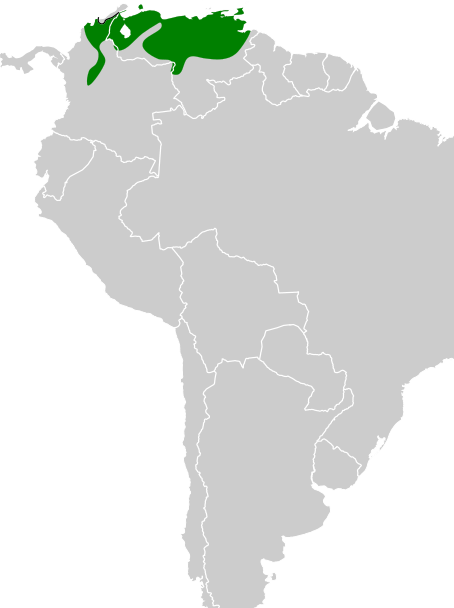
Data retrieved on October 14, 2025 at 8:19 PM