Bird of the day
Resplendent quetzal
Pharomachrus mocinno
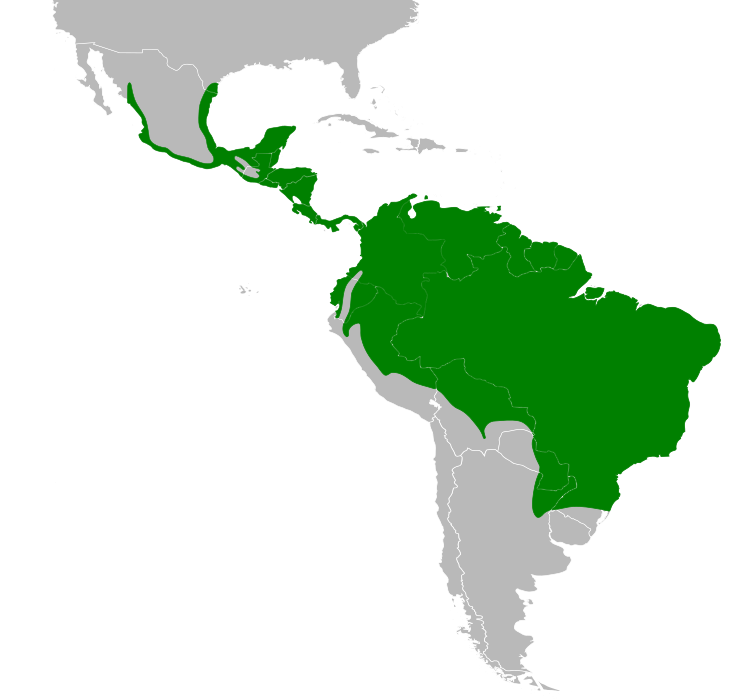
The resplendent quetzal (Pharomachrus mocinno) is a small bird found in Central America and southern Mexico that lives in tropical forests, particularly montane cloud forests. They are part of the family Trogonidae and have two recognized subspecies, P. m. mocinno and P. m. costaricensis. Like other quetzals, the resplendent is mostly omnivorous; its diet mainly consists of fruits of plants in the laurel family, Lauraceae, but it occasionally also preys on insects, lizards, frogs and snails.
The species is well known for its colorful and complex plumage that differs substantially between sexes. Males have iridescent green plumes, a red lower breast and belly, black innerwings and a white undertail, whilst females are duller and have a shorter tail. Grey lower breasts, bellies, and bills, along with bronze-green heads are characteristic of females. These birds hollow holes in decaying trees or use ones already made by woodpeckers as a nest site. They are known to take turns while incubating, males throughout the day and females at night. The female usually lays one to three eggs, which hatch in 17 to 19 days. The quetzal is an altitudinal migrant, migrating from the slopes to the canopy of the forest. This occurs during the breeding season, which varies depending on the location, but usually commences in March and extends as far as August.
The resplendent quetzal is considered near threatened on the IUCN Red List, with habitat destruction being the main threat. It has an important role in Mesoamerican mythology, and is closely associated with Quetzalcoatl, a deity. It is the national animal of Guatemala, being pictured on the flag and coat of arms; it also gives its name to the country's currency, the Guatemalan quetzal.
The resplendent quetzal is the largest trogon. It is 36 to 40 cm (14–16 in) long; in the nominate subspecies, the tail streamers measure between 31 cm (12 in) and 100.5 cm (39.6 in), with the median being 75 cm (30 in) for males. The nominate subspecies weighs about 210 g (7.4 oz), while the subspecies costaricensis is slightly smaller than the nominate race, with shorter wings and bills. The tail plumes are shorter and narrower, measuring between 32 cm (13 in) and 86 cm (34 in), with the median being 63 cm (25 in).
Resplendent quetzals have a green body (showing iridescence from green-gold to blue-violet) and a red lower breast and belly. Depending on the light, quetzal feathers can shine in a variant of colors: from green, cobalt, lime, and yellow to ultramarine. Their green upper tail coverts hide their tails and are particularly splendid in breeding males, being longer than the rest of the body. Though the quetzal's plumage appears green, they are actually brown due to the pigment melanin. The primary wing coverts are also unusually long and have a fringed appearance. The male has a helmet-like crest. The bill, which is partly covered by green filamentous feathers, is yellow in mature males and grey in females. Their iridescent feathers, which cause them to appear shiny and green like the canopy leaves, are a camouflage adaptation to hide within the canopy during rainy weather. The quetzal's skin is very thin and easily torn, so it has evolved thick plumage to protect its skin. It has large eyes, adapted to see in the dim light of the forest. Their song is an array of full-toned, mellow, slurred notes in plain patterns and is often remarkably melodious: keow, kowee, keow, k'loo, keeloo.
Aliases
Pharomachrus mocinno
Range