 Bird App
Bird of the day
Rufous-vented ground cuckoo
Neomorphus geoffroyi
The rufous-vented ground cuckoo (Neomorphus geoffroyi) is a Vulnerable species of cuckoo in the tribe Neomorphini of subfamily Crotophaginae. It is found in Bolivia, Brazil, Colombia, Costa Rica, Ecuador, Nicaragua, Panama, and Peru.
The rufous-vented ground cuckoo is 45 to 51 cm (18 to 20 in) long, about half of which is its tail, and weighs about 300 to 400 g (11 to 14 oz). Adults have a heavy decurved bill that is pale grayish green to horn-colored at its base with a yellow tip. All subspecies have a shaggy, glossy blue-black, erectile crest, bright blue skin surrounding the eye, and a rufous vent area. The sexes have similar plumage. Adults of the nominate subspecies N. g. geoffroyi have a cinnamon brown forehead, crown, and lower face; bronzy olive green upperparts and wings; and a glossy purple tail. Their chin, throat, and upper breast are light buffy with a black band across the chest. The rest of their underparts are pale buff. Their head and breast have heavy paler semicircles that give a scaled appearance.
Subspecies N. g. salvini has dark bronze-brown upperparts with a purple sheen, especially on the wings and tail. The tail's upper surface may have some green gloss as well. Its face and breast have fainter scaling than the nominate and its underparts are pale buff to grayish. N. g. aequatorialis has a brown forehead and crown, bronzy green wings and upperparts, and a wide black breast band. The scaling on its breast is faint. N. g. australis has a dark brown forehead and crown and a pale grayish throat and central breast with heavily marked sides. N. g. amazonicus has black barring on a light forehead and crown, a green gloss on the hindneck, wings, and upperparts, and a faint purple gloss on the tail's upper surface. Its underparts are pale gray to whitish buff with heavy scaling on the breast. N. g. dulcis has dark glossy blue wings and upperparts and darker underparts than the nominate with heavy scaling on the breast.
Aliases
Neomorphus geoffroyi
Range
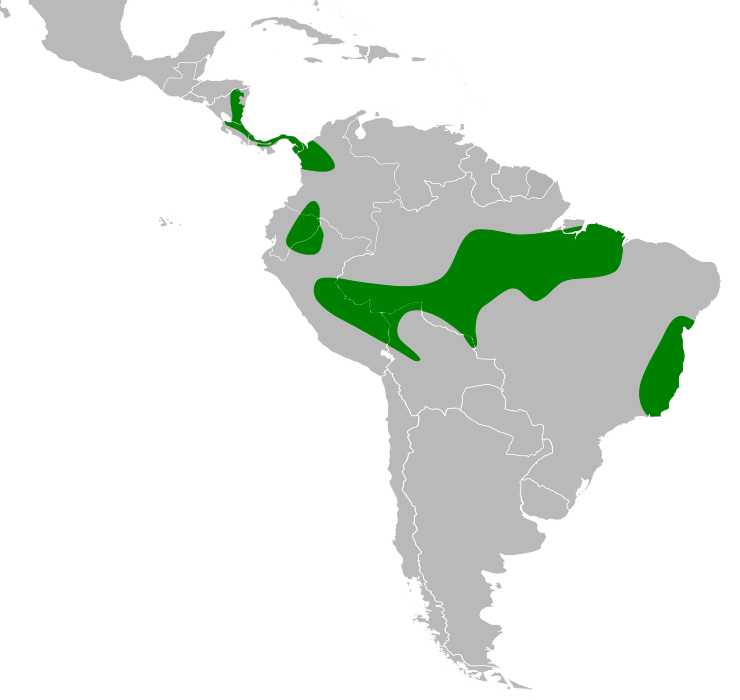
Data retrieved on October 14, 2025 at 8:15 PM