 Bird App
Bird of the day
Wing-barred seedeater
Sporophila americana
The wing-barred seedeater (Sporophila americana) is a species of bird in the family Thraupidae, the tanagers and allies. It is found in every mainland South American country except Argentina, Chile, Paraguay, and Uruguay. It formerly was found on Tobago but has been extirpated.
The wing-barred seedeater is 10 to 11.5 cm (3.9 to 4.5 in) long and weighs 10 to 14 g (0.35 to 0.49 oz). It has a short thick bill with a rounded culmen. The species is sexually dimorphic. Adult males of the nominate subspecies S. a. americana have a mostly black head and neck with a white chin and throat that connect to a white collar below the nape. Their upperparts are mostly black with black speckles on a white rump. Their wings are mostly black with white tips on the median and greater coverts and white bases on the primaries. The white areas show as two wing bars and a patch on the folded wing respectively. Their tail is black. Their underparts are mostly white with some gray wash on the flanks and usually a thin broken black band through the breast. Adult females have a buffy brown crown and a paler, warmer, buffy brown face. Their nape, upperparts, wings, and tail are also buffy brown. Their throat, breast, and flanks are pale warm cinnamon and their belly and undertail coverts are a paler buff. Juveniles resemble adult females. Subspecies S. a. dispar is larger than the nominate. Males have a more nearly pure white rump and more white on their primaries. Females may have more grayish upperparts and whiter underparts, but not all descriptions support this. Males of S. a. murallae have white on the lesser wing coverts but not the median coverts and so have only one wing bar; they also have less white on the primaries than the nominate. Both sexes of all subspecies have a dark brown iris. Males have a black bill and legs; females have a blackish brown bill and legs.
Aliases
Sporophila americana
Range
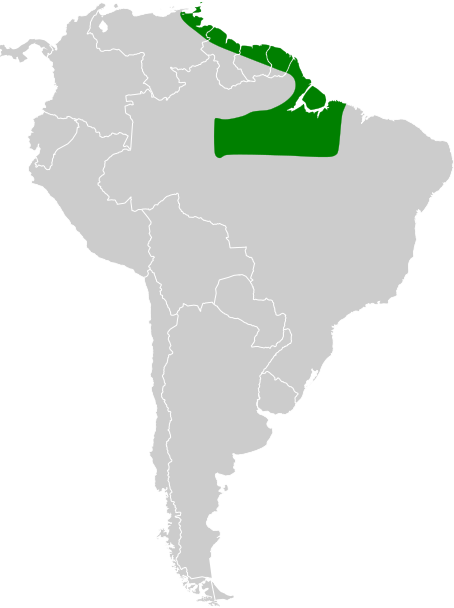
Data retrieved on September 27, 2026 at 3:56 PM