 Bird App
Bird of the day
Western barn owl
Tyto alba
The western barn owl (Tyto alba) is a species of barn owl native to Europe, southwestern Asia, and Africa. It was formerly considered a subspecies group together with barn owls native to other parts of the world, but this classification was found to be paraphyletic with respect to some other members of the genus.
The plumage on the head and back is a mottled shade of grey or brown; that on the underparts varies from white to brown and is sometimes speckled with dark markings. The facial disc is characteristically large and heart-shaped, with white plumage in most subspecies. This owl does not hoot, but utters an eerie, drawn-out screech.
The western barn owl is nocturnal over most of its range, but in Great Britain, it also hunts by day. Barn owls specialise in hunting animals on the ground, and nearly all of their food consists of small mammals, which they locate by sound, their hearing being very acute. The owls usually mate for life unless one of the pair is killed, whereupon a new pair bond may be formed. Breeding takes place at varying times of the year, according to the locality, with a clutch of eggs, averaging about four in number, being laid in a nest in a hollow tree, old building, or fissure in a cliff. The female does all the incubation, and relies on the male to hunt for food. When large numbers of small prey are readily available, barn owl populations can expand rapidly, and globally the barn owl is listed Least Concern on the IUCN Red List. Some subspecies with restricted ranges are more threatened.
The barn owl is a medium-sized, pale-coloured owl with long wings and a short, squarish tail. There is some size variation across the subspecies, with a typical specimen measuring about 33 to 35 cm (13 to 14 in) in overall length, with a wingspan of 80 to 95 cm (31 to 37 in). Adult weight is also variable, with nominate T. a. alba from Italy weighing 240–310 g (8.5–10.9 oz), T. a. guttata in Germany weighing 290–480 g (10–17 oz), while T. a. poensis from South Africa weighs 295–380 g (10.4–13.4 oz); the sexes are broadly similar in weight, with females on average slightly heavier than males (typically about 10% heavier), but with considerable overlap. In general, owls living on small islands are smaller and lighter, perhaps because they have a higher dependence on insect prey and need to be more manoeuvrable. Birds found dead or dying from starvation weighed 190–240 g (6.7–8.5 oz). The shape of the tail is a means of distinguishing the barn owl from typical owls when seen in the air. Other distinguishing features are the undulating flight pattern and the dangling, feathered legs. The pale face with its heart shape and black eyes gives the flying bird a distinctive appearance, like a flat mask with oversized, oblique black eyeslits, the ridge of feathers above the bill somewhat resembling a nose.
The bird's head and upper body typically vary between pale brown and some shade of grey (especially on the forehead and back) in most subspecies. Some are purer, richer brown instead, and all have fine black-and-white speckles, except on the remiges and rectrices (main wing feathers), which are light brown with darker bands. The heart-shaped face is usually bright white, but in some subspecies it is brown. The underparts, including the tarsometatarsal (lower leg) feathers, vary from white to reddish buff among the subspecies and are either mostly unpatterned or bear a varying number of tiny blackish-brown speckles. It has been found that at least in the continental European populations, females with more spotting are healthier than plainer birds. This does not hold true for European males by contrast, where the spotting varies according to subspecies. The bill varies from pale horn to dark buff, corresponding to the general plumage hue, and the iris is blackish brown. The toes, like the bill, vary in colour, ranging from pink to dark pinkish-grey, and the talons are black.
Both leucistic and melanistic barn owls have been recorded in the wild and in captivity, with melanistic individuals estimated to occur with odds of 1 out of every 100,000 birds.
On average within any one population, males tend to have fewer spots on the underside and are paler in colour than females. Nestlings are covered in white down, but the heart-shaped facial disk becomes visible soon after hatching.
Contrary to popular belief, the barn owl does not hoot (such calls are made by typical owls, like the tawny owl or other members of the genus Strix). It instead produces a characteristic piercing shree scream, an eerie, long-drawn-out shriek. Males in courtship give a shrill twitter. Both young and old can hiss like a snake to scare away intruders. Other sounds produced include a purring chirrup, denoting pleasure, and a "kee-yak", which resembles one of the vocalisations of the tawny owl. When captured or cornered, the barn owl throws itself on its back and flails with sharp-taloned feet, making for an effective defence. In such situations, it may emit rasping sounds or clicking snaps, produced probably by the bill but possibly by the tongue.
Aliases
Tyto alba, Strix alba, common barn-owl, common barn owl, barnowl, white houlet, barn owl, Western barn owl
Range
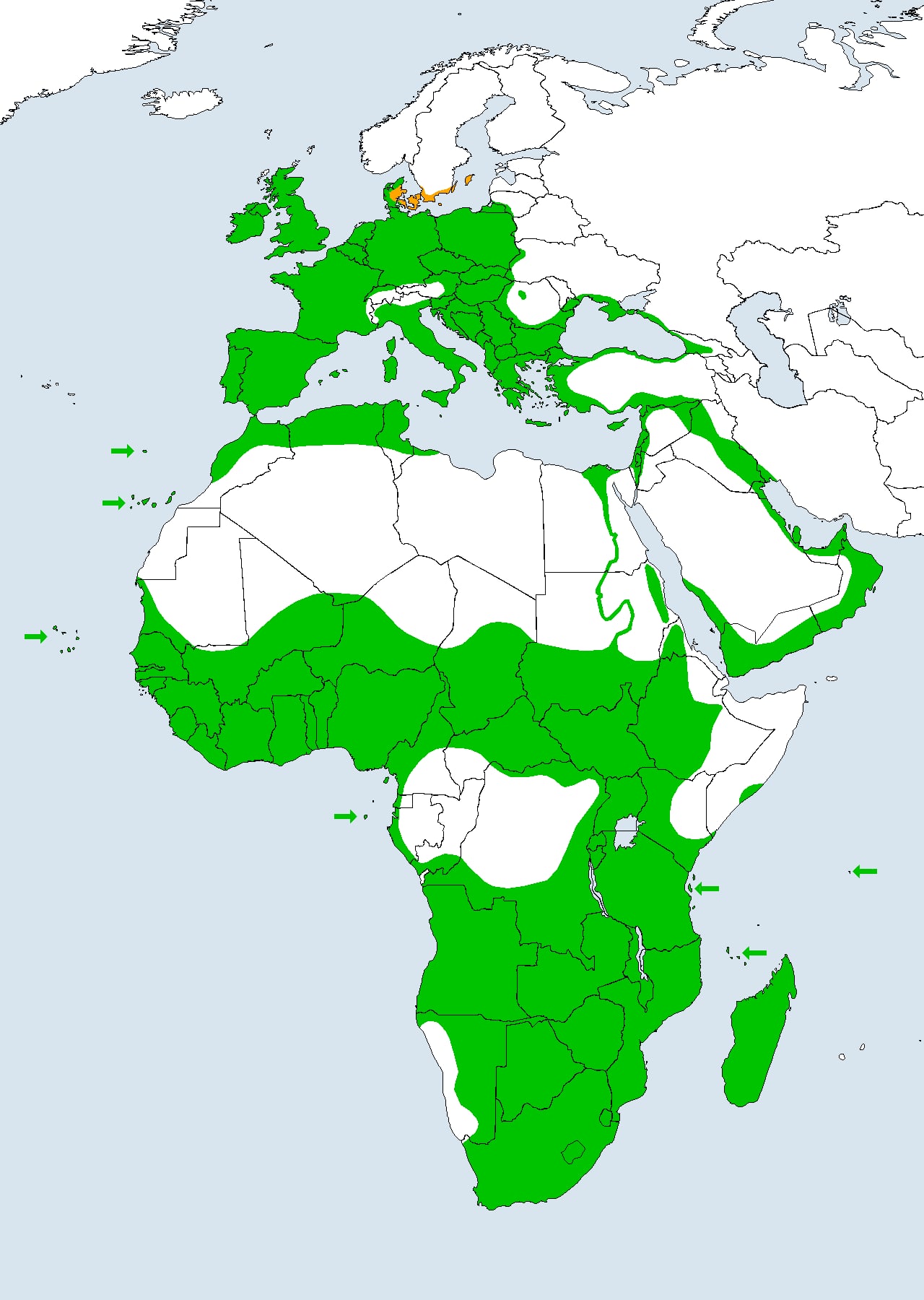
Data retrieved on October 14, 2025 at 8:05 PM