 Bird App
Bird of the day
Splendid fairywren
Malurus splendens
The splendid fairywren (Malurus splendens) is a passerine bird in the Australasian wren family, Maluridae. It is also known simply as the splendid wren or more colloquially in Western Australia as the blue wren. The splendid fairywren is found across much of the Australian continent from central-western New South Wales and southwestern Queensland over to coastal Western Australia. It inhabits predominantly arid and semi-arid regions. Exhibiting a high degree of sexual dimorphism, the male in breeding plumage is a small, long-tailed bird of predominantly bright blue and black colouration. Non-breeding males, females and juveniles are predominantly grey-brown in colour; this gave the early impression that males were polygamous as all dull-coloured birds were taken for females. It comprises several similar all-blue and black subspecies that were originally considered separate species.
Like other fairywrens, the splendid fairywren is notable for several peculiar behavioural characteristics; the birds are socially monogamous and sexually promiscuous, meaning that although they form pairs between one male and one female, each partner will mate with other individuals and even assist in raising the young from such trysts. Male fairywrens pluck pink or purple petals and display them to females as part of a courtship display.
The habitat of the splendid fairywren ranges from forest to dry scrub, generally with ample vegetation for shelter. Unlike the eastern superb fairywren, it has not adapted well to human occupation of the landscape and has disappeared from some urbanised areas. The splendid fairywren mainly eats insects and supplements its diet with seeds.
The splendid fairywren is a small, long-tailed bird 14 cm (5.5 in) long. Exhibiting a high degree of sexual dimorphism, the breeding male is distinctive with a bright blue forehead and ear coverts, a violet throat and deeper rich blue back wings, chest and tail with a black bill, eye band and chest band. The blue breeding plumage of the male is often referred to as nuptial plumage. The non-breeding male is brown with blue in the wings and a bluish tail. The female resembles the non-breeding male but has a chestnut bill and eye-patch. Immature males will moult into breeding plumage the first breeding season after hatching, though this may be incomplete with residual brownish plumage and may take another year or two to perfect. Both sexes moult in autumn after breeding, with males assuming an eclipse non-breeding plumage. They will moult again into nuptial plumage in winter or spring. Some older males have remained blue all year, moulting directly from one year's nuptial plumage to the next. Breeding males' blue plumage, particularly the ear-coverts, is highly iridescent due to the flattened and twisted surface of the barbules. The blue plumage also reflects ultraviolet light strongly, and so may be even more prominent to other fairywrens, whose colour vision extends into this part of the spectrum. The call is described as a gushing reel; this is harsher and louder than other fairywrens and varies from individual to individual. A soft single trrt serves as a contact call within a foraging group, while the alarm call is a tsit. Cuckoos and other intruders may be greeted with a threat posture and churring threat. Females emit a purr while brooding.
Aliases
Malurus splendens
Range
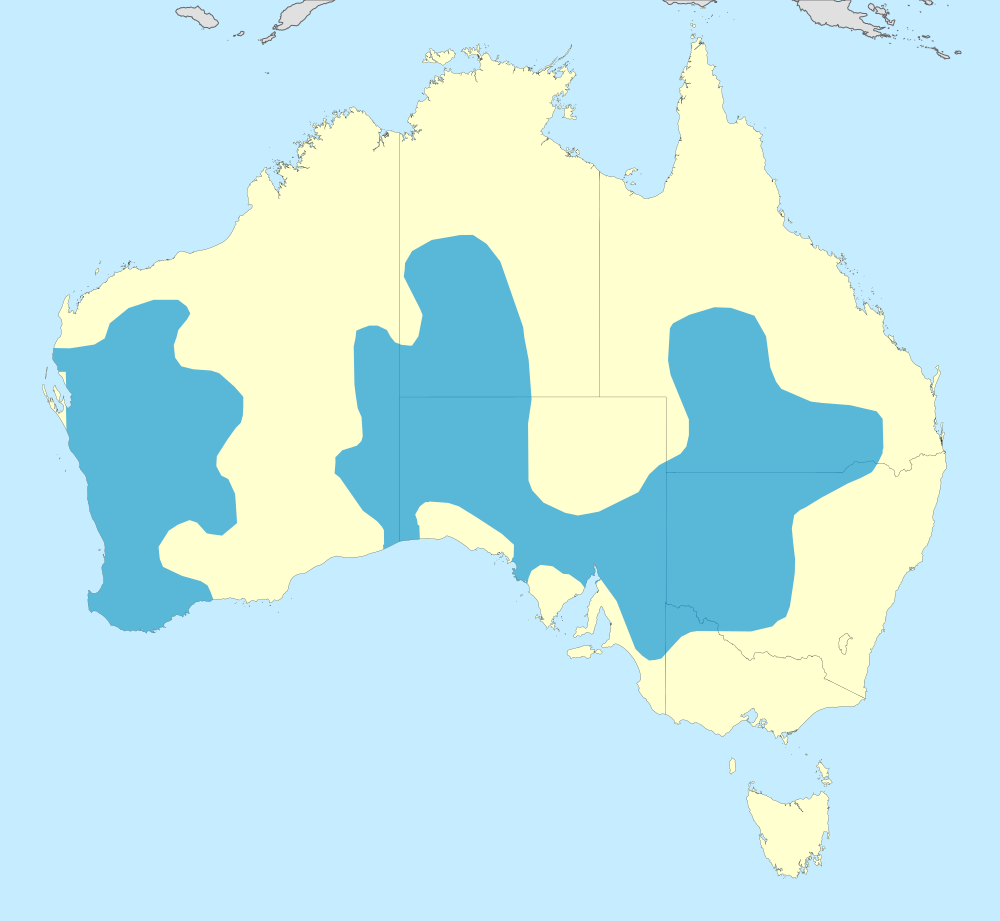
Data retrieved on October 14, 2025 at 8:04 PM