 Bird App
Bird of the day
Rufous-crowned sparrow
Aimophila ruficeps
The rufous-crowned sparrow (Aimophila ruficeps) is a small American sparrow. This passerine is primarily found across the Southwestern United States and much of the interior of Mexico, south to the transverse mountain range, and to the Pacific coast to the southwest of the transverse range. Its distribution is patchy, with populations often being isolated from each other. Twelve subspecies are generally recognized, though up to eighteen have been suggested. This bird has a brown back with darker streaks and gray underparts. The crown is rufous, and the face and supercilium are gray with a brown or rufous streak extending from each eye and a thick black malar streak.
These sparrows feed primarily on seeds in the winter and insects in the spring and summer. The birds are often territorial, with males guarding their territory through song and displays. Flight is awkward for this species, which prefers to hop along the ground for locomotion. They are monogamous and breed during spring. Two to five eggs are laid in the bird's nest, which is cup-shaped and well hidden. Adult sparrows are preyed upon by house cats and small raptors, while young may be taken by a range of mammals and reptiles. They have been known to live for up to three years, two months. Although the species has been classified as least concern, or unthreatened with extinction, some subspecies are threatened by habitat destruction and one may be extinct.
The rufous-crowned sparrow is a smallish sparrow at 5.25 inches (13.3 cm) in length, with males tending to be larger than females. It ranges from 15 to 23 g (0.53 to 0.81 oz) in weight and averages about 19 g (0.67 oz). It has a brown back with darker streaks and gray underparts. Its wings are short, rounded, and brown and lack wingbars, or a line of feathers of a contrasting color in the middle of the bird's wing. The sparrow's tail is long, brown, and rounded. The face and supercilium (the area above the eye) are gray with a brown or rufous streak extending from each eye and a thick black streak on each cheek. The crown ranges from rufous to chestnut, a feature which gives it its common name, and some subspecies have a gray streak running through the center of the crown. The bill is yellow and cone-shaped. The sparrow's throat is white with a dark stripe. Its legs and feet are pink-gray. Both sexes are similar in appearance, but the juvenile rufous-crowned sparrow has a brown crown and numerous streaks on its breast and flanks during the spring and autumn.
The song is a short, fast, bubbling series of chip notes that can accelerate near the end, and the calls include a nasal chur and a thin tsi. When threatened or separated from its mate, the sparrow makes a dear-dear-dear call.
Aliases
Aimophila ruficeps
Range
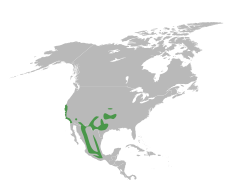
Data retrieved on October 14, 2025 at 8:00 PM