 Bird App
Bird of the day
Baer's pochard
Aythya baeri
Baer's pochard (Aythya baeri) is a diving duck found in eastern Asia. It is a resident bird in North and Central China, and formerly bred in southeast Russia and Northeast China, migrating in winter to southern China, Vietnam, Japan, and India. Baer's pochard is a monotypic species. The holotype was collected in middle Amur.
It has a distinctive black head and neck with green gloss. While in poor light, it is likely to look completely black. It is similar and closely related to the ferruginous duck, and they were previously considered to be a single species; Baer's pochard is differentiated by its white flanks when floating on the water, as well as its longer, more rounded head and larger size.
Its breeding season varies by latitude and environment. The nest, built from sedges, reeds and other plants, is placed among emergent vegetation, usually in shallow water or on small islands or ridges. Its clutch size ranges from 5 to 14. Males usually take on sentry duty, and females take on the responsibility of incubating.
Baer's pochard was once a common species in its range, but is now very rare. The number of mature individuals may be fewer than 1,000, and its population is still declining. Hunting and habitat loss are considered to be the main reasons. This species has been classified as critically endangered by the IUCN, and listed as a first-class protected animal in China.
The Baer's pochard is 41–47 cm (16–19 in) long with a 70–79 cm (28–31 in) wingspan. The male is slightly larger, weighing on average 500–730 g (18–26 oz), wings lengthed 18.6–20.3 cm (7.3–8.0 in), tail at 53–60 mm (2.1–2.4 in), and culmen at 38–44 mm (1.5–1.7 in). Relatively, the female weighing on average 590–655 g (20.8–23.1 oz), wings lengthed 19.1–20.5 cm (7.5–8.1 in), tail at 51–64 mm (2.0–2.5 in), and culmen at 40–44 mm (1.6–1.7 in). Both male and female's tarsometatarsus lengthed 33–34.7 mm (1.30–1.37 in).
Breeding male has a black head and neck with green gloss, white or paler yellow eyes, blackish-brown back, dark chestnut breast, white or light chestnut flanks and a short and low tail. While it is likely to look completely black in poor light. Female has brown eyes and a dark brown head and neck that blend into the chestnut-brown breast and flanks. Eclipse and first-winter male resembles female, but retain the white eyes. Both male and female have wide white speculum feathers, white vent-side, dark-grey bill, black nail and dark-grey tarsometatarsus.
It is similar to its close relative, the ferruginous duck (A. nyroca), both have white vent-side and iris in males, black nail, and wide white speculum feathers. Although Baer's pochard is bigger, has a longer head, body and bill. Unlike the ferruginous duck's tall and triangular head, Baer's pochard has a more rounded head and a flatter forehead. The white part on the belly extends to its flanks in Baer's pochard, which is visible when floating on the water, while the ferruginous duck has a smaller white part on its belly. The female Baer's pochard has a distinctly bright chestnut spot at the lore, which is absent in ferruginous duck.
Baer's pochard is usually a quieter duck, but during its courtship display, both sexes give harsh graaaak. Females may give kura kura kura and males may give kuro kuro at other times.
Aliases
Aythya baeri
Range
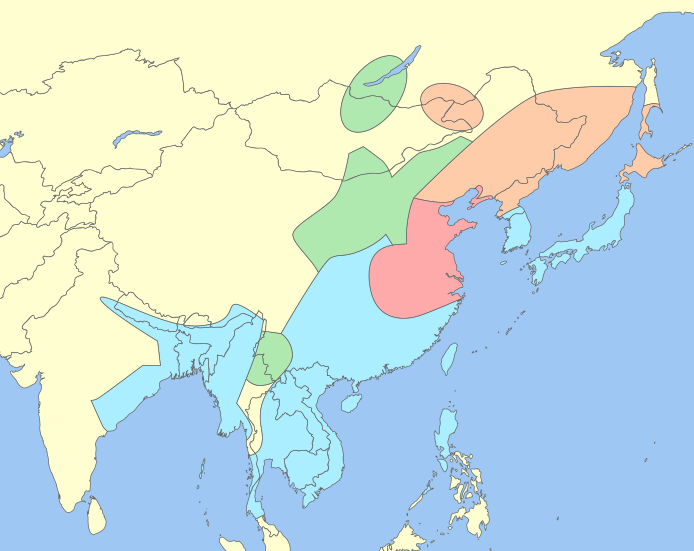
Data retrieved on October 14, 2025 at 7:58 PM