 Bird App
Bird of the day
Chestnut-vented nuthatch
Sitta nagaensis
The chestnut-vented nuthatch (Sitta nagaensis) is a species of bird in the nuthatch family Sittidae. It is a medium-sized nuthatch, measuring 12.5–14 cm (4.9–5.5 in) in length. The upperparts are a solid grey-blue, with a markedly black loral stripe. The underparts are uniform grey to buff from the throat to belly, with brick red on the flanks. The undertail is white with a rufous border. The chestnut-vented nuthatch utters different kinds of calls, which can sometimes sound like a wren alarm, and its song is a monotonous, stereotypical crackle, typically chichichichi. Its ecology is poorly known, but it probably feeds on small arthropods and seeds, and the breeding season begins between March and May. The nest is typically located in a hole in the trunk of a tree, and the clutch has two to five eggs.
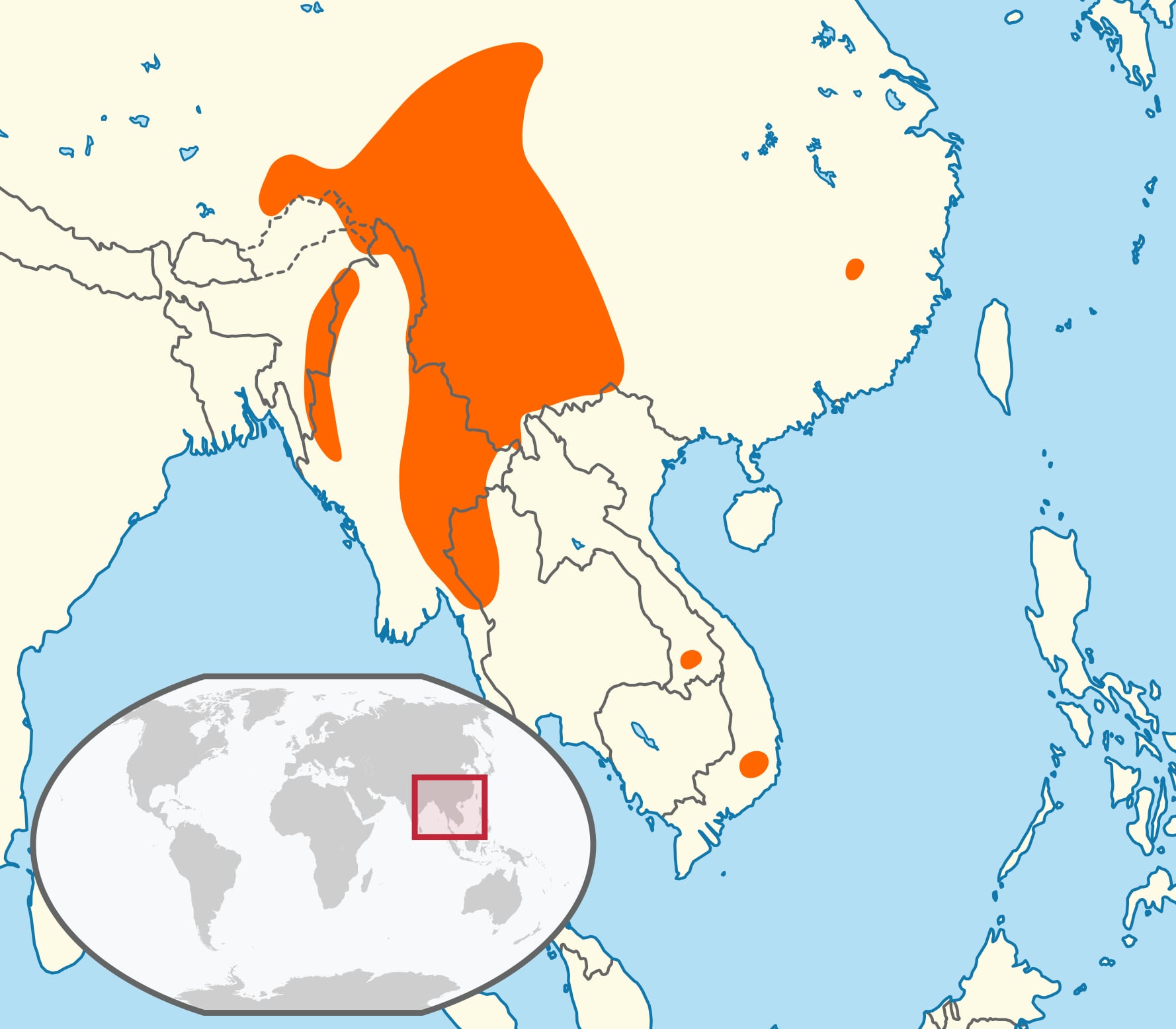
Chestnut-vented nuthatches are found in the northeast of India, in parts of Tibet and south-central China, descending into eastern Myanmar and northwestern Thailand. Isolated populations also live in southern Laos and Vietnam. It mainly lives in evergreen forests or pine forests, but can also live in mixed or deciduous forests. Its natural habitats are subtropical or tropical moist lowland forests and subtropical or tropical moist montane forests. Its altitudinal distribution varies according to the localities, but ranges from 915–4,570 m (3,002–14,993 ft). The species was described in 1874 by the British naturalist Henry Haversham Godwin-Austen, who named it Sitta nagaensis after the Naga Hills, where the type material was collected. It belongs to the S. europaea group of species, including the Kashmir nuthatch (S. cashmirensis) and the Eurasian nuthatch (S. europaea), all of which build mud entrances to their nests. The species' population is not known but appears to be declining. However, the bird's range is relatively wide, and the International Union for the Conservation of Nature currently considers the species of least concern.
The chestnut-vented nuthatch is a medium-sized nuthatch, measuring 12.5–14 cm (4.9–5.5 in) in length. The upperparts are a solid blue-grey from crown to tail, with a marked black loral line extending to the base of the wing. The underparts are pale grey, more or less tinted buff-tinged depending on the subspecies or the wear of the plumage; the dark brick-red back flanks contrast strongly with the rest of the underparts. The undertail coverts, which may be of the same colour depending on the subspecies, have a large white border at the end of the feathers or a white patch near the tip.
The species does not show marked sexual dimorphism. The male's rear flanks are deep brick-red, deeper and less orange than the undertail coverts, whereas the female's flanks are rufous, concolorous with the undertail coverts. Females also have duller underparts, and juveniles are more buff than adults with worn plumage. The iris is brown to dark brown, the bill is greyish-black to blackish with the base of the lower mandible (and sometimes the base of the upper) slate-grey or blue-grey. The legs are dark brown, greenish or blue-grey, with almost black claws.
Three subspecies are accepted, but variation is essentially clinal, with Chinese populations (S. n. montium) having buff underparts, which get duller and purer grey as they move southward in the species' distribution. In Northeast India and western Myanmar, S. n. nagaensis in fresh plumage is as buff as S. n. montium in worn plumage. In southern Vietnam and southwestern Myanmar, S. n. grisiventris has purer grey underparts than S. n. nagaensis. Adults undergo a complete moult after the breeding season, from May to June, and an incomplete moult occurs before it.
The range of the chestnut-vented nuthatch overlaps with that of the Burmese nuthatch (S. neglecta). However, the chestnut-vented nuthatch is easily distinguished by the colour of its underparts, and the lack of contrast between the sides of the head and the throat, whereas the other species has white chins, cheeks, and parotid region contrasting with brick-red to orange-brown underparts. However, in the chestnut-vented nuthatch, some individuals in fresh plumage (especially in S. n. montium) may have underparts almost as buff as some Burmese nuthatch females or juveniles. The chestnut-vented nuthatch can then be recognised by its darker, duller blue upperparts, by its red flanks contrasting with the buff, and by its undertail, with feathers edged with red giving a "scales" pattern, when they appear almost uniformly white in the Burmese nuthatch.
The subspecies S. n. montium can also be confused with the subspecies S. e. sinensis of the Eurasian nuthatch (S. europaea) where they coexist in Sichuan and Fujian. As the latter subspecies has more orange underparts, some Eurasian females may be difficult to differentiate from chestnut-vented nuthatches in fresh plumage. The two species can be distinguished by their vocalisations, with chestnut-vented nuthatch lacking the characteristic singing dwip of the Euraisan nuthatch. Hybrids between these two taxa have been suggested, with montane populations of S. e. sinensis being, like the chestnut-vented nuthatch, greyer on the underside, darker above, and larger than lowland individuals. The chestnut-vented nuthatch, however, is even greyer, and does not have the whitish cheeks of the Eurasian nuthatch.
In southwest China, the chestnut-vented nuthatch lives within the range of the Yunnan nuthatch (S. yunnanensis). However, the latter is smaller, has a thin white supercilium, and has plain, pale buff underparts with no russet on the flanks. In northeastern India and northwestern Myanmar, the chestnut-vented nuthatch can also be confused with the white-tailed nuthatch (S. himalayensis); both species share similar habitats. The white-tailed nuthatch, however, has a white spot on the top of the middle rectrices, and has more orange underparts, without brick-red flanks or white spots on the undertail. The giant nuthatch (S. magna), whose distribution overlaps with that of the chestnut-vented nuthatch in India, Myanmar, and Thailand, differs from the latter in being much larger in size, having a finer eyestripe, and having a crown that is much lighter than the rest of the mantle.
Aliases
chestnut-vented nuthatch
Range
Data retrieved on October 15, 2025 at 8:06 AM