 Bird App
Bird of the day
Mandarin duck
Aix galericulata
The mandarin duck (Aix galericulata) is a perching duck species native to the East Palearctic. It is sexually dimorphic; the males are elaborately coloured, while the females have more subdued colours. It is a medium-sized duck, at 41–49 cm (16–19 in) long with a 65–75 cm (26–30 in) wingspan. It is closely related to the North American wood duck, the only other member of the genus Aix. 'Aix' is an Ancient Greek word which was used by Aristotle to refer to an unknown diving bird, and 'galericulata' is the Latin for a wig, derived from galerum, a cap or bonnet. Outside of its native range, the mandarin duck has a large introduced population in the British Isles and Western Europe, with additional smaller introductions in North America.
The mandarin duck is among the smaller species of waterfowl, with a shorter body and smaller overall body size than most dabbling ducks, and is slightly smaller than its American wood duck relative. The adult male has a small red bill, large white crescent above the eye and reddish face and "whiskers". The male's breast is purple with two vertical white bars, the flanks ruddy, and has two orange 'sail' feathers at the back (large feathers that stick up similar to boat sails). The female is similar to the female wood duck, with greyish-brown plumage, and a slender white eye-ring and stripe running back from the eye. The female is paler on the underside, has a small white flank stripe, and a pale tip to its bill.
Both the males and females have crests, but the purple crest is more pronounced on the male.Like many other species of ducks, the male undergoes a moult after the mating season into eclipse plumage. When in eclipse plumage, the male looks similar to the female, but can be distinguished by its bright yellow-orange or red beak, lack of any crest, and a less pronounced eye-stripe.
Mandarin duck ducklings are almost identical in appearance to wood duck ducklings, and very similar to mallard ducklings. The ducklings can be distinguished from mallard ducklings because the eye-stripe of mandarin duck ducklings (and wood duck ducklings) stops at the eye, while in mallard ducklings it reaches all the way to the bill.
Aliases
Aix galericulata, Pato mandarín
Range
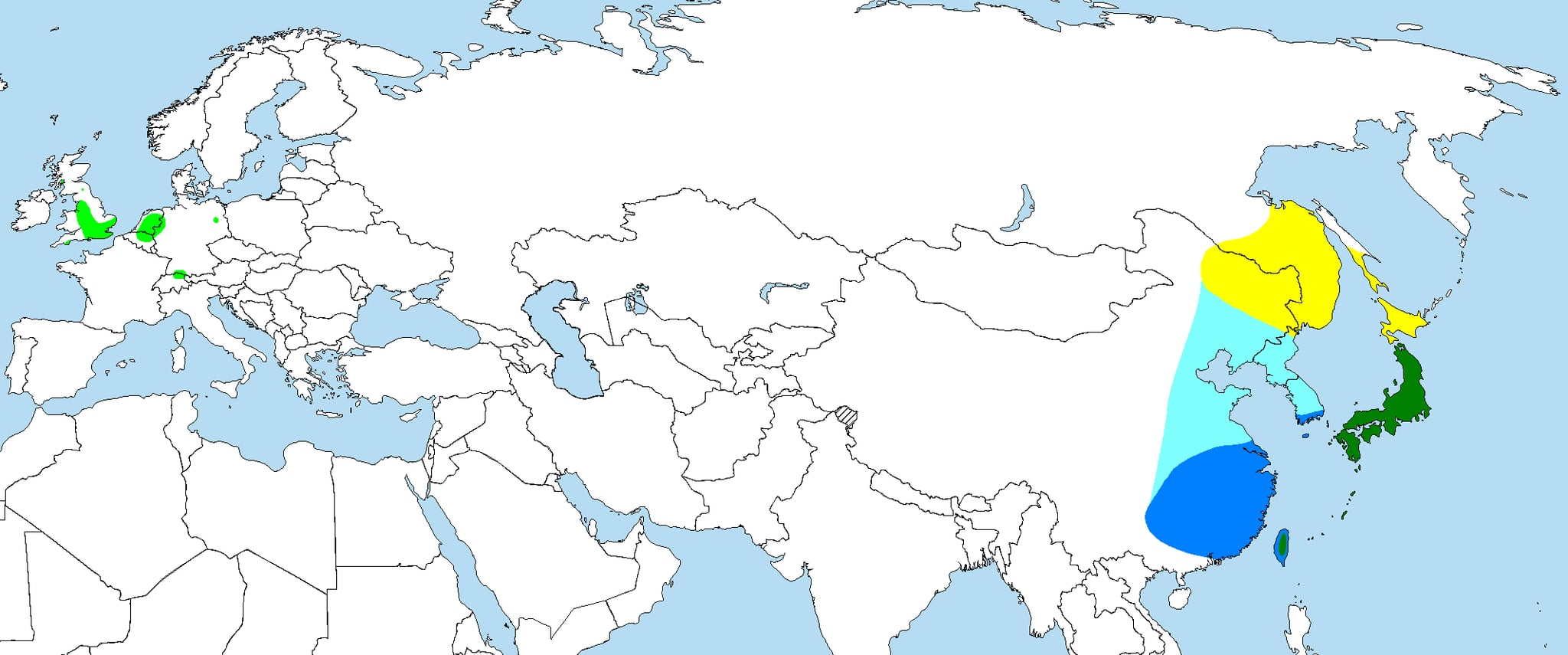
Data retrieved on October 15, 2025 at 8:05 AM