 Bird App
Bird of the day
Manx shearwater
Puffinus puffinus
The Manx shearwater (Puffinus puffinus) is a medium-sized shearwater in the seabird family Procellariidae. The scientific name of this species records a name shift: Manx shearwaters were called Manks puffins in the 17th century. Puffin is an Anglo-Norman word (Middle English pophyn) for the cured carcasses of nestling shearwaters. The Atlantic puffin acquired the name much later, possibly because of its similar nesting habits.
The Manx shearwater is 30–38 cm (12–15 in) with a 76–89 cm (30–35 in) wingspan and weighs 350–575 g (12+1⁄2–20+1⁄2 oz). It has the typically "shearing" flight of the genus, dipping from side to side on stiff wings with few wingbeats, the wingtips almost touching the water. This bird looks like a flying cross, with its wings held at right angles to the body, and it changes from black to white as the black upper parts and white under sides are alternately exposed as it travels low over the sea.
This shearwater is mainly silent at sea, even when birds are gathered off the breeding colonies. It calls on its nocturnal visits to the nesting burrows in flight, on the ground, and in the burrows, although moonlight depresses the amount of calling. The vocalisations largely consists of a raucous series of croons, howls, and screams, typically in groups of a few syllables, which become weaker and throatier. The male has some clear ringing and shrieking tones absent from the harsher repertoire of the female, the difference being obvious when a pair duets.
The nocturnal vocalisations of Manx shearwater are notorious for their eerie character and the alarm they might arouse in uninitiated hearers. Anecdotally: "the diabolical shrieks and cackles of this species have earned it, in various parts of the world and various languages, the local nickname 'Devil Bird'".
Females can recognise the voice of their mates, but not of their young. They do not provide postnesting care, and a chick in their burrow is likely their own, so voice identification is not needed.
The vision of the Manx shearwater has a number of adaptations to its way of life. Like other tube-nosed seabirds, it has a long, narrow area of visual sensitivity containing the fovea across the retina of the eye. This region is characterised by the presence of ganglion cells that are regularly arrayed and larger than those found in the rest of the retina. This feature helps in the detection of items in a small area projecting below and around the bill. It may assist in the detection of prey near the sea surface as a bird flies low over it.
Since it visits its breeding colony at night, a shearwater has adaptations for nocturnal vision, too. In the shearwater's eyes, the lens does most of the bending of light necessary to produce a focused image on the retina. The cornea, the outer covering of the eye, is relatively flat, so of low refractive power. In a diurnal bird like a pigeon, the reverse is true; the cornea is highly curved and is the principal refractive component. The ratio of refraction by the lens to that by the cornea is 1.6 for the shearwater and 0.4 for the pigeon. The shorter focal length of shearwater eyes give them a smaller, but brighter, image than is the case for pigeons. Although the Manx shearwater has adaptations for night vision, the effect is small, and these birds likely also use smell and hearing to locate their nests.
Aliases
Puffinus puffinus
Range
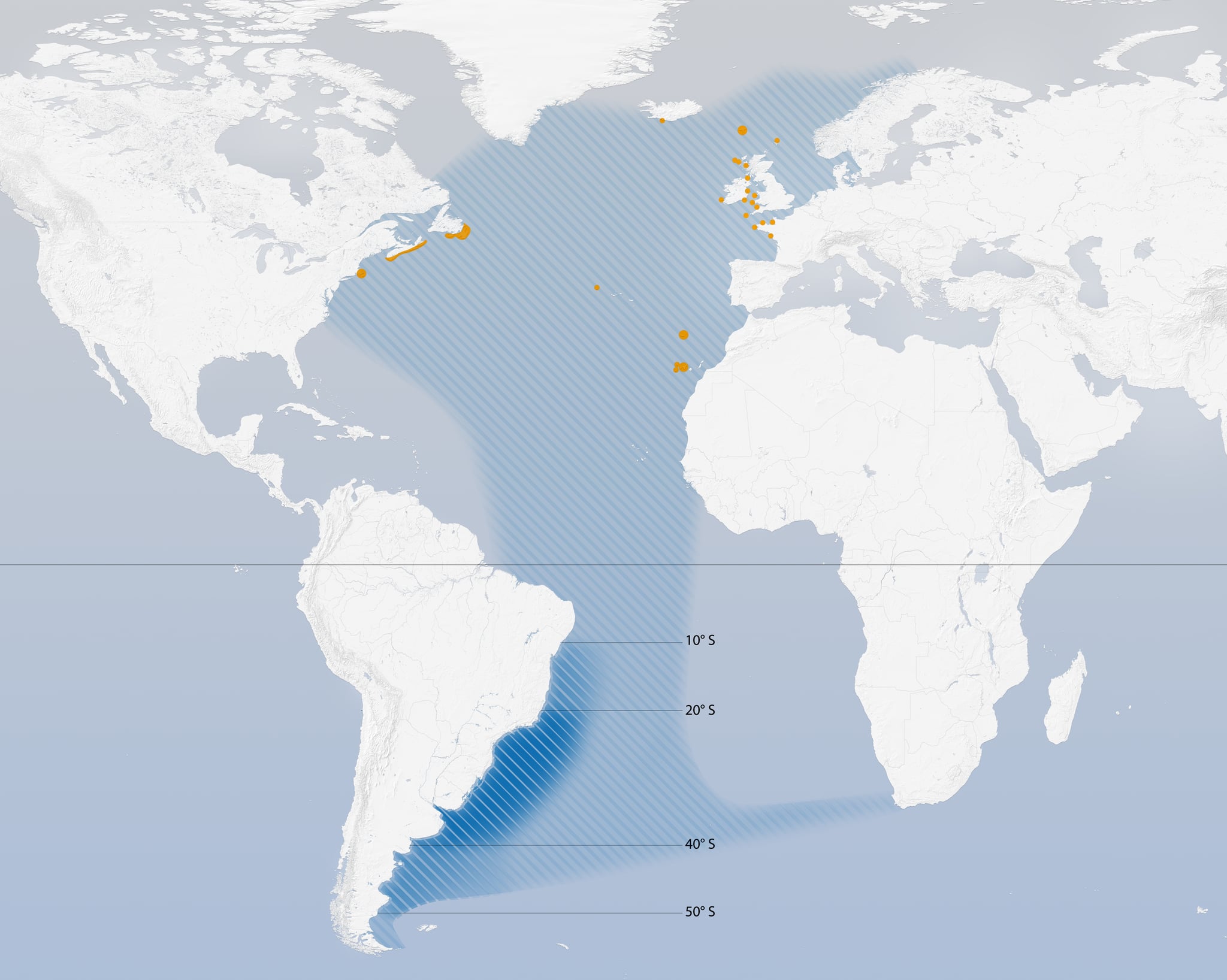
Data retrieved on October 15, 2025 at 8:02 AM