 Bird App
Bird of the day
Guadeloupe woodpecker
Melanerpes herminieri
The Guadeloupe woodpecker (Melanerpes herminieri) or Tapeur is a species of bird in the woodpecker family Picidae belonging to the genus Melanerpes. Endemic to the Guadeloupe archipelago in the Lesser Antilles, it is a medium-sized forest woodpecker with entirely black plumage and red-to-purple reflections on its stomach. It lives mainly in the islands' tropical rainforest areas. The woodpecker has no sexual dimorphism. The species has adapted under the pressure of urbanization to more open forest environments.
During the breeding season, the Guadeloupe woodpecker is solitary bird that nests in holes it digs with its beak in the trunk of dead trees—mainly coconut—where the female lays three to five eggs. The eggs are incubated for fifteen days before hatching, after which the adult female feeds the chicks in the nest for about a month. Juvenile birds stay with the parents for several months before becoming independent. Guadeloupe woodpeckers are mainly insectivorous, but they also feed on small vertebrates like tree frogs and Anolis marmoratus, as well as a variety of seasonal fruits.
The Guadeloupe woodpecker was long considered "near-threatened" according to the International Union for Conservation of Nature due to its endemism, predation of its eggs and nests by black rats, its relatively low numbers, and the specificities of the archipelago—island topography, habitat fragmentation, and urbanization. It was downgraded to an assessment of "least concern" in July 2019. While the Guadeloupe woodpecker seems relatively protected on the island Basse-Terre, the state of its populations on Grande-Terre—where there are risks of extinction—is much more of a problem. It has become an emblem of Guadeloupean fauna and is now commonly found in the Guadeloupe National Park.
The Guadeloupe woodpecker is a medium-sized, robust woodpecker species measuring 26–28 cm (10–11 in) in length, and with a mass of 86–97 g (3.0–3.4 oz) in males and 69–78 g (2.4–2.8 oz) in females. It is distinct in its appearance within its genus, and unlike other species of Melanerpes, males and females do not present a marked sexual dimorphism in their plumage; they are entirely black with gradual reflections ranging from dark red to burgundy on the ventral plumage, dark blue on the back, and metallic blue on the wing tips. Males have a wingspan of 42.5 cm (16.7 in) compared with 40.5 cm (15.9 in) in females). The black coloration of the Guadeloupe woodpecker may be an advantage in drying feathers by exposure to the sun and fighting against humidity, and the black feathers may be resistant to abrasion, but no definitive explanation has been advanced by the scientific community. This woodpecker is solitary animal, a social behavioral trait that is often associated with plumage monomorphism.
The legs, which terminate in four toes in a zygodactyl arrangement, are gray-green to gray-blue and powerful, with highly developed talons. The talons are curved for gripping bark with the tip of the claw; this represents an adaptation to living on trunks and branches of trees. The eyes are 6 mm (0.24 in) in diameter (pupil 2 mm (0.079 in)) with dark brown irises. The beak is entirely black and is between 15 and 20 percent longer and more robust in males; this is the main criterion for recognizing the sex of individuals. The size of the female's beak is equal to that of her head while that of the male is distinctly longer.
As with all woodpeckers that are adapted to piercing wood, the nostrils on the culmen have small feathers to protect respiration and mucous glands to trap dust. The pterygoid protractor muscle, which is highly developed in woodpeckers, is important for adapting to shock absorption by uncoupling the beak, which can move laterally, from the skull to minimize the transmission of kinetic energy to the brain and eyes. There is also a specific pterygoid bone in Picidae compared to other birds. They have a specific cancellous tissue between the skull and the beak, with a displacement of the attachment of the greater horn of the hyoid bone to the quadrate bone, as well as a reinforced sternum and keel. These elements maximize energy dissipation and shock absorption for the bird during impact. The specific, long tongue of the Picidae is cylindrical and is about twice the size of its bill. The tongue is the result of an evolution of the hyoid apparatus with two parts; one bony at the end is equipped with small hooks, the other cartilaginous lengthens under the action of a branchiomandibular muscle that attaches to the branch of the mandible, split, anchoring on the anterior part at the base of the culmen, surrounding the skull from behind with its two branches, descending on either side of the spine, esophagus and larynx, which pushes the hyoid horns and tongue out of the beak.
Juvenile birds are similar to adults but have duller, dark brown plumage. The life expectancy of individuals is greater than five years and estimated to be between eight and ten years.
Aliases
Melanerpes herminieri
Range
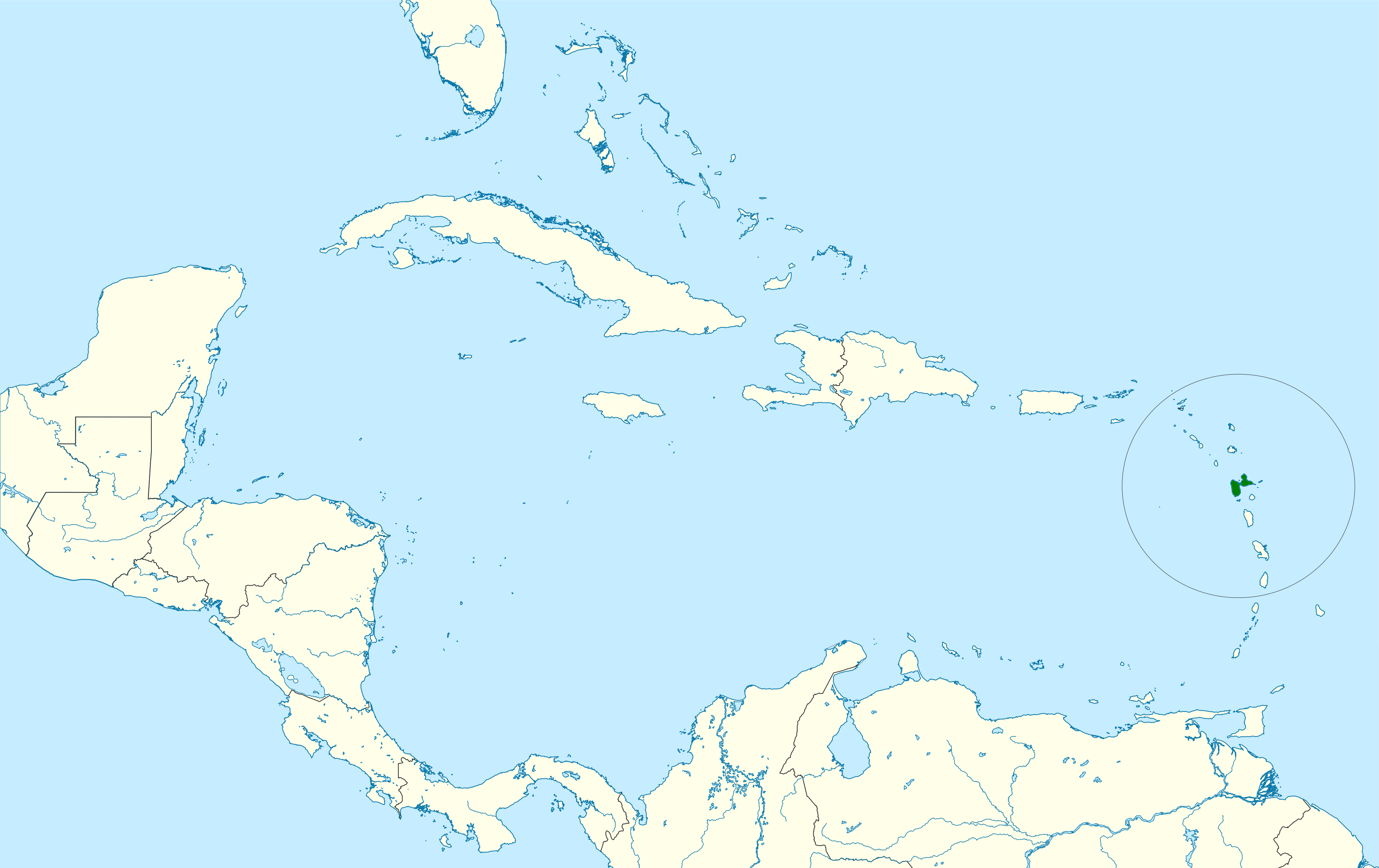
Data retrieved on September 27, 2026 at 4:04 PM