 Bird App
Bird of the day
Cape vulture
Gyps coprotheres
The Cape vulture (Gyps coprotheres), also known as Cape griffon and Kolbe's vulture, is an Old World vulture in the family Accipitridae. It is endemic to southern Africa, and lives mainly in South Africa, Lesotho, Botswana, and in some parts of northern Namibia. It nests on cliffs and lays one egg per year. In 2015, it had been classified as Endangered on the IUCN Red List, but was down-listed to Vulnerable in 2021 as some populations increased and have been stable since about 2016.
This large vulture is of a creamy-buff colour, with contrasting dark flight and tail feathers. The adult is paler than the juvenile, and its underwing coverts can appear almost white at a distance. The head and neck are near-naked. The eyes are yellowish, and the bill is black. Juveniles and immatures are generally darker and more streaked, with brown to orange eyes and red necks. It closely resembles the white-backed vulture, however it is larger and has yellow irises.
The average length of adult vultures is about 96–115 cm (38–45 in) with a wingspan of 2.26–2.6 m (7 ft 5 in – 8 ft 6 in) and a body weight of 7–11 kg (15–24 lb). The two prominent bare skin patches at the base of the neck, also found in the white-backed vulture, are thought to be temperature sensors and used for detecting the presence of thermals. The species is among the largest raptors in Africa, next to the lappet-faced vulture. With a mean body mass of roughly 8.9 to 9.22 kg (19.6 to 20.3 lb), it appears to be significantly heavier than wild lappet-faced vultures, despite the latter's extremely large appearance, and rivals only a few other species, namely the great white pelican and kori bustard, as the largest flying bird native to Africa. After the Himalayan griffon vulture and the cinereous vulture, the Cape vulture is the third largest Old World vulture on average.
Aliases
Gyps coprotheres
Range
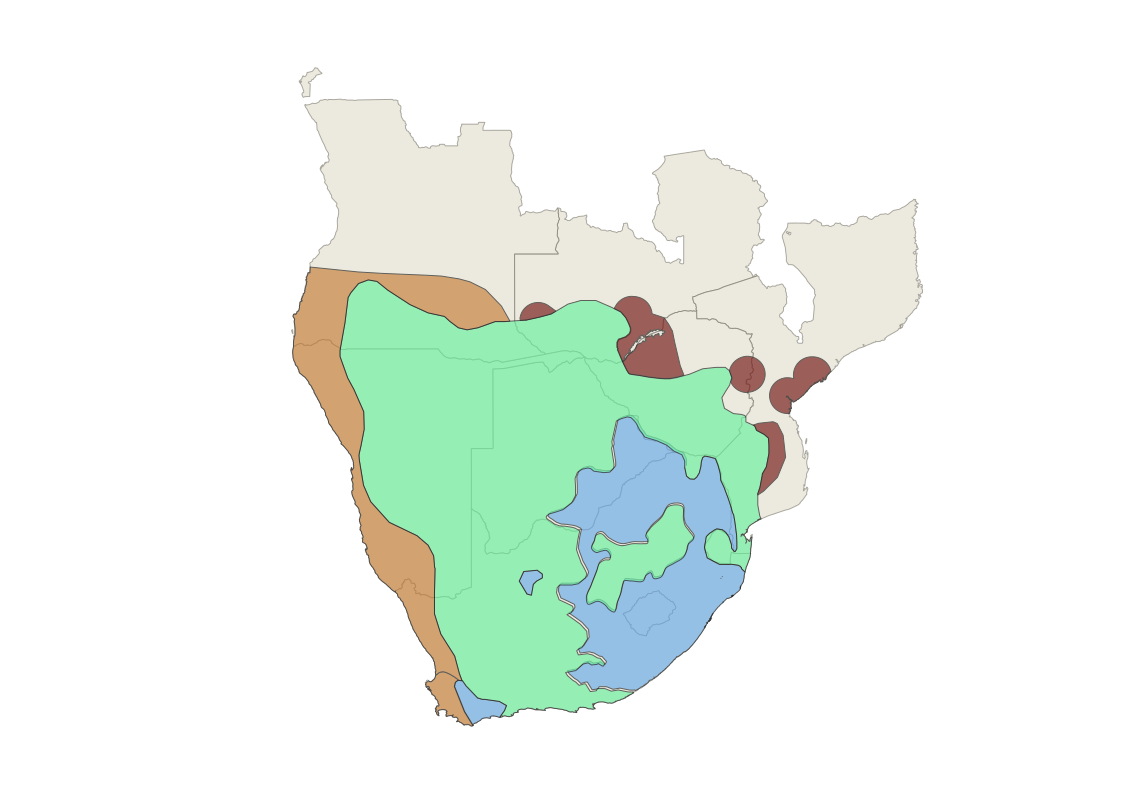
Data retrieved on October 15, 2025 at 7:44 AM