 Bird App
Bird of the day
Black-capped piprites
Piprites pileata
The black-capped piprites (Piprites pileata), also known as the black-capped manakin, bailarín castaño, or piprites capirotado, is a species of suboscine passerine. It has been placed in the genus Piprites, part of the Tyrannidae family. Previously, the species was included in the family Pipridae, but was reclassified following genetic studies.
It is found in the Atlantic Forest, especially in regions where Araucaria angustifolia are found, in the highlands of southeastern Brazil and northeastern Argentina. Until the recent rediscovery in Argentina, the only confirmed record there was a specimen taken in 1959. It is considered as rare and its population is in decline; it is considered vulnerable by BirdLife International. It is known from a number of protected areas, including the Itatiaia National Park in Rio de Janeiro, and Campos do Jordão State Park in São Paulo.
The adult black-capped piprites is a tyranid with a black cap and yellow beak. Its length has been measured to range from 12–12.5 centimetres (4.7–4.9 in). It has contrasting chestnut-colored upperparts, yellow legs, blackish and yellow-green remiges. In males, primary feathers are notably whitish. Females resemble males, though they are drab olive colored above rather than chestnut. The juvenile has not been described.
Black-capped piprites feed on small fruits and arthropods. They have been recorded as feeding in the canopy, subcanopy and understorey of Chusquea bamboo thickets.
The male black-capped piprites has a display ritual it performs during the mating season. Little else is known about their reproduction. The mating season takes place between September and November; nest construction has been observed in October.
The species' calls include a single "whééu" sound, followed by a variable series of brief, softer vocalizations.
Aliases
Piprites pileata, Piprites pileatus, Pipra pileata
Range
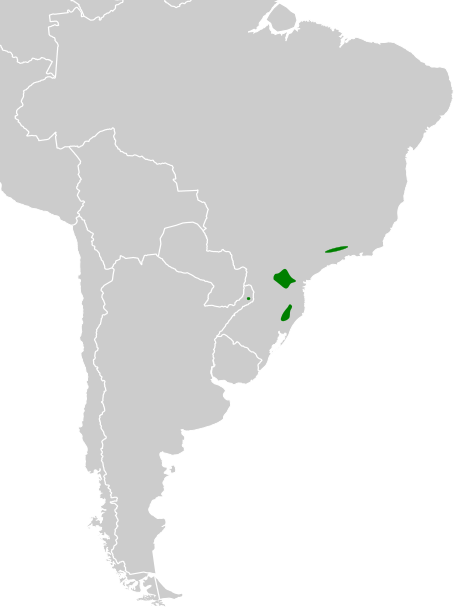
Data retrieved on October 15, 2025 at 7:41 AM