 Bird App
Bird of the day
Long-tailed ground roller
Uratelornis chimaera
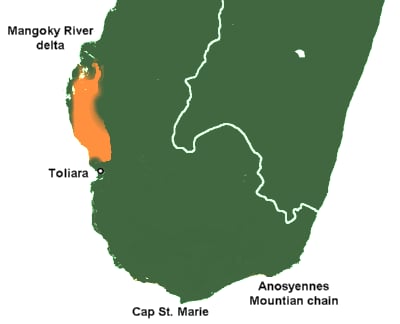
The long-tailed ground roller (Uratelornis chimaera) is a species of bird in the ground roller family Brachypteraciidae, placed in the monotypic genus Uratelornis. Endemic to arid spiny forests near the coast in southwestern Madagascar, this ground roller occurs at extremely low population densities throughout its habitat. This species requires shade and a deep layer of leaves on the ground, and it is absent from parts of the spiny forest lacking these features. It has no recognized subspecies, and its closest relative is the scaly ground roller. The long-tailed ground roller is the only ground roller to definitively display sexual dimorphism (differences in plumage or size between sexes). It is a medium-sized bird with a plump silhouette and a long tail. The upperparts are dark brown with black streaks while the underparts are light gray. The white throat is framed by black malar stripes and a black breastband, and a white stripe is present at the base of the bill. Sky-blue feathers are visible at the edge of the wings and the tail. Calls are rarely made outside the breeding season, though multiple courtship calls are made.
These ground rollers feed primarily on invertebrates, including ants, beetles, butterflies, and worms, which they find by searching through deep leaf litter or by remaining still and watching attentively. The ground roller primarily runs through its habitat on its strong legs, as its wings are relatively weak. It is a monogamous species, and it defends a territory during the breeding season of October to February. It digs a tunnel in the sand, at the end of which is a wider chamber where it makes its nest out of leaves and earthy pellets. Two to four eggs are laid. After the chicks fledge, the birds continue living in family groups until at least February before dispersing more widely across the scrubland.
This bird is classified as vulnerable by the IUCN and is threatened by habitat destruction. Since the arid, spiny forests in which it lives are not protected by the Malagasy government, it is losing habitat to slash-and-burn agriculture, charcoal collection, and logging. It is also hunted by the native peoples of Madagascar.
The long-tailed ground roller's silhouette is highly distinctive due to its long tail and plump silhouette. The bird is 34 to 47 centimeters (13 to 19 in) long, although its tail can contribute up to 30 centimeters (12 in) of the length, which makes it the longest tail of any of the ground rollers. This ground roller has short wings and long, pinkish-brown legs. The male has a sandy buff crown and dark brown upperparts with black streaks. Its supercilium is a pale buff color, while the ear-coverts are brown. The eyes are brown, while the short and stout beak is black. Its tongue is long with a brush-like tip to help it collect insects. A white stripe is present at the base of the bill and is surrounded by brown and black malar stripes. These malar stripes and the black breastband frame a white throat. The tail has 15 to 20 dark brown bars marking it, while the outer rectrices are sky blue; this sky blue is also present on the wing-coverts. In flight, the bird's two black and white bands on the primaries and secondaries are conspicuous. The underparts are a light gray, and the breast white. The toes are zygodactylous, with the first and fourth toes turned outwards and the middle two toes turned inwards. The female resembles the male, but is smaller and has a narrower chestband and a shorter tail. Also, the female loses her tail while nesting. These differences make the long-tailed ground roller the only ground roller to definitively display sexual dimorphism. Juveniles of both sexes resemble the adult female, but have duller plumage, particularly in the black bands on the chest, neck, and eyes.
Although it is generally a silent species, during the breeding season the vocalizations of the long-tailed ground roller include a "hooting" sound, a "popping" tu-tuc, and a soft boo sound. The low-pitched "hooting" is given by males from a perch 2 to 6 meters (6.6 to 19.7 ft) above the ground at dusk or at night. The sound carries for a distance of at least 200 meters (660 ft) and may either attract a mate or defend a territory. The bird pumps its tail while giving this call. One territorial call is a series of soft boo notes, typically coming in sets of six to ten and descending in volume near the end. Another call, given by both sexes, is a series of chuckling tu-tuc sounds lasting between 10 and 40 seconds that occasionally ends in a loud snapping sound produced by the wings. This call is given when birds are close to each other either on the ground or on low perches, and it does not carry over long distances. The use of wing-snapping to produce a sound is a rare phenomenon in birds, and in the order Coraciiformes only one other family, the todies, is known to do it. Low gu notes are given by mates as they come in contact with each other.
Aliases
Uratelornis chimaera
Range
Data retrieved on October 15, 2025 at 7:40 AM