 Bird App
Bird of the day
Cinereous tinamou
Crypturellus cinereus
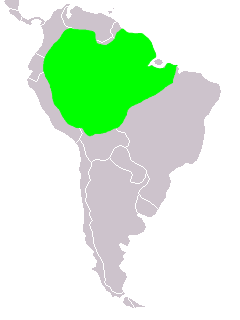
The cinereous tinamou (Crypturellus cinereus), also known as brushland tinamou, is a type of ground bird found in swamp and lowland forests in northern South America. They have some localized names that have been used by the indigenous people such as in Amazonas where they are called inambu-pixuna, and in Pará, Brazil where they are called nambu-sujo. Also, throughout their range they are called inhambu-preto. Cinereous tinamous have been around for many centuries. They are part of the oldest families of the world today and have fossils discovered dating back tens of millions of years. Their quick reflexes play a role in their ability to survive.
The cinereous tinamou is a shy and secretive bird. It is approximately 29–32 cm (11–13 in) in length, and the male bird weighs around 435 grams (15.3 oz) and the female of the species weighs 549–602 grams (19.4–21.2 oz).
It is colored similar to the Berlepsch's tinamou in that it is dark brown to sooty brown or brownish black in coloration. It tends to be a slightly more brown than the Berlepsch's tinamou. It is recognized by its smoky-grey with reddish-brown crown and nape. The feather shafts on side of its head are white, which shows through on occasion. Their color helps them blend with the environment making it harder for predators to detect them. The under parts of the bird are only slightly paler than the body, and the legs appear a dull orange to yellow. They have a light-colored eye ring. Their bill has a dark upper mandible and a yellow lower mandible. In general, their bill is very similar to the Berlpesch's tinamou's except it trends smaller and thinner. The females are generally slightly larger in size then the males.
The cinereous tinamou is specially known to be easy to hear, but very difficult to see. It has a loud distinctive whistle heard mainly at dawn and dusk. The whistle has a unique pitch and last almost two seconds between each whistle. It is mostly heard at dawn and dusk, and are monosyllabic. The bird is very capable of projecting its voice to seem like it came from another direction so hearing them and finding their exact location is very difficult. The call between the males and females are similar but not identical to the human ear. The space between calls shortens as time progresses, so as to appear as to be speeding up in frequency.
Aliases
Crypturellus cinereus
Range
Data retrieved on October 15, 2025 at 7:40 AM