 Bird App
Bird of the day
Collared forest falcon
Micrastur semitorquatus
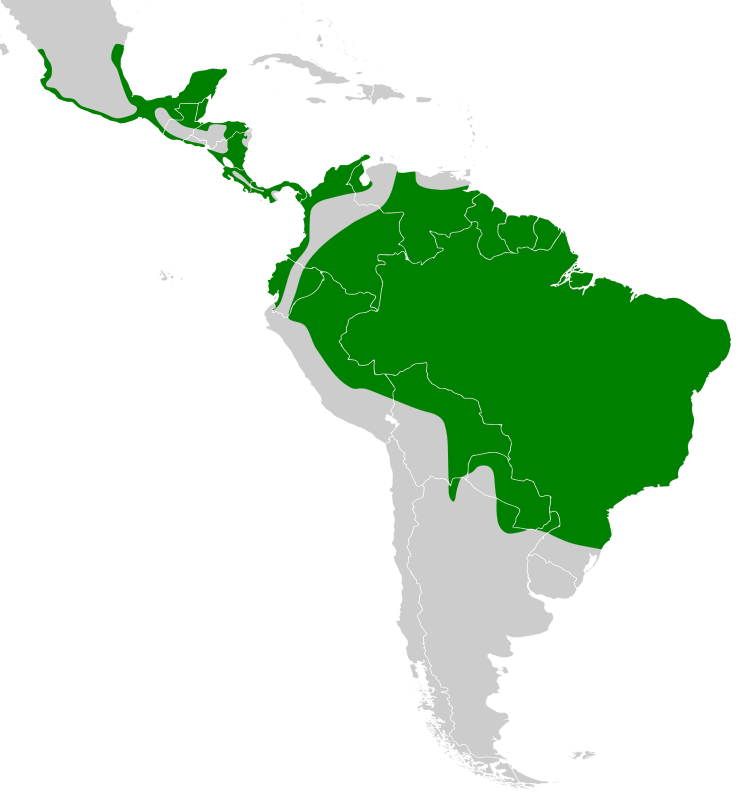
The collared forest falcon (Micrastur semitorquatus) is a species of bird of prey in the family Falconidae. It is the largest member of the Micrastur genus and a common inhabitant of tropical rainforests in Latin America. Hiding in the dense forest canopy, they are a secretive bird often only recognized by their distinctive call. With a morphology or body type allowing them to be agile in their forested habitat, their diet comprises a wide variety of prey from smaller frogs (20 g) to adult turkeys (2.7-3.2 kg).
Nesting occurs mainly in the cavities of Spanish cedar trees, which are also a key species exploited by the local logging industry. This is a potential conservation concern for the collared forest falcon.
The collared forest falcon has a dark coloured back with a white neck and breast. The species has three morphological variants (morphs): pale, tawny and dark. The former two have a light coloured collar at the back of their neck, which explains their name. This is the largest species of the forest falcon genus, with a total length of 46 to 58 cm (18 to 23 in), wingspan of 72 to 86 cm (28 to 34 in) and male weights of 467 to 646 g (1.030 to 1.424 lb), averaging some 523 g (1.153 lb), and female weights of 649–940 g (1.431–2.072 lb), averaging 740 g (1.63 lb), this species is nearly the size of peregrine falcon albeit longer-tailed and much shorter-winged. Although its forest lifestyle, rounded short wings, long tail and lack of the characteristic beak tooth suggest affinities to hawks, there are several morphological connections to the Falconidae in which it is now placed, e.g. moult pattern and the morphology of the skull.
M. semitorquatus display sexual size dimorphism, with the female being much larger than the males on many accounts such as mass, size of beak, tail and wing chord. It averages a value of 9.5 on the dimorphism index (moderately large). This value was calculated from observations done at Tikal National Park in Guatemala.
Nestlings are born with a cover of natal down, white nails, light yellow legs and short, deep, laterally compressed, yellowish white beaks. Their heads are held up and eyes open after a couple days. Pupils begin with a blue back hue and black iris which turns to a more chocolate brown after four weeks. After a few weeks the young are able to defend themselves if bothered. Down feathers will be gone by the sixth week, replaced with juvenile feathers. However, fledging will occur before wing and tail feathers are completely grown. In the weeks that follow, fledglings will continue to move further from the nesting site as they grow bigger and more confident.
Aliases
Micrastur semitorquatus
Range
Data retrieved on October 15, 2025 at 7:38 AM