 Bird App
Bird of the day
Red-billed quelea
Quelea quelea
The red-billed quelea (; Quelea quelea), also known as the red-billed weaver or red-billed dioch, is a small—approximately 12 cm (4.7 in) long and weighing 15–26 g (0.53–0.92 oz)—migratory, sparrow-like bird of the weaver family, Ploceidae, native to Sub-Saharan Africa.
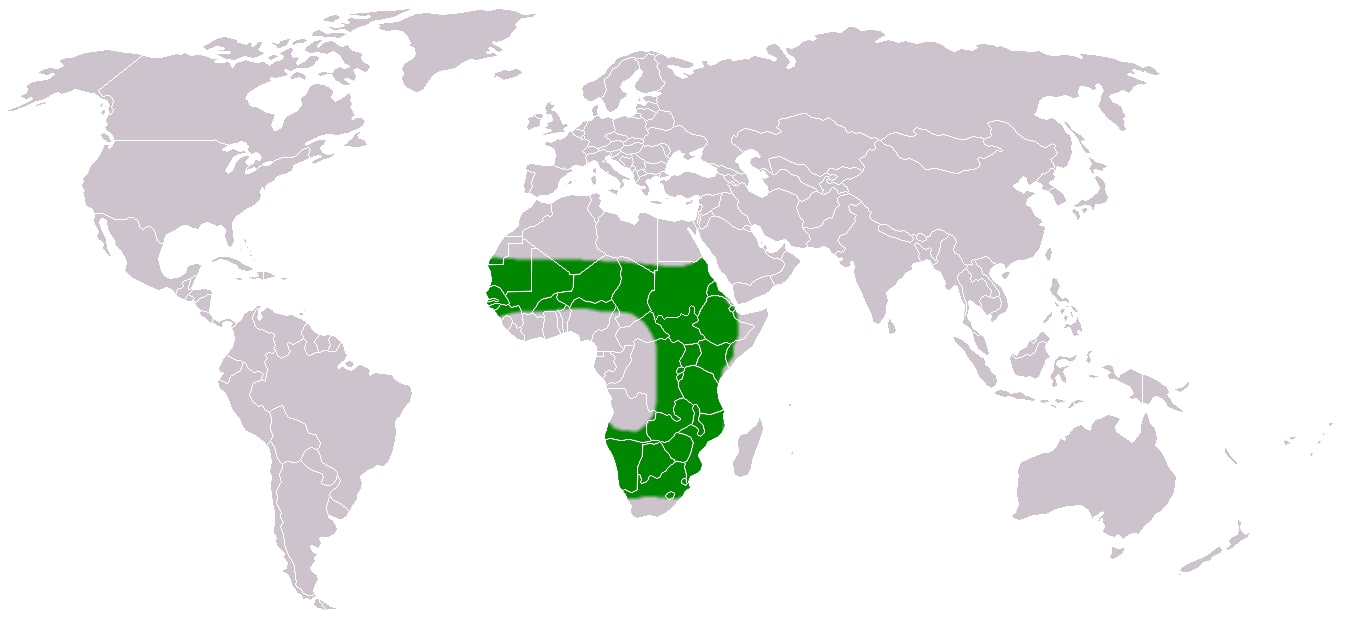
It was named by Linnaeus in 1758, who considered it a bunting, but Ludwig Reichenbach assigned it in 1850 to the new genus Quelea. Three subspecies are recognised, with Quelea quelea quelea occurring roughly from Senegal to Chad, Q. q. aethiopica from Sudan to Somalia and Tanzania, and Q. q. lathamii from Gabon to Mozambique and South Africa. Non-breeding birds have light underparts, striped brown upper parts, yellow-edged flight feathers and a reddish bill. Breeding females attain a yellowish bill. Breeding males have a black (or rarely white) facial mask, surrounded by a purplish, pinkish, rusty or yellowish wash on the head and breast. The species avoids forests, deserts and colder areas such as those at high altitude and in southern South Africa. It constructs oval roofed nests woven from strips of grass hanging from thorny branches, sugar cane or reeds. It breeds in very large colonies.
The quelea feeds primarily on seeds of annual grasses, but also causes extensive damage to cereal crops. Therefore, it is sometimes called "Africa's feathered locust". The usual pest-control measures are spraying avicides or detonating fire-bombs in the enormous colonies during the night. Extensive control measures have been largely unsuccessful in limiting the quelea population. When food runs out, the species migrates to locations of recent rainfall and plentiful grass seed; hence it exploits its food source very efficiently. It is regarded as the most numerous undomesticated bird on earth, with the total post-breeding population sometimes peaking at an estimated 1.5 billion individuals. It feeds in huge flocks of millions of individuals, with birds that run out of food at the rear flying over the entire group to a fresh feeding zone at the front, creating an image of a rolling cloud. The conservation status of red-billed quelea is least concern according to the IUCN Red List.
The red-billed quelea is a small sparrow-like bird, approximately 12 cm (4.7 in) long and weighing 15–26 g (0.53–0.92 oz), with a heavy, cone-shaped bill, which is red (in females outside the breeding season and males) or orange to yellow (females during the breeding season).
Over 75% of males have a black facial "mask", comprising a black forehead, cheeks, lores and higher parts of the throat. Occasionally males have a white mask. The mask is surrounded by a variable band of yellow, rusty, pink or purple. White masks are sometimes bordered by black. This colouring may only reach the lower throat or extend along the belly, with the rest of the underparts light brown or whitish with some dark stripes. The upperparts have light and dark brown longitudinal stripes, particularly at midlength, and are paler on the rump. The tail and upper wing are dark brown. The flight feathers are edged greenish or yellow. The eye has a narrow naked red ring and a brown iris. The legs are orangey in colour. The bill is bright raspberry red. Outside the breeding season, the male lacks bright colours; it has a grey-brown head with dark streaks, whitish chin and throat, and a faint light stripe above the eyes. At this time, the bill becomes pink or dull red and the legs turn flesh-coloured.
The females resemble the males in non-breeding plumage, but have a yellow or orangey bill and eye-ring during the breeding season. At other times, the female bill is pink or dull red.
Newborns have white bills and are almost naked with some wisps of down on the top of the head and the shoulders. The eyes open during the fourth day, at the same time as the first feathers appear. Older nestlings have a horn-coloured bill with a hint of lavender, though it turns orange-purple before the post-juvenile moult. Young birds change feathers two to three months after hatching, after which the plumage resembles that of non-breeding adults, although the head is grey, the cheeks whitish, and wing coverts and flight feathers have buff margins. At an age of about five months they moult again and their plumage starts to look like that of breeding adults, with a pinkish-purple bill.
Different subspecies are distinguished by different colour patterns of the male breeding plumage. In the typical subspecies, Q. quelea quelea, breeding males have a buff crown, nape and underparts and the black mask extends high up the forehead. In Q. quelea lathamii the mask also extends high up the forehead, but the underparts are mainly white. In Q. quelea aethiopica the mask does not extend far above the bill, and the underparts may have a pink wash. There is much variability within subspecies, and some birds cannot be ascribed to a subspecies based on outward appearance alone. Because of interbreeding, specimens intermediate between subspecies may occur where the ranges of the subspecies overlap, such as at Lake Chad.
The female pin-tailed whydah could be mistaken for the red-billed quelea in non-breeding plumage, since both are sparrow-like birds with conical red-coloured bills, but the whydah has a whitish brow between a black stripe through the eye and a black stripe above.
Flying flocks make a distinct sound due to the many wing beats. After arriving at the roost or nest site, birds keep moving around and make a lot of noise for about half an hour before settling in. Both males and females call. The male sings in short bursts, starting with some chatter, followed by a warbling tweedle-toodle-tweedle.
Aliases
Quelea quelea, red-billed weaver, red-billed dioch
Range
Data retrieved on October 15, 2025 at 7:35 AM