 Bird App
Bird of the day
American robin
Turdus migratorius
The American robin (Turdus migratorius) is a migratory bird of the true thrush genus and Turdidae, the wider thrush family. It is named after the European robin because of its reddish-orange breast, though the two species are not closely related, with the European robin belonging to the Old World flycatcher family. The American robin is widely distributed throughout North America, wintering from southern Canada to central Mexico and along the Pacific coast.
According to the Partners in Flight database (2019), the American robin is the most abundant landbird in North America (with 370 million individuals), ahead of red-winged blackbirds, introduced European starlings, mourning doves and house finches. It has seven subspecies.
The species is active mostly during the day and assembles in large flocks at night. Its diet consists of invertebrates (such as beetle grubs, earthworms, and caterpillars), fruits, and berries. It is one of the earliest bird species to lay its eggs, beginning to breed shortly after returning to its summer range from its winter range. The robin's nest consists of long coarse grass, twigs, paper, and feathers, and is smeared with mud and often cushioned with grass or other soft materials. It is among the earliest birds to sing at dawn, and its song consists of several discrete units that are repeated.
The adult's main predator is the domestic cat; other predators include hawks and snakes. When feeding in flocks, it can be vigilant, watching other birds for reactions to predators. Brown-headed cowbirds (Molothrus ater) lay their eggs in robin nests (see brood parasite), but the robins usually reject the egg.
The eastern subspecies (T. m. migratorius) is 23 to 28 cm (9.1 to 11.0 in) long with a wingspan ranging from 31 to 41 cm (12 to 16 in), with similar size ranges across all subspecies. The species averages about 77 g (2.7 oz) in weight, with males ranging from 72 to 94 g (2.5 to 3.3 oz) and females ranging from 59 to 91 g (2.1 to 3.2 oz). Among standard measurements, the wing chord is 11.5 to 14.5 cm (4.5 to 5.7 in), the culmen is 1.8 to 2.2 cm (0.71 to 0.87 in) and the tarsus is 2.9 to 3.3 cm (1.1 to 1.3 in). The head varies from jet black to gray, with white eye arcs and white supercilia. The throat is white with black streaks, and the belly and undertail coverts are white. The adult has a brown back and a reddish-orange breast, varying from a rich red maroon to peachy orange. The bill is mainly yellow with a variably dark tip, the dusky area becoming more extensive in winter, and the legs and feet are brown.
The sexes are similar, but females tend to be duller in color than males, with a brown tint to the head, brown upperparts, and less-bright underparts. However, some birds cannot be accurately sexed on the sole basis of plumage. Juveniles are paler in color than adult males and have dark spots on their breasts and whitish wing coverts. First-year birds are not easily distinguishable from adults, but they tend to be duller, with first-year males resembling adult females, and a small percentage retain a few juvenile wing coverts or other feathers.
Aliases
Turdus migratorius, robin, robin redbreast, robin red-breast
Range
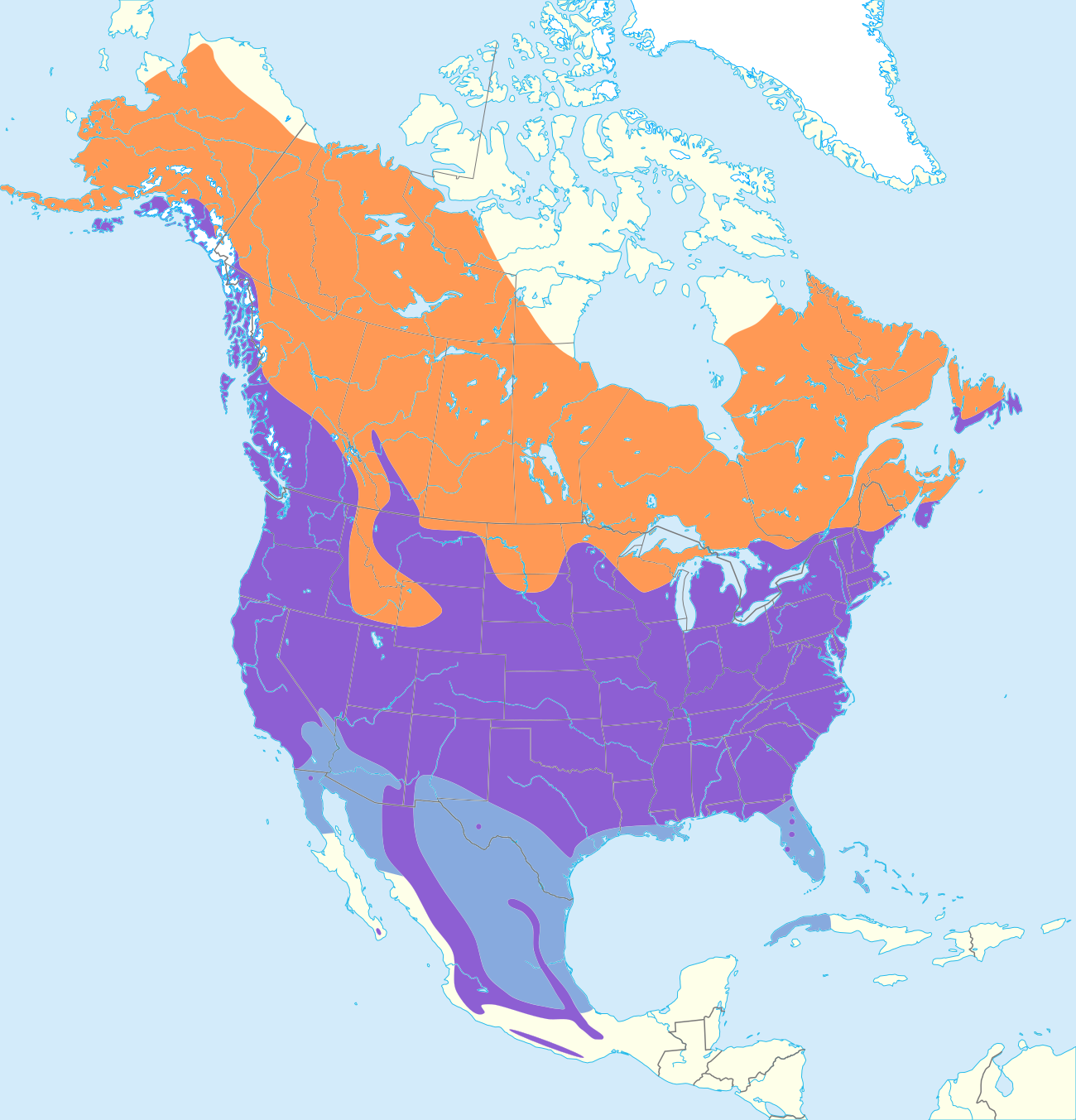
Data retrieved on October 15, 2025 at 7:31 AM