 Bird App
Bird of the day
Siberian jay
Perisoreus infaustus
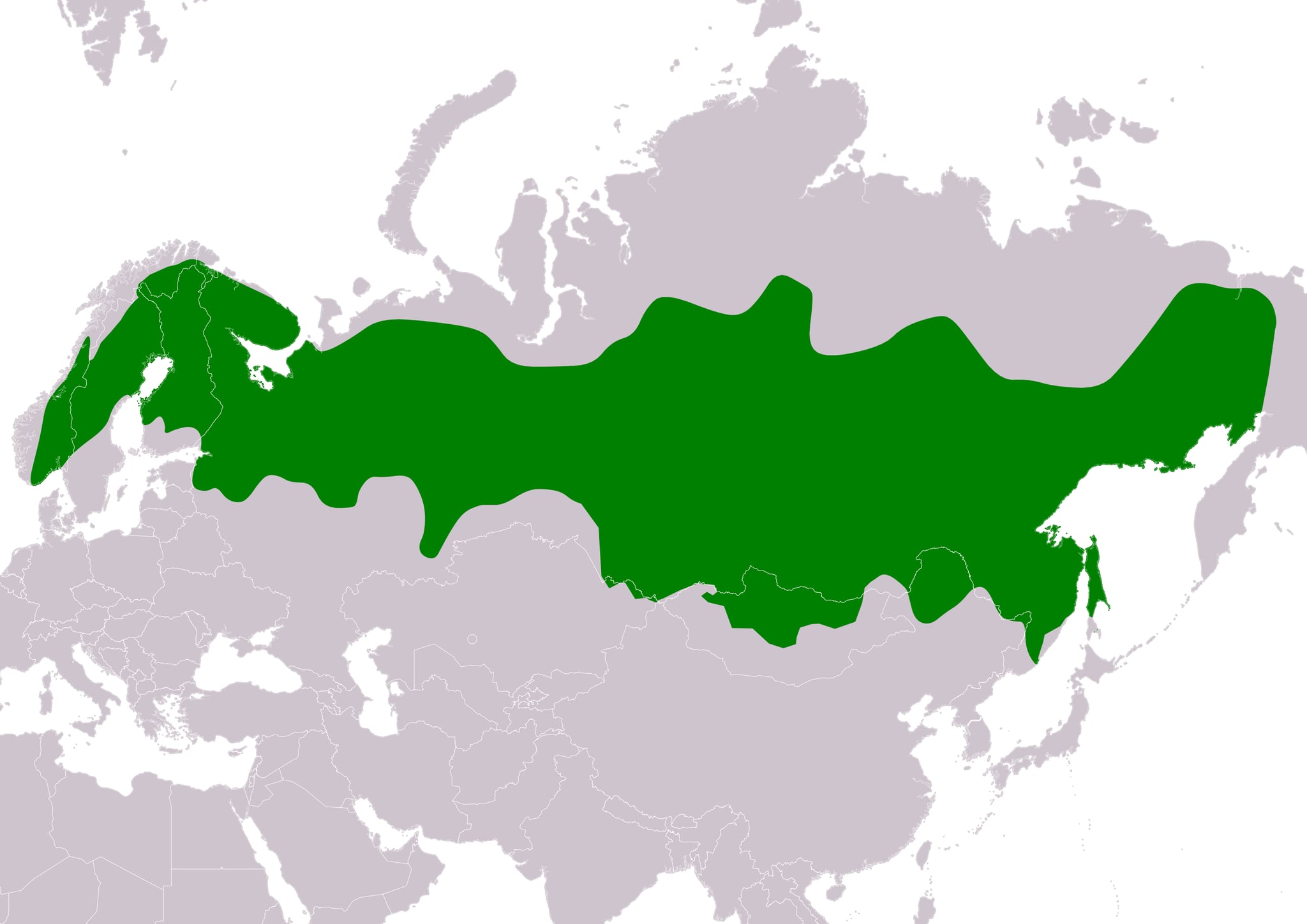
The Siberian jay (Perisoreus infaustus) is a small jay with a widespread distribution within the coniferous forests in North Eurasia. It has grey-brown plumage with a darker brown crown and a paler throat. It is rusty-red in a panel near the wing-bend, on the undertail coverts and on the sides of the tail. The sexes are similar. Although its habitat is being fragmented, it is a common bird with a very wide range so the International Union for Conservation of Nature has assessed its conservation status as being of "least concern".
The Siberian jay is the smallest of the western Palearctic corvids, weighing 75 to 90 g (2.6 to 3.2 oz) and measuring about 30 centimetres (12 inches) in length. The adult plumage is greyish brown, with a dark brown head, paler forehead and buff breast. The rump is yellowish and the chin and throat are grey. There is also rufous streaking on the outer feathers, and the bill and legs are black. Their overall colouration is fairly inconspicuous to visually conceal them from predators within their forest habitat. The plumage is also very soft and downy for insulation against extreme cold in winter. There is one moult per year, which lasts from mid-June to mid-September. The longest recorded lifetime is 13 years 4 months for a bird ringed in Finland, although the average lifespan has been reported as 7.1 years.
Siberian jays appear to be specially adapted to navigate in flight through dense forest despite being rather cumbersome flyers across open terrain. This may explain their vulnerability to predation by raptors outside forests.
The Siberian jay is mostly silent, but it can emit a loud screech similar to that of a buzzard (Buteo spp.). Both sexes perform the song, which is mainly heard during the breeding season from a short distance away, and it comprises a wide repertoire of sounds. These range from sequences of separate soft and harsh notes to bouts of whistling, creaking and trilling, and sometimes incorporate mimicked songS of other birds. Siberian jays also engage in nepotistic alarming callS, which may serve to warn conspecifics of an approaching predator. Experimental studies have shown that warning calls decrease the reaction time of non-breeding individuals in response to an approaching predator and improve their survival rate. However, females seem more able than males to differentiate between kin and non-kin. Alongside directly warning to family group members, a breeding female's nepotistic alarm calls may also divert a predator's attention away from her offspring.
Aliases
Perisoreus infaustus
Range
Data retrieved on October 15, 2025 at 7:29 AM