Bird App
Bird of the day
Common gull
Larus canus
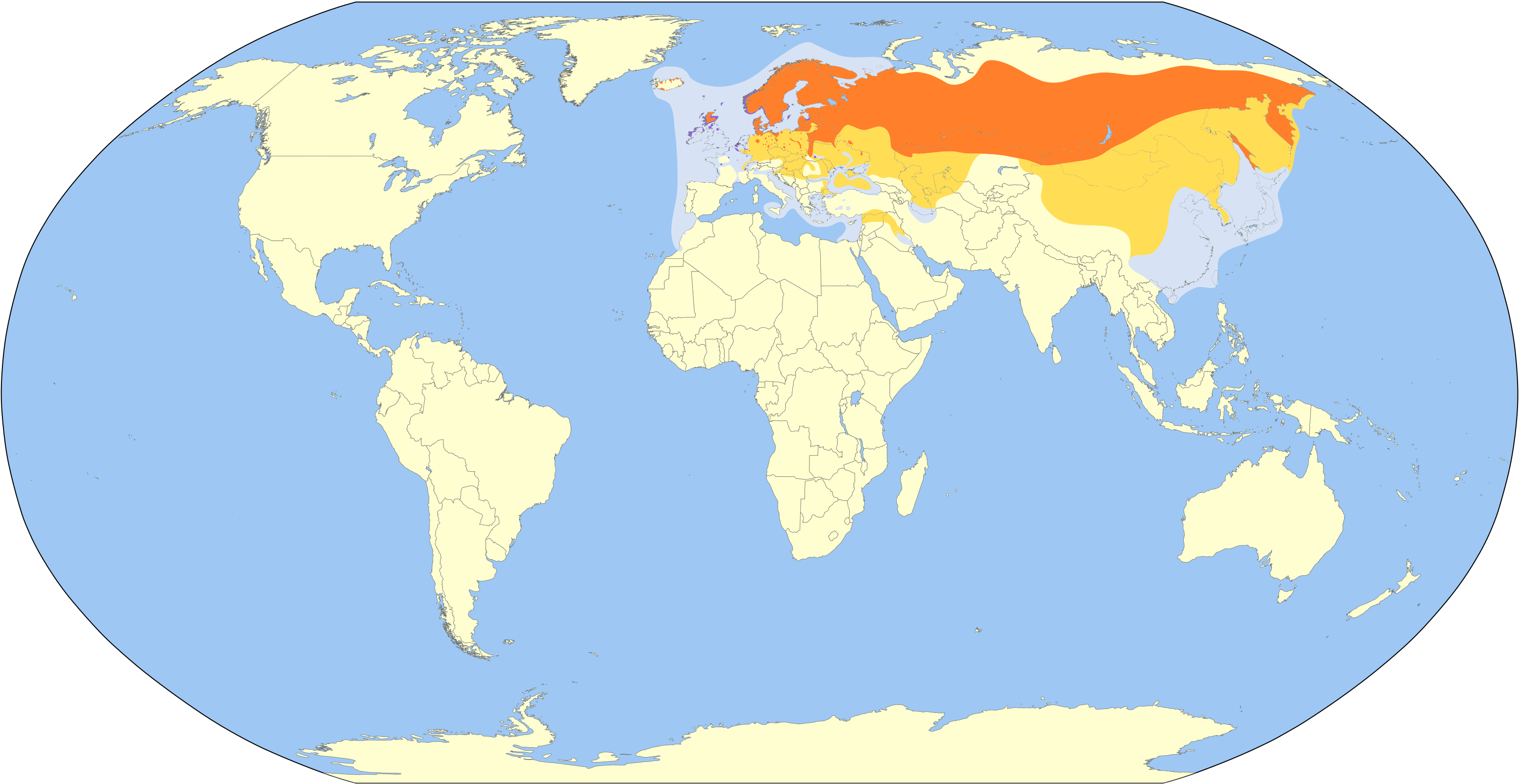
The common gull (Larus canus) is a medium-sized gull that breeds in cool temperate regions of the Palearctic from Iceland and Scotland east to Kamchatka in the Russian Far East. Most common gulls migrate further south in winter, reaching the Mediterranean Sea, the southern Caspian Sea, and the seas around China and Japan; northwest European populations are at least partly resident. The closely related short-billed gull was formerly often included in this species, which was then sometimes known collectively as "mew gull".
Adult common gulls are 40–46 cm (16–18 in) long and a wingspan of 100–115 cm (39–45 in), noticeably smaller than the herring gull and slightly smaller than the ring-billed gull. It is further distinguished from the ring-billed gull by its shorter, more tapered bill, which is a more greenish shade of yellow and is unmarked during the breeding season. The body is grey above and white below. The legs are yellow in breeding season, becoming duller in the winter. In winter, the head is streaked grey and the bill often has a poorly defined blackish band near the tip, which is sometimes sufficiently obvious to cause confusion with ring-billed gull. They have black wingtips with large white "mirrors" on the outer primaries p9 and p10, which are smaller than those in the short-billed gull. Young birds have scaly black-brown upperparts and a neat wing pattern, and pink legs which become greyish in the second year before tuning yellow. By the first winter, the head and belly are white, with fine streaks and greyish feathers grow on the saddle. They take three years (up to four in the Kamchatka subspecies) to reach maturity. The call is a high-pitched "laughing" cry.
Aliases
Larus canus
Range