Bird App
Bird of the day
Rosy-billed pochard
Netta peposaca
The rosy-billed pochard (Netta peposaca), alternatively named rosybill or rosybill pochard, is a member of family Anatidae. Though classified as a diving duck, this pochard feeds more like a dabbling duck feeding on seeds roots, sedges, aquatic plants and other grasses. Netta is Ancient Greek for "duck" and peposaca is a transcription of the Guaraní name of this species which means "showy wings", referring to the broad white stripe that is only visible with stretched out wings. Male characteristic features include a bright red bill with a rounded knob at the base.
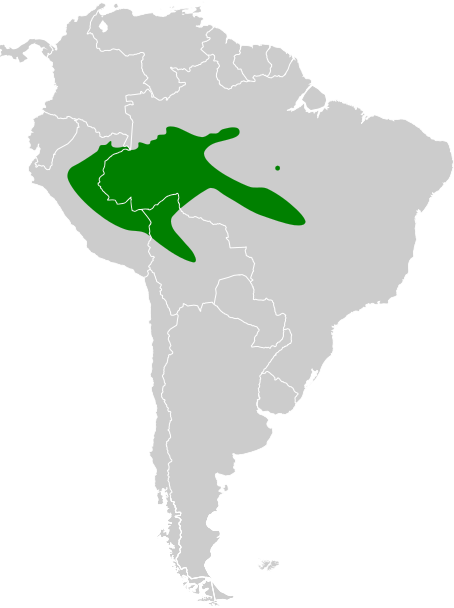
The rosy-billed pochard is endemic to South America. It is found in Argentina, central Chile, Paraguay, Uruguay and southern Brazil. The population in southern Argentina migrates northward during the austral winter, reaching Brazil and southern Bolivia. It is a vagrant to the Falkland Islands.
Like many other members of family Anatidae, the rosy-billed pochard exhibits significant sexual dimorphism. Males have a purplish-black head, neck and breast with gray sides, a white area on the crissum (the area around the cloaca), and a bright red bill and red eyes. The bill has a large rounded knob, which is bright red, and rest of the bill gradually fades towards a pale pink before ending with a black tip. The rounded knob of the bill increases in size and intensity in colour during the mating season. When in flight, the mostly dark plumage noticeably contrasts with the white primaries and secondaries. The legs and feet are yellow to orange. On the other hand, females are dull and brown. The bill is bluish-gray with a black tip and the legs are yellow-orange to gray. The contrasting white crissum is the most noticeable feature on females.
Young are almost identical in appearance to the females, but their underparts are darker. Rosybill adults lack the dull eclipse plumage that is characteristic of northern individuals of the genera Aytha and Anas.
Males tend to be slightly larger than females, but in general both sexes are very similar in terms of body size. Adults can grow to about 22 inches (56 cm) in length and weigh 2.2-2.6 pounds (1-1.2 kg). Despite these pochards being strong fliers, their blunt-tipped wings require a faster wing-beats than that of many ducks and they have some trouble taking off. They do not walk as well on land as other dabbling ducks because their legs are placed further back on their bodies to help propel them when underwater. Their minimum wingspan recorded is 72 cm, while the maximum is 84 cm.
Aliases
Netta peposaca
Range