Bird App
Bird of the day
Antarctic tern
Sterna vittata
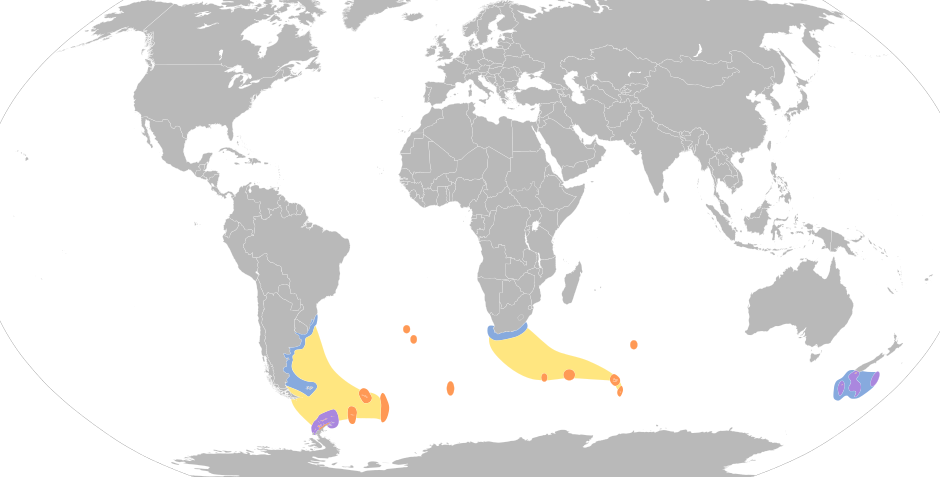
The Antarctic tern (Sterna vittata) is a seabird in the family Laridae. It ranges throughout the southern oceans and is found on small islands around Antarctica as well as on the shores of the mainland. Its diet consists primarily of small fish and crustaceans. It is very similar in appearance to the closely related Arctic tern, but it is stockier, and it is in its breeding plumage in the southern summer, when the Arctic tern has shed old feathers to get its non-breeding plumage. The Antarctic tern does not migrate like the Arctic tern does, but it can still be found on a very large range. This tern species is actually more closely related to the South American tern.
Gulls, skuas and jaegers are the primary predators of the bird's eggs and young.
The Antarctic tern can be further divided into six subspecies. The total global population of this bird is around 140,000 individuals.
The Antarctic tern is a medium-sized tern ranging from 35 to 40 cm (14 to 16 in) in length with a wingspan of 74 to 79 cm (29 to 31 in). It weighs between 150 and 180 g (5.3 and 6.3 oz) but it tends to be heavier during the winter months.
In breeding plumage, the tern has light grey body and wings. Its deeply forked tail, lower back just above it and cheeks are white. It also has a distinctive black cap that reaches from the nape down to the bill and the eye is brownish-black. The bill, legs and feet are bright red. In non-breeding plumage, the black cap is reduced to just the area behind the eyes, the underparts become lighter and the bill becomes a dull reddish-black colour. Juveniles have yellowish-brown, grey, and white spots on their backs, with a yellowish-brown belly and breast. Their bill is dull black and the legs are dull red. The chicks have a yellowish-brown colour with black spots on their heads and back. They have a greyish white belly with a darker throat. The bill, legs and feet can be flesh colored or reddish black.
The Antarctic tern closely resembles the Arctic tern. However, the local Antarctic Terns are in their breeding plumage when the migrating Arctic Terns arrive in their non-breeding plumage. Arctic terns also have shorter legs and more prominent black margins on the outside of their primary feathers. The white-fronted tern is also quite similar to the Antarctic tern but it can be distinguished by the larger body size, lighter colors, and longer black bill of the white-fronted tern. The different subspecies vary in size and plumage tone but are often hard to distinguish from one another.
Antarctic terns are quite noisy around their roost sites. "trr-trr-kriah" is their main call and is given when they are in flight or fishing. They also use a "chrrrr" to defend their nests against intruders or predators. They make a higher-pitched call to catch the attention of their mates.
Aliases
Sterna vittata
Range