Bird App
Bird of the day
Tree swallow
Tachycineta bicolor
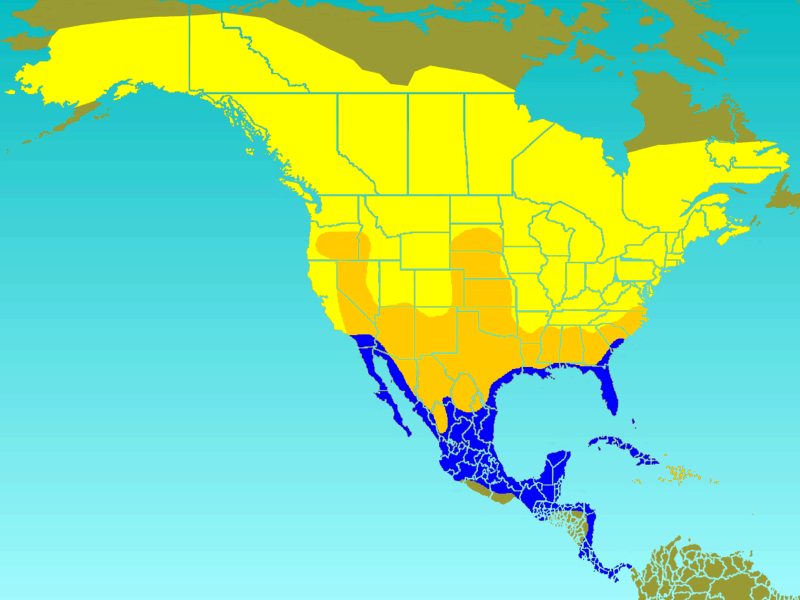
The tree swallow (Tachycineta bicolor) is a migratory bird of the family Hirundinidae. Found in the Americas, the tree swallow was first described in 1807 by French ornithologist Louis Vieillot as Hirundo bicolor. It has since been moved to its current genus, Tachycineta, within which its phylogenetic placement is debated. The tree swallow has glossy blue-green upperparts, with the exception of the blackish wings and tail, and white underparts. The bill is black, the eyes dark brown, and the legs and feet pale brown. The female is generally duller than the male, and the first-year female has mostly brown upperparts, with some blue feathers. Juveniles have brown upperparts, and gray-brown-washed breasts. The tree swallow breeds in the US and Canada. It winters along southern US coasts south, along the Gulf Coast, to Panama and the northwestern coast of South America, and in the West Indies.
The tree swallow nests either in isolated pairs or loose groups, in both natural and artificial cavities. Breeding can start as soon as early May, although this date is occurring earlier because of climate change, and it can end as late as July. This bird is generally socially monogamous (although about 8% of males are polygynous), with high levels of extra-pair paternity. This can benefit the male, but since the female controls copulation, the lack of resolution on how this behavior benefits females makes the high level of extra-pair paternity puzzling. The female incubates the clutch of two to eight (but usually four to seven) pure white eggs for around 14 to 15 days. The chicks hatch slightly asynchronously, allowing the female to prioritize which chicks to feed in times of food shortage. They generally fledge about 18 to 22 days after hatching. The tree swallow is sometimes considered a model organism, due to the large amount of research done on it.
An aerial insectivore, the tree swallow forages both alone and in groups, eating mostly insects, in addition to mollusks, spiders, and fruit. The nestlings, like the adult, primarily eat insects, fed to it by both sexes. This swallow is vulnerable to parasites, but, when on nestlings, these do little damage. The effect of disease can become stronger as a tree swallow gets older, as some parts of the immune system decline with age. Acquired T cell-mediated immunity, for example, decreases with age, whereas both innate and acquired humoral immunity do not. Because of its large range and stable population, the tree swallow is considered to be least concern by the International Union for Conservation of Nature. In the US, it is protected by the Migratory Bird Treaty Act of 1918, and in Canada by the Migratory Birds Convention Act. This swallow is negatively affected by human activities, such as the clearing of forests; acidified lakes can force a breeding tree swallow to go long distances to find calcium-rich food items to feed to its chicks.
The tree swallow has a length between about 12 and 14 cm (4.7 and 5.5 in) and a weight of approximately 17 to 25.5 g (0.60 to 0.90 oz). Wingspan ranges from 30 to 35 cm (12 to 14 in). The male has mostly glossy blue-green upperparts, the wings and tail being blackish. The underparts and the cheek patch are white, although the underwing coverts are gray-brown. The bill is black, the eyes dark brown, and the legs and feet pale brown. The female is duller in color than the male, and sometimes has a brown forehead. The second-year female also has brown upperparts, with a variable number of blue feathers; some third-year females also retain a portion of this subadult plumage. According to a 1987 study, this likely allows a younger female to explore nest sites, as the resident male is usually less aggressive to a subadult female. A 2013 study found that the resident female was less aggressive towards second-year female models when they were presented separately from older models. Why the female eventually replaces its subadult plumage is unknown; it may allow males to assess female quality, as pairs mate assortatively based on plumage brightness. The juvenile tree swallow can be distinguished by its brown upperparts and gray-brown-washed breast.
The tree swallow's song consists of three parts: the chirp, the whine, and the gurgle. These sections may be repeated or omitted, and all can stand alone. The first, as the chirp call (sometimes divided into the contact call and solicitation call), is made by the female during copulation and in both sexes to stimulate the nestlings to beg or (in some populations) when their mate leaves or enters the nest cavity. The whine, generally consisting of a downward shift in frequency followed by an upward shift, may be given alone as the anxiety call, occasionally made in response to certain predators. The gurgle, as when it appears at the end of the song, is usually uttered twice. It is likely involved in pair bonding. The chatter call is used to advertise nest sites (the reason it is also known as the "nest-site advertising call") and is also given to intruding conspecifics. A short high-pitched submission call is sometimes uttered after an aggressive encounter with another tree swallow. While being physically restrained or in pain, a distress call may be given. The male often utters a ticking (or rasping) aggression call during copulation, and both sexes use it at the end of mobbing dives. The alarm call is given in reaction to predators and other intruders, and can serve to induce older nestlings to crouch and stop begging when a predator is near.
Communication between parents and offspring can be disrupted by human-generated noise. A 2014 study, for example, found that broods for whom white noise was played were less likely to crouch or stop begging in response to alarm calls. Parents did not alter their calls to compensate, likely increasing predation risk. Noise can also disrupt whether parents respond to begging, but this may be balanced out by the louder calls nestlings give when exposed to it. Increased begging effort, however, may be ineffective or costly for louder levels of noise.
Aliases
Tachycineta bicolor
Range